

Milwaukee first announced the M18 Fuel Super Sawzall back in 2018. It’s hard to believe we’ve been using it for nearly 8 years!
There haven’t been any updates to this saw, and it’s natural to question whether there’s a need to. It was already outperforming the 15-amp Super Sawzall out of the gate. Plus, M18 Forge batteries offer a little more of a boost over the High Output packs it was originally designed to use.
However, the competition has changed quite a bit over that time. So, how does the Milwaukee M18 Fuel Super Sawzall stack up against the newest competition?
That’s what I’m looking more closely at in this review.
Pros
- Still the top-performing reciprocating saw available
- Exceptionally wide range of compatible trade-focused tools
Cons
- Higher vibration than most
- Heavier than most
- Shaft-mounted blade release
- Expensive
Read
Best Cordless Reciprocating Saw Head-to-Head Review
How We Test Reciprocating Saws
Putting the “Super” in the Milwaukee M18 Fuel Super Sawzall

Powerstate Brushless Motor
Like all M18 tools with the “Fuel” designation, the M18 Fuel Super Sawzall has a brushless motor. It wasn’t just a standard Fuel motor the product team used, though.
Ahead of this saw’s launch, Milwaukee began differentiating motors between large-frame and small-frame designs. Power-hungry tools like this get a bigger motor to help them back up the claims of outperforming 15-amp corded models, while tools like impact drivers have been able to stay compact with small-frame motors.
The motor runs at speeds up to 3000 SPM with a 1 1/4-inch stroke length. That’s really aggressive, so the product team gave it two ways to control it.
The first is a variable speed trigger like you find on nearly every reciprocating saw made.
The second is a speed dial. Even though it’s marked as speeds 1 through 5, you can settle in positions between them, giving you a ton of speed control.
Read
Brushed vs Brushless Motors: What’s the Difference
Designed for High Output, Better with Forge

As I mentioned earlier, the saw was designed around Milwaukee’s 12.0Ah High Output battery, which launched alongside the Super Sawzall in 2018. That battery uses 21700 cells combined with heat dissipation and efficient power delivery to deliver more watts than Milwaukee’s standard M18 batteries.
However, M18 Forge batteries are now available and pair even better with this saw. Thanks to tabless connections and pouch cells, the Forge 12.0Ah battery can deliver up to 50% more power than the 12.0Ah High Output pack. That’s a huge difference!
For our most recent testing, we selected the Forge 8.0Ah battery to get its higher power output while shaving a little weight off the total package.
Read
Milwaukee M18 Forge 8.0Ah and 12.0Ah Batteries
Orbital Action
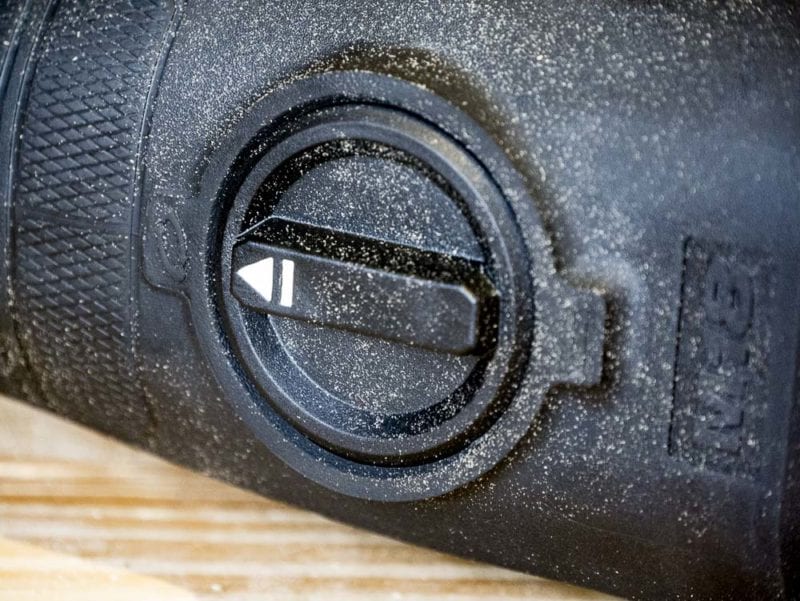
Orbital action is a big deal on reciprocating saws, and the lack of it on Milwaukee’s M18 Fuel Sawzall 2721 hurt its head-to-head cutting performance in our wood-cutting tests. That’s not the case with the cordless Super Sawzall, as our tests showed that its cutting speed was significantly better in wood.
Read
What is Orbital Action on a Reciprocating Saw and Why Do You Need it?
Milwaukee M18 Fuel Sawzall with One-Key Review
Milwaukee M18 Fuel Super Sawzall vs the Competition
When we originally tested this saw head-to-head against its competition back in 2020, it easily led the group in performance. The only test it didn’t win outright was in the relatively light-duty EMT cutting test.
Now that times, competitors, and even our own testing methods have evolved, we were anxious to see where the Super Sawzall fits in the current landscape.
You can see the full details of each test on our main head-to-head page (linked here), but here’s a quick overview of what we put these saws through:
PVC Cutting

- Material: 4-inch, schedule 40 PVC pipe
- Blade: Milwaukee 9-inch Torch Thick Metal
- Downforce Control: 5-lb weight
- Mode: Full speed, orbital off
- Result: Average of three cuts
Without a doubt, cutting PVC pipe is the easiest test we put our saws through. Milwaukee averaged 2.96 seconds, which was good enough for third place. However, it wasn’t far off from the Makita XGT’s 2.79-second average at the top.
Clean Wood Cutting

- Material: 2 x 12 dried yellow pine lumber
- Blade: Milwaukee 5 TPI, 9-inch Carbide Ax for Wood with Nails
- Downforce Control: 5-lb weight
- Mode: Full speed, orbital on
- Result: Average of three cuts
Moving into a demo application that requires more effort, the Super Sawzall averaged 8.18 seconds, earning a first-place finish. Unlike our previous head-to-head testing, it wasn’t a runaway, though. Second place Metabo HPT averaged 8.23 seconds, and third place Makita was 8.29 seconds.
Wall Cutting

- Material: Three 2 x 4 studs with three nails in each (nine nails total), 7/16-inch OSB, Hardie board siding
- Blade: Milwaukee 6 TPI, 9-inch Nitrus Carbide Wrecker for Multi-Material
- Downforce Control: 5-lb weight
- Mode: Full speed, orbital on
- Result: Average of three cuts
Clint didn’t want us to actually demo the walls of our shop, so we built a common mock-up that includes a representative mix of what you might come across. Most importantly, it’s consistent, so each saw gets a fair shot.
Again, Milwaukee took first place in this test with an 18.05-second average. In what became a theme, Metabo HPT (18.11 seconds) and Makita (18.58 seconds) weren’t far behind.
Cast Iron Pipe Cutting

- Material: 3-inch cast iron pipe
- Blade: Milwaukee 8 TPI, 9-inch Nitrus Carbide Torch for Thick Metal and Cast Iron
- Downforce Control: Hand control
- Mode: Full speed, orbital off
- Result: One successful cut
Cutting cast iron with a reciprocating saw isn’t for the faint of heart, yet in some parts of the country, you still have to tackle it. This time, Milwaukee was second at 41.54 seconds, just 0.30 seconds behind Makita.
Performance Analysis
After analyzing the full performance of each saw, the Milwaukee M18 Fuel Super Sawzall is still the leader in the cordless reciprocating saw category, even though it’s been on the market for more than seven years. That’s impressive staying power!
It’s closer than it once was, though, and Makita is a very close second place. But for now, Milwaukee still claims the crown as the performance king.
What’s interesting is that aside from a good move forward from Metabo HPT, the rest of the field is still a decent way back from Milwaukee. Brands like Bosch, DeWalt, and Flex aren’t closing the gap fast enough to put any real pressure on it.
Milwaukee M18 Fuel Design Notes
Ergonomics

There’s no getting around it — this is a heavy saw. The Milwaukee M18 Fuel Super Sawzall weighs in at 8 pounds, 13 ounces bare and a whopping 12.2 pounds with the 12.0 Ah High Output battery. Using the 8.0Ah Forge battery we tested with, it slims down a bit to 11.8 pounds.
Its physical footprint is large as well, stretching to a length of 18.9 inches. While the front handle overmold has more cushioning than most saws we’ve tested, the size and weight are the trade-off for such high performance.
Considering this is a heavy-duty demo tool, I’m not too worried about the length. The weight, on the other hand, is the highest in our test group by nearly a pound.
Blade Clamp
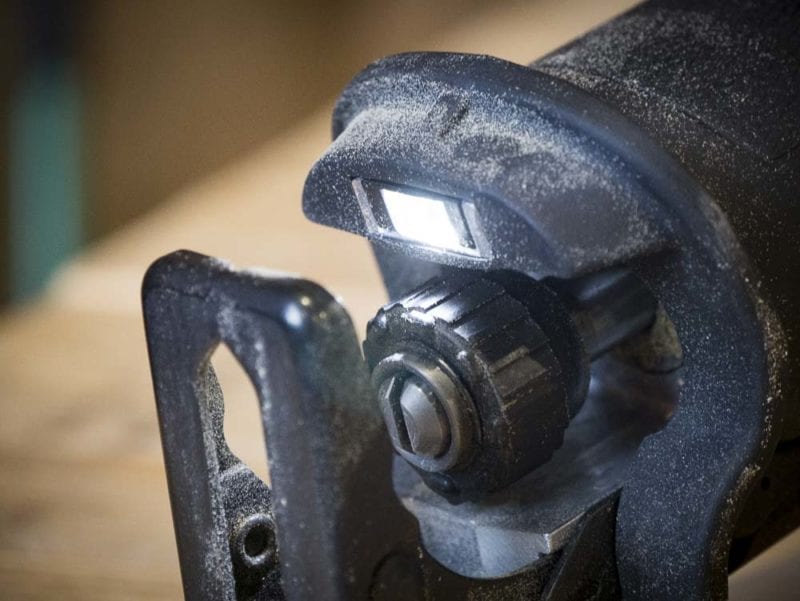
When it comes to features, the Milwaukee M18 Fuel Super Sawzall checks off just about every box you can hope for in this class of tool. However, there is one thing that detracts slightly from its otherwise excellent feature set.
The first is the blade clamp. Instead of having a lever release on the outside of the housing, Milwaukee opts for a twist lock directly on the shaft. It’s not as convenient to access, especially if you have the shoe extended.
As long as I’m building a wish list, I’d also like to see Milwaukee shift to an auto-clamping blade lock. It’s a small thing that a couple of other manufacturers add, but it gives the convenience factor a bump up.
Additional Features
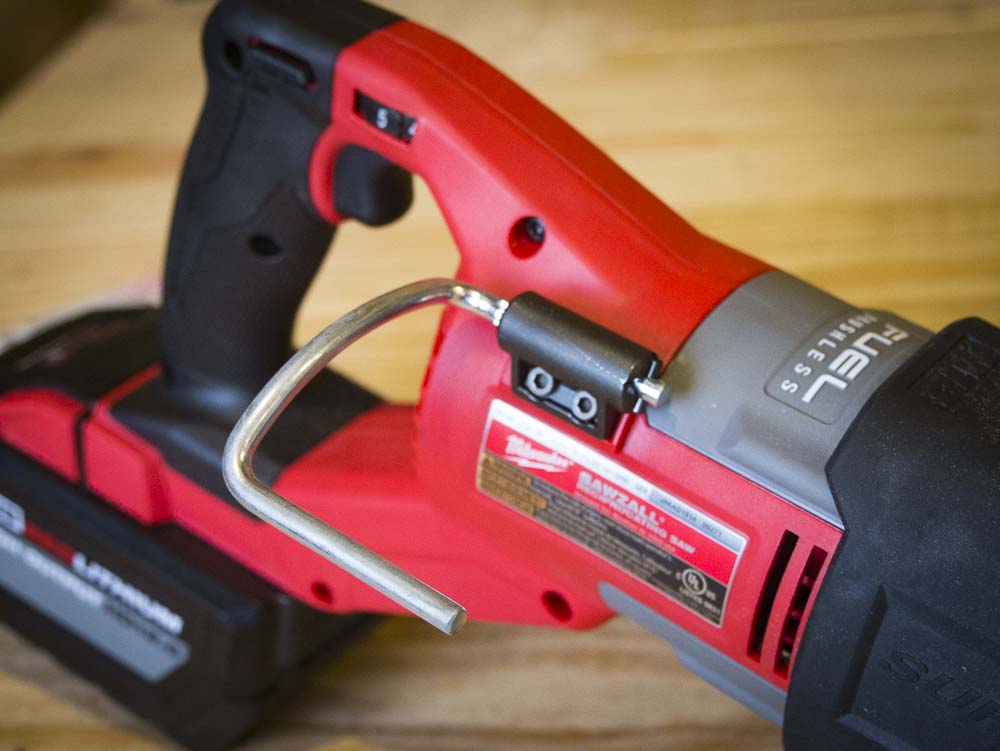
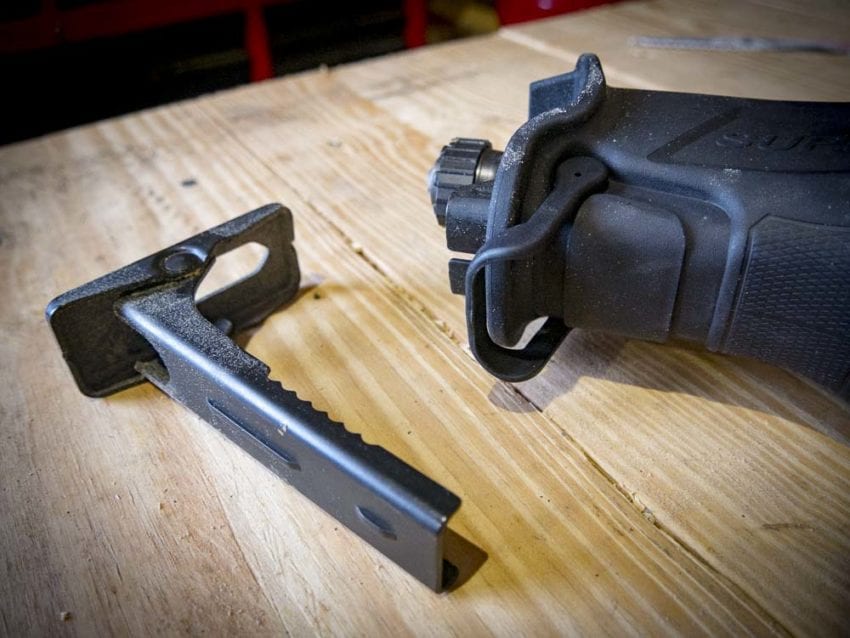
- Hang Hook: Hang your saw on a rafter, ladder, or other convenient location
- Adjustable Shoe: Adjust the length to engage different teeth and extend your blade life
- LED Light: Illuminate dark areas to your cut and what’s around it better
Price and Options
If you’re after the bare tool, it runs $299. The kit comes with a 12.0Ah High Output battery and is $499. While I haven’t seen any combo kits that include this model, Acme Tools has some reconditioned ones in stock for $169 if you’d like to save some money.
Milwaukee backs the tool with a 5-year warranty.
Compared to other brands, this is a higher price point. However, it’s less than Makita’s 40V XGT model, and that’s the only one that gave the Super Sawzall a run for its money in performance.
Should You Buy It?
The M18 Fuel Super Sawzall has outperformed its 15-amp corded counterpart and every other major competitor. That makes it the highest-performing reciprocating saw we’ve tested, period. So, if high performance is your primary goal, there’s none better.
However, the weight is a real consideration. If you’re frequently cutting overhead or in tight, awkward spaces, this model can be a challenge.
But there’s a silver lining in that this isn’t the only reciprocating saw Milwaukee makes. Rather, it’s the headliner of a trio. I’m not saying everyone has the budget for it, but by having this saw, the M18 Fuel (2821), and the M18 Fuel Hackzall (2719), you’ll have an unbeatable cutting team that can handle nearly any situation you come up against.
Read
M18 Fuel Sawzalls 2821/2822
M18 Fuel Hackzall Review 2719
Milwaukee M18 Fuel Super Sawzall Specifications
- Model: Milwaukee 2722-21HD
- Power Source: Milwaukee M18 battery (12.0 Ah High Output included in kit)
- Stroke Length: 1 1/4-inch
- Max Stroke Rate: 3000 SPM
- Weight: 8.8 pounds bare, 12.2 pounds with 12.0 Ah High Output battery
- Warranty: 5 years