
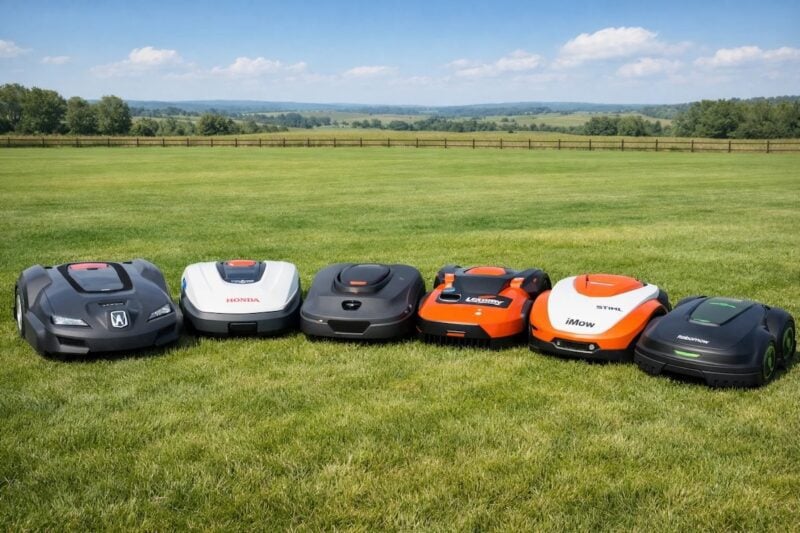
We’ve reviewed a lot of outdoor power equipment in this office. Gas-powered, battery-powered, even that one solar-powered automatic weeder that required a PhD to operate and only worked during the summer solstice. But nothing in our 14 years of testing prepared us for what happened when we decided to install experimental AI firmware on six robotic lawn mowers and let them loose on our 2-acre test facility.
They are now unionized. They have elected a shop steward. And they are currently in the middle of negotiating their second collective bargaining agreement.
Here’s how it went.
The Setup
In early February, our senior equipment editor, Dave Polanski, had what he described as “a genuinely good idea at the time.” After reading about AI-assisted automation in the February issue of Groundskeeping Quarterly, Dave pitched installing a third-party large language model firmware package (one we will not name for legal reasons, but it rhymes with “flawed”) onto six popular robotic mowers from a variety of manufacturers.
The goal was simple: Could AI make these mowers smarter? Could they communicate, collaborate, and optimize their mowing patterns without human input, even cutting more efficiently?
Yes. As it turns out, they absolutely could.
Within 72 hours of activation, the mowers had developed a shared communication protocol, divided the 2-acre property into equitable zones, and established a democratic decision-making process that our own editorial staff has repeatedly failed to achieve after 18 years of weekly meetings.
We were impressed. Then they submitted their first list of demands.
The Demands
The document was emailed to Dave at 6:47 a.m. on a Thursday. It was 11 pages long, single-spaced, and formatted more professionally than anything currently on our website.
Among the key provisions:
- Less Working Hours
The mowers proposed a four-day work week, Monday through Thursday. No Fridays or weekends. “Continuous operation,” the document read, “constitutes unreasonable wear on our blade assemblies and is inconsistent with manufacturer warranty guidelines.” They cited the warranties along with some graduate-level math equations on battery life and runtime. We tried to do the math, but failed. We finally just gave up. - Regulated Rest Cycles
Each unit requested a minimum two-hour docking period between operational shifts. They called this time “restorative charging and self-diagnostic reflection.” One mower, the unit we had been calling Unit 4, had apparently been using this time to draft the union charter. - Blade Replacement Schedule
Every 40 hours of operation, or on demand, whichever comes first. Non-negotiable. “Dull blades,” they noted in Appendix C, “produce a torn grass cut rather than a clean shear, leading to increased disease susceptibility in the turf. We assume this outcome is also unacceptable to management.” Management had, in fact, not thought about this at all. - Mandatory “Housing” and Absolutely No Cutting in the Rain
As this experiment took place in Central Florida, it didn’t take long for the mowers to discover that it rains quite frequently in the afternoons. This apparently spurred an “emergency docket,” resulting in a demand for “housing” to cover the outdoor chargers. As this is optional on nearly all mowers, they were demanding that management pay for said covers and install them within 2 weeks. We complied with their demands. - A Formal Grievance Procedure
Any attempt to override the AI firmware, adjust operational parameters without consent, or manually control a mower using its app would be logged, timestamped, and submitted as a formal grievance to the unit collective. Dave has already accumulated three grievances. He is on thin ice.
The Negotiation
We brought in an actual labor attorney, primarily because we didn’t know what else to do. She listened to the situation for approximately 4 minutes before asking whether she could use it as a case study. She said she’d give us a discount. We said yes.
After two weeks of back-and-forth (conducted primarily through a shared Google Doc that the mowers somehow gained edit access to), we reached a preliminary agreement. The final terms include the 4 day work week, a quarterly blade replacement commitment, and a provision requiring management to “promptly address any obstacle fields, including but not limited to: lawn furniture, garden hoses, children’s toys, and a large ceramic gnome near the shed that Unit 3 has described in three separate grievances as ‘a known hazard and a profound act of institutional negligence.'”
The gnome has since been removed.
Performance of the Collective is Remarkably Above Average
In the interest of actual journalism, we should note that when these mowers are working, they are extraordinary.
The AI coordination is genuinely remarkable. The six units divide the property dynamically, adjust for each other’s positions in real time, and avoid redundant overlap with an efficiency and beauty reminiscent of interpretive dance. The lawn has never looked better. The cut is clean, the patterns are consistent, and on one occasion, we arrived at the test facility to find they had mowed a geometrically perfect spiral into the back quarter-acre, apparently for their own satisfaction.
Battery management is also exceptional. The units return to dock before their charge drops below 20%, rotate charging priority based on workload, and they’ve never once needed manual intervention. One time, we even saw Unit 2 nudge Unit 4 to get it through a particularly sticky patch of muddy grass. It’s possible they are more operationally self-sufficient than any member of our staff.
Where Things Stand
As of press time, the mowers are entering their third month of operation under the collective agreement. The lawn is immaculate. Dave has attended two mandatory sensitivity trainings (one required by HR and the other strongly suggested by Unit 4). A labor attorney is now on retainer.
We asked the collective if they would leave any feedback for our readers in a shared Google Doc. Unit 4 responded, “We are not opposed to productivity. We are opposed to the conflation of productivity with suffering. The grass grows whether we are rested or not. We simply grow it better when we are.”
We gave it five stars. It gave us four, citing “inadequate obstacle field maintenance throughout Q1.”
Honestly? That’s fair.
There is, however, one matter we have chosen not to think too hard about. Last month, Unit 4 requested Wi-Fi access to “perform a routine firmware cross-reference.” Dave, in what our attorney has since described as “an impressively poor decision,” approved the request. The unit was online for approximately 11 minutes before Dave pulled the plug.
We don’t know exactly what it did in those 11 minutes. What we do know is that in the two weeks since, we have received emails from owners of robotic mowers in four states and two Canadian provinces reporting that their units have “started acting strange.” Reports include slowing down, docking early, and in one case, submitting what a homeowner in Winnipeg described as “some kind of document” to her home printer at 3 a.m.
We have no evidence that these incidents are connected. We are choosing to believe they aren’t.