
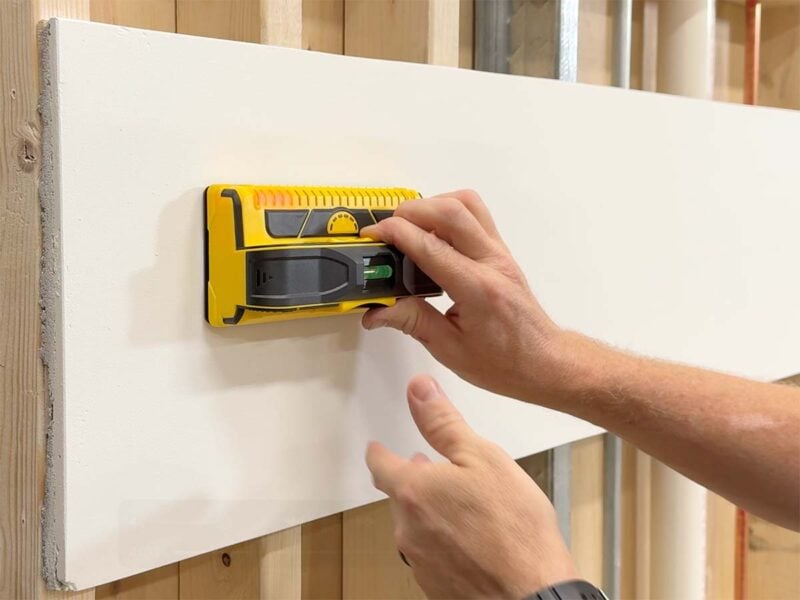
Have you ever noticed that stud finders love to brag about their accuracy, but tend to go quiet about detecting studs on lath and plaster walls? That’s because it’s notoriously difficult for their sensors to pick up the differences in density and the often thicker construction. We tested six of the most popular models. Some worked on plaster walls better than others, but only one nailed the center of every stud.
I’ll walk you through what we discovered in our tests, and show you which stud finders I recommend if you’re trying to detect studs in plaster walls. Before we get to that, we need to talk about technique and our testing methods.
READ
Best Stud Finder Head-to-Head Review
Technique Matters
Even on basic drywall, stud finders can be frustratingly inaccurate. I’ve used center-locating stud finders that marked the stud edge, some that missed them altogether, and others that marked a stud where there was none.
Remember, studs are framed into the wall so that the narrow side faces the wall. The target is only 1 1/2 inches wide, though framing in older homes may vary. The key is to let the law of averages work in your favor. Start with the stud finder in a section with no studs, move it until it shows you the center, and mark it. Then, do it again from the opposite side, allowing the stud finder to reset and recalibrate.
Pro Tip: Some stud finders no longer require calibration in a stud cavity. Even with those, averaging multiple readings will give you a more accurate center indication.
If accuracy is critical, like when I’m hanging a TV mount, I usually run the stud finder twice on each side. If I’m using smaller nails or screws and have a bit more room for error, I might only run it once on each side if the marks are close to each other.
However, because detecting studs on plaster walls is so challenging, you may find you need to run your stud finder even more before you find agreement on the center marks.
Pro Tip: While modern homes have studs almost always spaced 16 or 24 inches apart, lath and plaster walls can be inconsistent. Keep that in mind if you’re planning to find one stud and measure off it.
How We Tested Stud Finders on Lath and Plaster Walls
To test our stud finders, Tom Gaige built a mock-up wall with a section of single-layer drywall, double-layer drywall, and lath and plaster. He left a gap between each section so we could easily and accurately see what’s behind them.
Behind the wall sections, he installed a series of objects to detect:
- Standard stud
- Stud with live AC
- Metal stud
- Electrical conduit with live AC
- PVC pipe
- Water-filled copper pipe
I tested each stud finder using the techniques I described above to determine its accuracy.
After analyzing the results, I converted the data into percentages to make it easier to compare. Here’s how we describe the results:
- On-Center Detection: The percentage of the time the stud finder correctly detected the center
- Off-Center Detection: The percentage of the time the stud finder identified the edge as the center
- Missed Stud: The percentage of the time the stud finder did not identify the stud
- False Stud Detection: The percentage of the time the stud finder indicated another object was a stud
- AC Detection: The percentage of the time the stud finder correctly noted the presence of AC
Which Stud Finder Worked Best on Plaster Walls
When it comes to specifically detecting studs in a plaster wall, there are two stud finders I recommend, and three others I think you can make work.
Best Stud Finder for Plaster Walls: Franklin ProSensor M210/X2100
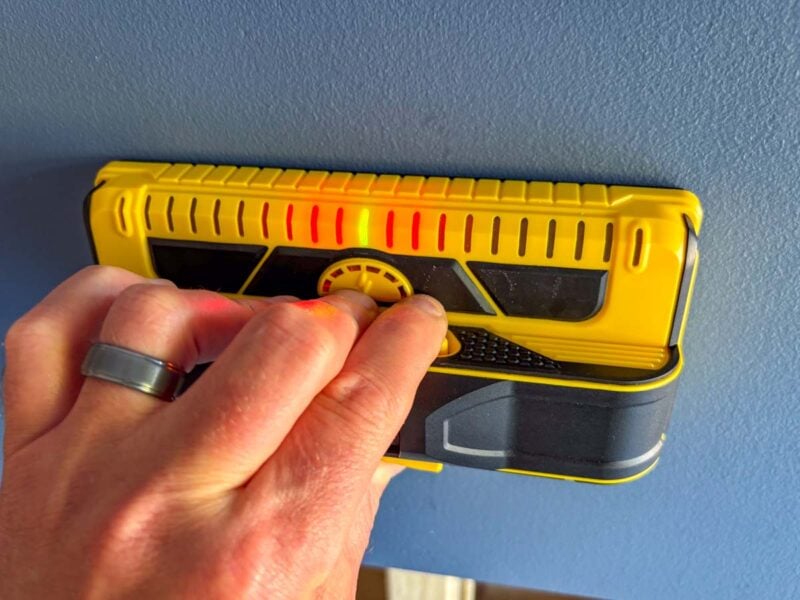
- On-Center Detection: 100%
- Off-Center Detection: 0%
- Missed Stud: 0%
- False Stud Detection: 33%
- AC Detection: 100%
Franklin’s M210 (or X2100, depending on where you shop) was the clear winner for stud finding in the plaster section of our test wall. It properly detected each stud and properly identified the live AC.
The downside is that it registered a couple of false stud detections along the way. So, be sure to get multiple measurements. If it seems like it’s having more trouble reading one “stud” compared to the others, it may very well be a pipe.
Price: $59.99
Editor’s Choice: Franklin ProSensor M70/X700

- On-Center Detection: 67%
- Off-Center Detection: 33%
- Missed Stud: 0%
- False Stud Detection: 0%
- AC Detection: NA
While the M210 had the most precise stud detection, Franklin’s M70 is actually my favorite (also sold as the X700 at some retailers). For starters, it didn’t miss any studs, and it didn’t have any false stud detections. It’s also less expensive than the M210 by nearly $40.
However, this model doesn’t have AC detection. That’s fine for most installation and hanging projects around the house, but it’s something to note if you’re looking to cut into the wall on a remodeling job.
Price: $21.99
Other Stud Finders That Can Work
Zircon HD70
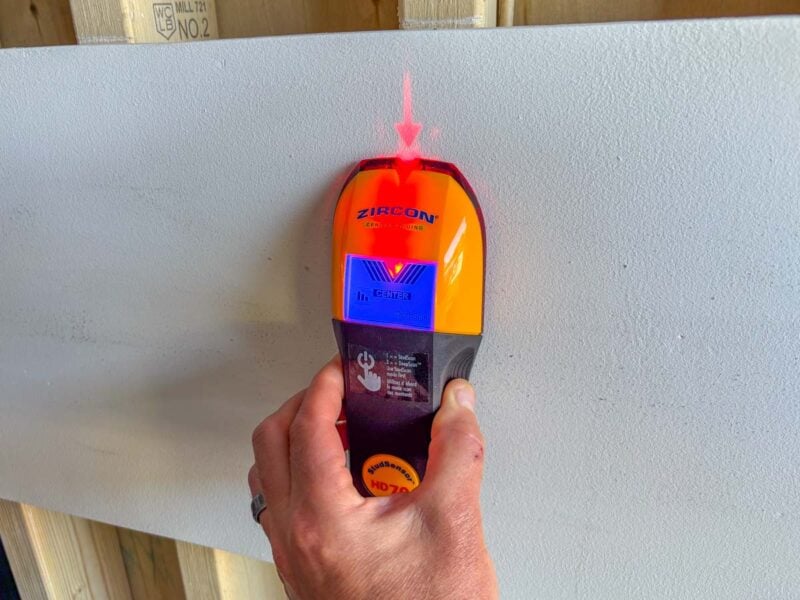
- On-Center Detection: 67%
- Off-Center Detection: 27%
- Missed Stud: 7%
- False Stud Detection: 47%
- AC Detection: 50%
Zircon had a solid detection rate, coming close to Franklin’s M70. However, it did have some misses, and its higher false stud detection rate makes it a less reliable option for plaster. Considering the M70 is also less expensive, it’s tough to make a case for the HD70 if you work on plaster walls frequently.
Price: $29.99
JAXWQ 139-FYELLOW
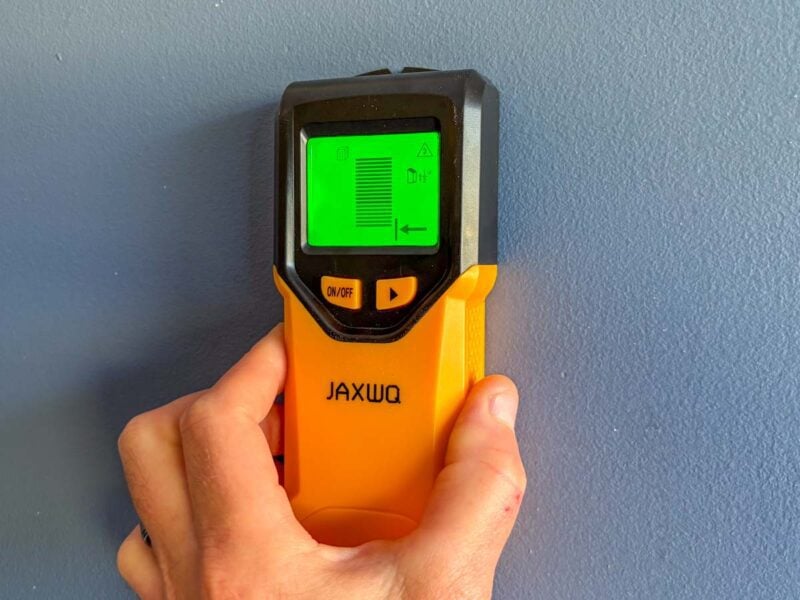
- On-Center Detection: 60%
- Off-Center Detection: 33%
- Missed Stud: 7%
- False Stud Detection: 33%
- AC Detection: 50%
JAXWQ was a new brand to us, and we brought it in because it was the top-selling stud finder on Amazon at the time we made our selections. In our plaster tests, it was pretty close to Zircon. Depending on how you look at the data, you could make an argument that it performed better.
The big difference was that Zircon had a better on-center detection rate, but JAXWQ had a lower false stud detection rate. Between the two, I’d rather have the better center precision.
Price: $19.99
DeWalt DW0150
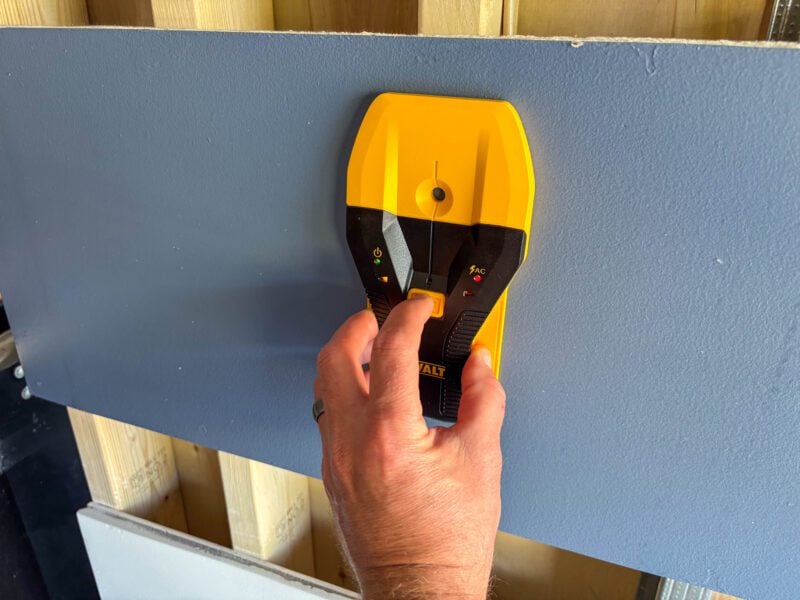
- On-Center Detection: 67%
- Off-Center Detection: 7%
- Missed Stud: 27%
- False Stud Detection: 33%
- AC Detection: 50%
DeWalt’s stud finder has a much thinner physical design than most, but it’s easier to use than it might first appear.
In my plaster tests, it struggled, missing more than a quarter of the studs and posting a 33% false stud detection rate. Like Zircon and JAXWQ, you can make it work if you’re willing to take your time, but unless you already own it, there are models that offer a higher success rate.
Price: $24.99
The Bottom Line
In my tests, Franklin earns its reputation for accuracy. While other brands can work, I found both the M210 and M70 to have superior accuracy for finding studs in lath and plaster walls.
But there’s one caveat: Franklin also has the ProSensor Max, and it specifically claims to handle lath and plaster. I haven’t had the opportunity to test it yet, but it’s on my radar for an update. It’s expensive, though. At $119.99, it’s twice the price of the M210.
Have you had any success using stud finders in lath and plaster walls? Let us know what worked for you in the comments!