
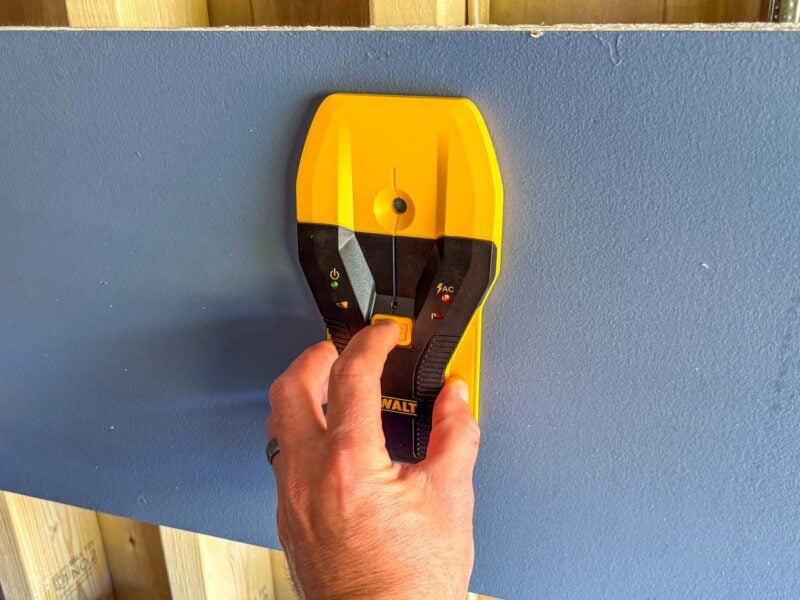
Stud finders aren’t exactly the flashiest tools on the jobsite, but when you’re hanging cabinets, mounting TVs, or locating anchor points behind finished walls, accuracy matters in a big way. The problem is that many entry-level stud finders either overcomplicate the process with excessive features or struggle to provide consistent readings when you actually need them.
The DeWalt DW0150 stud finder takes a much more straightforward approach. Rather than loading it up with unnecessary extras, DeWalt focused on dependable stud detection, easy operation, and a sleek design.
The question is whether that simple formula is enough to stand out in an already saturated category.
READ
Best Stud Finder: We Tested the Most Popular Models
Pros
- Very good detection on single-layer drywall detection
- Decent detection on plaster
- Excellent AC detection
- Good ergonomics
Cons
- Doesn’t show stud edges or whole stud
- Inconsistent on double-layer drywall
- High number of false positives on non-stud materials
DeWalt DW0150 Stud Finder Performance
Stud Detection
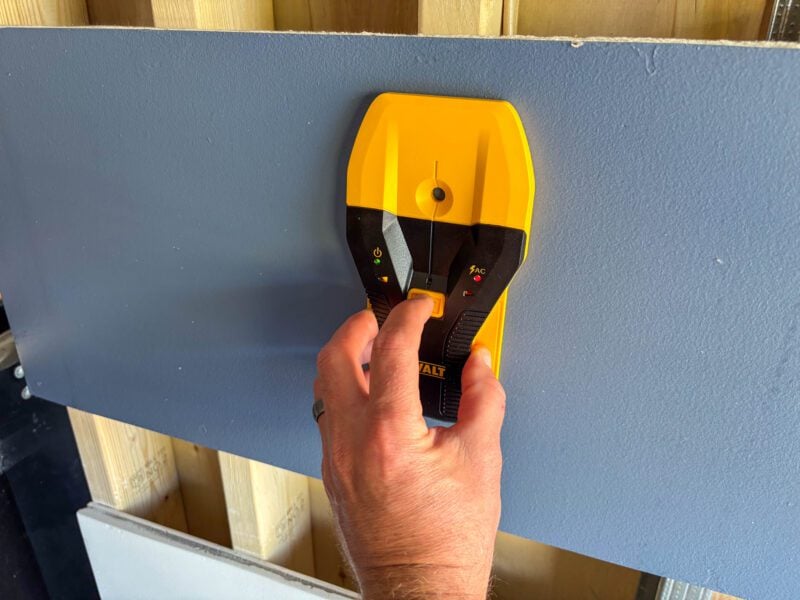
At its core, the DeWalt DW0150 is designed to locate wood and metal studs up to 1-1/2 inches deep behind drywall and other common wall materials. That depth rating puts it right in line with what we expect from a quality mid-range stud finder.
In practical use, the scanner consistently located stud edges, but required multiple passes across the wall to ensure accuracy. Overall, the detection level feels stable and predictable, which is honestly one of the biggest compliments you can give a stud finder. There’s nothing worse than chasing phantom readings across a sheet of drywall.
DeWalt also incorporated center-find functionality, helping you quickly identify the midpoint of the stud once both edges are located. That makes layout work much faster when you’re installing shelving, mounting hardware, or running a series of fasteners.
Accuracy and Application
One thing I appreciate about the DW0150 is that it doesn’t feel overly sensitive. Some stud finders tend to overreact to texture changes or uneven drywall, but this model maintains pretty consistent readings, even if you do need to make multiple passes.
Using this stud finder is pretty simple. Start by placing the DW0150 against the wall, pressing the power button, allowing the sensors to calibrate for a few seconds, and then gently sliding it across the surface.
Once the scanner detects a stud edge, the LED indicators and audible alert make it very clear where the framing begins. The overall system feels intuitive and easy to trust, even if you don’t use a stud finder every day.
Live Wire Detection
In addition to locating studs, the DW0150 can also detect live AC wiring behind the wall. This is one of those features you hope you never truly need, but it adds an important layer of safety when drilling or cutting into finished surfaces. While I’d never rely solely on a stud finder for electrical safety, the added warning system is definitely appreciated.
DeWalt DW0150 Stud Finder Design Notes
Size and Ergonomics
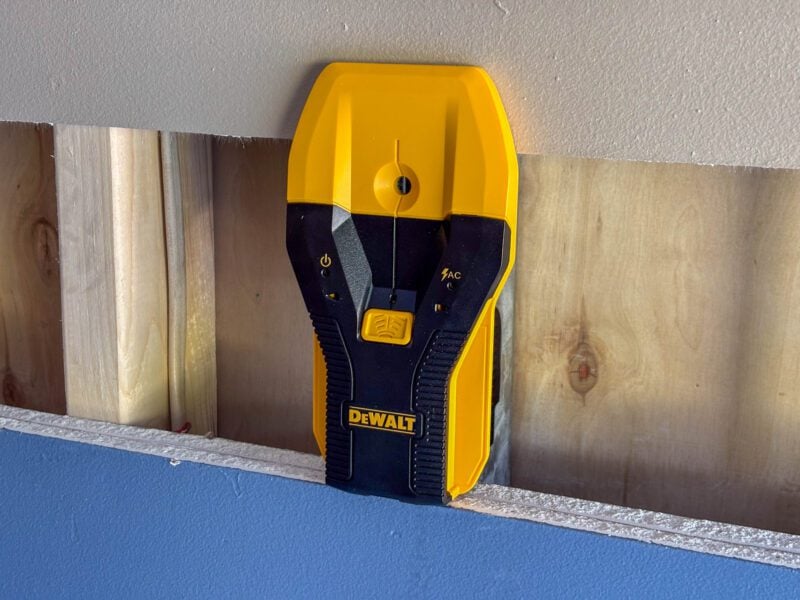
The DW0150 features a compact, low-profile design that feels comfortable in the hand and easy to maneuver across vertical surfaces. It measures 7.25 inches long and weighs a mere 5 ounces. On top of that, it’s only 0.8 inches thick, making it compact enough to toss in a tool bag or even your back pocket between uses.
The one concern I have is that the entire housing is plastic. I hope to see some protective rubber overmolding on future iterations to increase overall durability and comfort.
Display and Indicators
Rather than using a large digital screen, DeWalt opted for a simpler LED indicator system paired with audible alerts.
Personally, I think that was the right move for this style of tool. The bright directional LEDs are easy to see, and the center indicator removes a lot of guesswork when marking your layout lines.
Sometimes simpler really is better, especially for a tool designed to speed up workflow rather than slow it down with complex menus and settings.
Ease of Use
One of the biggest strengths of the DW0150 is how approachable it feels. There’s almost no learning curve thanks to the single-button operation, automatic calibration, and audible and visual feedback.
That simplicity makes it equally appealing for homeowners and Pros who just want a tool that works without fuss.
DeWalt DW0150 Stud Finder Hands-On Impressions
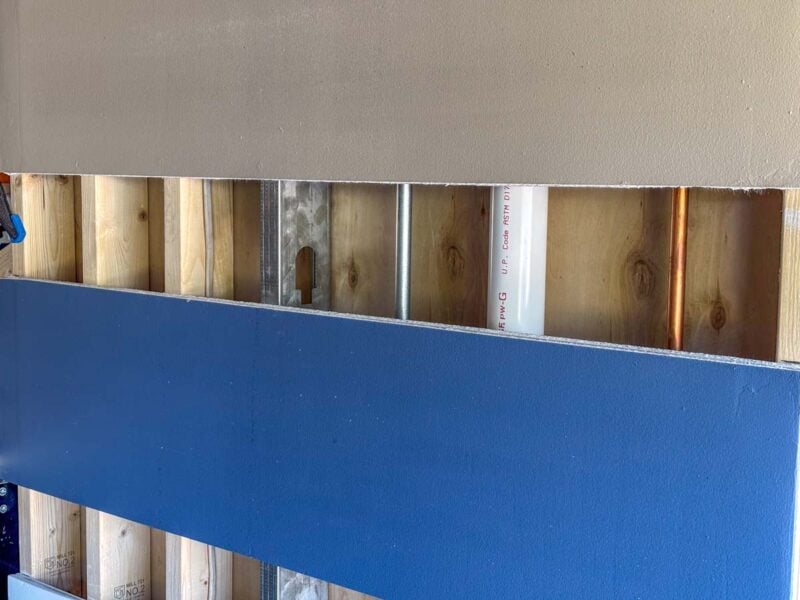
For testing, we constructed a wall that consisted of three sections: painted single-layer drywall, double-layer drywall, and plaster/lath. Behind these sections, we placed wood and metal studs, a live Romex cable, a section of EMT conduit containing live wires, a 2-inch PVC vent pipe, and a copper water line. These are meant to simulate real-world scenarios and help us determine the true accuracy of each stud finder.
Here’s what we discovered:
- On-Center Detection: The percentage of times the center was successfully detected
- Off-Center Detection: The percentage of times the edge was indicated as the center
- Missed Stud: The percentage of times a center was not indicated
- AC Detection: The percentage of times AC was successfully detected
- False Stud Detection: The percentage of times the EMT, PVC, or copper pipe was indicated as a stud center
| On-Center Detection | Off-Center Detection | Missed Stud | |
|---|---|---|---|
| Single-Layer Drywall | 87% | 7% | 7% |
| Double-Layer Drywall | 33% | 27% | 40% |
| Plaster and Lath | 67% | 7% | 27% |
| AC Detection | False Stud Detection | |
|---|---|---|
| Single-Layer Drywall | 70% | 67% |
| Double-Layer Drywall | 100% | 53% |
| Plaster and Lath | 50% | 33% |
Analysis
We tested this stud finder against a handful of others, so we have some context to go along with the data.
As you can imagine, single-layer drywall was the easiest test for all the models we tested. Only Franklin had a higher success rate in finding stud centers. DeWalt did struggle by falsely identifying the EMT, PVC, and copper pipe as studs more often, though.
Every model had a hard time with the double-layer drywall. In this section, the DW0150 was average with the group, though its perfect score on AC detection was a nice bonus.
The plaster section is always interesting, since most stud finders won’t claim accuracy in that application. However, we were able to find the stud more often than not. This was the model Tom favored when he was running his plaster tests, though Kenny preferred Franklin’s M210.
Looking at the overall results, the biggest concern was the rate of false stud detection. Even so, proper technique can save you from making an expensive mistake. Once you find what you believe is a stud, mark it, and find one to the right and left. If they’re either 16 or 24 inches away, it’s almost guaranteed to be a stud. If not, think about what’s on the other side of the wall. If it’s a bathroom or your kitchen sink, there’s a good chance it’s plumbing, so tread carefully.
On the positive side, while we did have an overall higher rate of success with a couple of other models, we’re satisfied with DeWalt’s ability to find studs. Again, using proper technique, you’ll be able to locate them consistently. It might just take a little longer than other designs.
All that said, even though it’s not loaded with advanced scanning modes or deep material analysis, honestly, that’s part of the appeal for me. I appreciate that the DW0150 sticks to the fundamentals and executes them well.
The Bottom Line
The DeWalt DW0150 succeeds by keeping things simple. While I found it to be generally dependable for both wood and metal studs, whether it’s the right fit for you depends on the types of walls you run into.
For standard single-layer drywall found in most homes, it gets the thumbs up from me. If you prefer DeWalt’s unusual ergonomics over traditional designs, pull the trigger.
If you’re working in a building that was constructed with double-layer drywall for fire protection or sound dampening, it’s a different story. The accuracy was significantly lower, and you’ll have more consistent success with the Franklin M210 or M70.
For those of you in older homes who still have to deal with plaster and lath walls, it’s a viable option. Franklin’s M210 is more accurate, but if you take your time, you can consistently locate studs with this model.
Ready to give it a shot? The DeWalt DW0150 retails for $34.99 and comes with a 3-year limited warranty.
Specs
- Model: DeWalt 0150
- Power Source: AAA battery (x2)
- Weight: 5 oz.
- Max Detection Depth: 1.5 in.
- Warranty: 3-year limited