
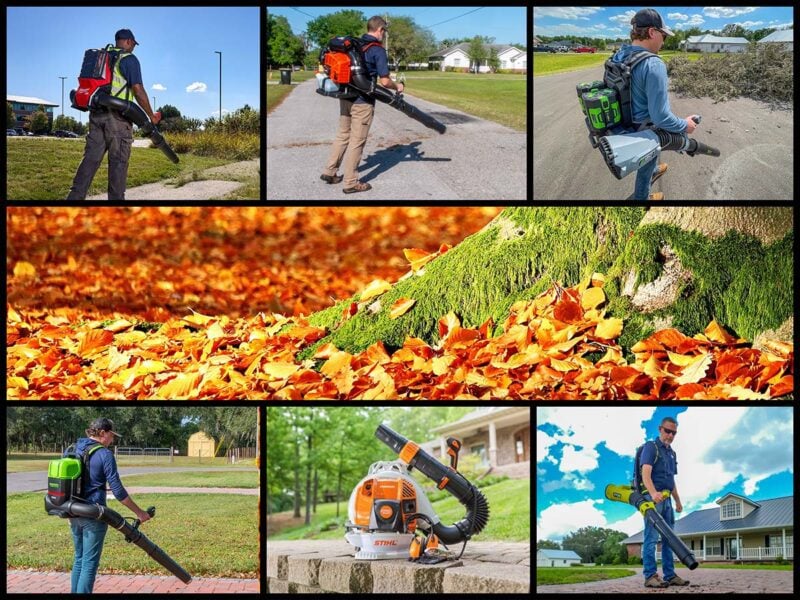
What does it feel like to have a hurricane strapped to your shoulders? Strapping on any of the best backpack leaf blowers will give you a close representation. With air velocity exceeding 200 MPH and CFMs reaching four digits, these monster air movers make short work of leaves and mower shrapnel.
We’ve spent plenty of trigger time with some of the top performers from high-end Pro models to homeowner levels, and our recommendations are the ones we’re confident will do the job for you.
Best Backpack Leaf Blower Overview
- Best Overall: Stihl BR 800 C-E Magnum
Jump to this Backpack Blower ↓ - Best Mid-Range: Husqvarna 560BTS
Jump to this Backpack Blower ↓ - Best Entry-Level: ECHO PB-580T
Jump to this Backpack Blower ↓ - Most Powerful: Husqvarna 590BTS
Jump to this Backpack Blower ↓ - Best Battery-Powered: Greenworks Commercial BB361
Jump to this Backpack Blower ↓ - Best For Homeowners: Ryobi 40V HP Brushless RY40HPLB02
Jump to this Backpack Blower ↓
Jump to These Sections to Learn More
- Best Backpack Blower Brands
- More Recommendations from Brands We Trust
- Backpack Blower Buying Guide
- Why You Can Trust Pro Tool Reviews
Related Content
Best Backpack Leaf Blower Overall
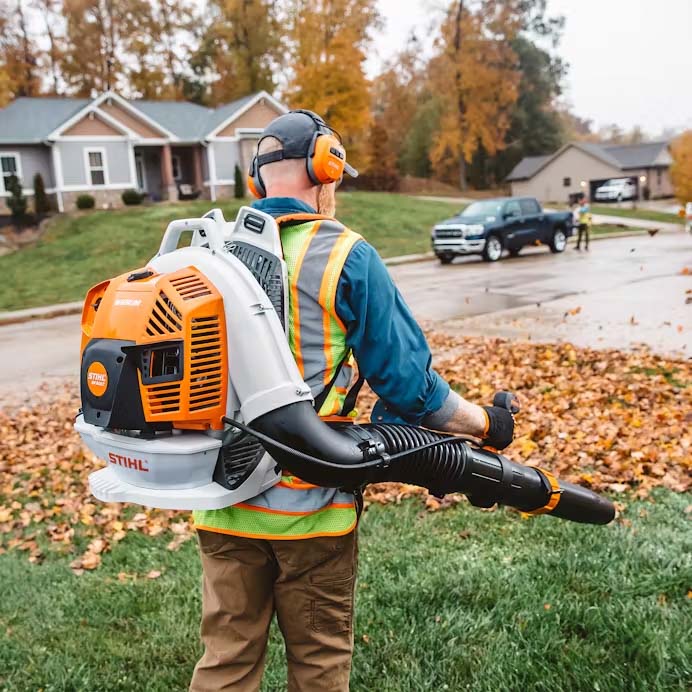
Stihl BR 800 C-E Magnum
- Engine: 79.9 cc
- Air Speed: 239 MPH
- Air Flow: 912 CFM
- Blowing Force: 41 Newtons
- Noise Rating: 78 decibels
- Fuel Capacity: 67.6 fl oz
- Dry Weight: 25.8 lbs
- Price: $749.99
Highlighted Features
- Easy2Start System: Side-mounted pull cord requires much less effort and can start the blower while you’re wearing it.
- Advanced Anti-Vibration System: Reduces the amount of vibration you feel along with the fatigue that comes with it.
Pros
- Excellent blowing force
- Easy starting
- Comfortable harness design
- Made in the USA using global materials
- Extensive servicing dealer network
Cons
- Expensive
- Heavy
We first experienced Stihl’s BR 800 C-E Magnum backpack blower back in 2018, and it’s still the best in my book. In addition to its advanced vibration control system, the Easy2Start system helps set it apart.
It’s significant for two reasons. First, it requires much less pull force to start. You gently pull the cord until you feel it engage with the internal mechanism, and then increase the force to start the engine. It’s surprising how low the effort is compared to standard ignition systems, and the pull length is shorter as well.
The second big improvement is the side start orientation for the pull cord. You can get the blower situated on your back, get your right arm comfortable on the throttle, and then simply pull the cord forward with your left hand. It’s convenient when you’re getting started, and a big time-saver when you need to stop and restart mid-job.
While it’s not the most powerful, the BR 800’s 41-Newton blowing force is still top-tier, so most Pros won’t feel like they’re missing out.
One downside is that this is on the heavier side for backpack blowers. We expect that from the 80 cc class, and Stihl’s harness system does a nice job of distributing the weight to help you stay comfortable.
The other downside is the cost. When you’re buying the best, you expect it to have a premium price tag. However, you can buy with confidence knowing you have Stihl’s service network to back you up.
Best Mid-Range Backpack Leaf Blower
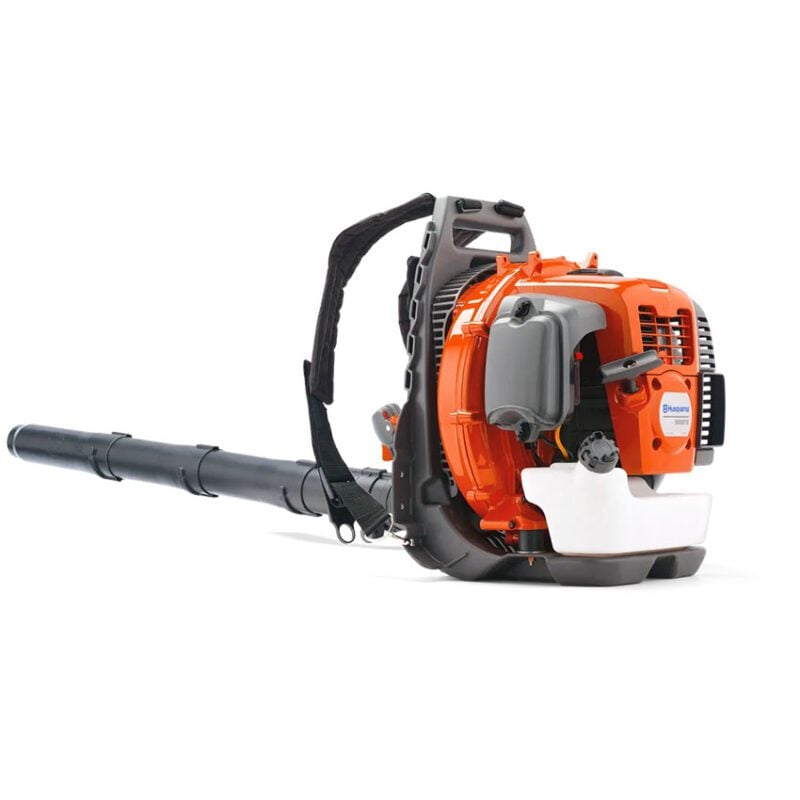
Husqvarna 560BTS
- Engine: 65.6 cc
- Air Speed: 232 MPH
- Air Flow: 631 CFM
- Blowing Force: 30 Newtons
- Noise Rating: 97 decibels (at operator’s ear)
- Fuel Capacity: 74.4 fl oz
- Dry Weight: 23.2 lbs
- Price: $509.99
Highlighted Features
- Offset Handle: Makes the nozzle easier to control at high blowing forces.
- Adjustable Throttle Angle: In addition to the throttle position, you can adjust the angle of the handle forward and back to customize your comfort.
Pros
- Excellent blowing force for this class
- Excellent control hand ergonomics
- Generous fuel tank capacity
Cons
- No hip strap
Mid-range models hit the sweet spot between performance and price, making them the best backpack blowers for the money. In my search for the best, three models rose above the rest of the pack: ECHO’s PB-755ST, Husqvarna’s 560BTS, and Stihl’s BR 600. All three are quality choices, but it’s the Husqvarna that earns my pick.
While Stihl is lighter and a little more powerful, and ECHO has a lower price tag, there were two things that got my attention from Husqvarna.
One is the ergonomics of the offset throttle control. Having your hand to the side of the nozzle can help reduce how much effort it takes to control at higher blowing forces. Husqvarna also designed the throttle handle to pivot forward or back, letting you change the angle and keep your wrist in as comfortable a position as possible.
I also like the large fuel tank. Combined with Husqvarna’s efficient X-Torq engine, having nearly 75 ounces of fuel on board saves you time by reducing how often you have to stop and refill.
Like many blowers in the mid-range class, there’s no hip strap to help you distribute the blower’s weight off your back. It’s something you’ll feel even more with a full fuel tank. It’s something to think about if you’re maintaining large campuses. However, it’s not as big of a deal for residential mow and blow crews.
Best Entry-Level Backpack Leaf Blower
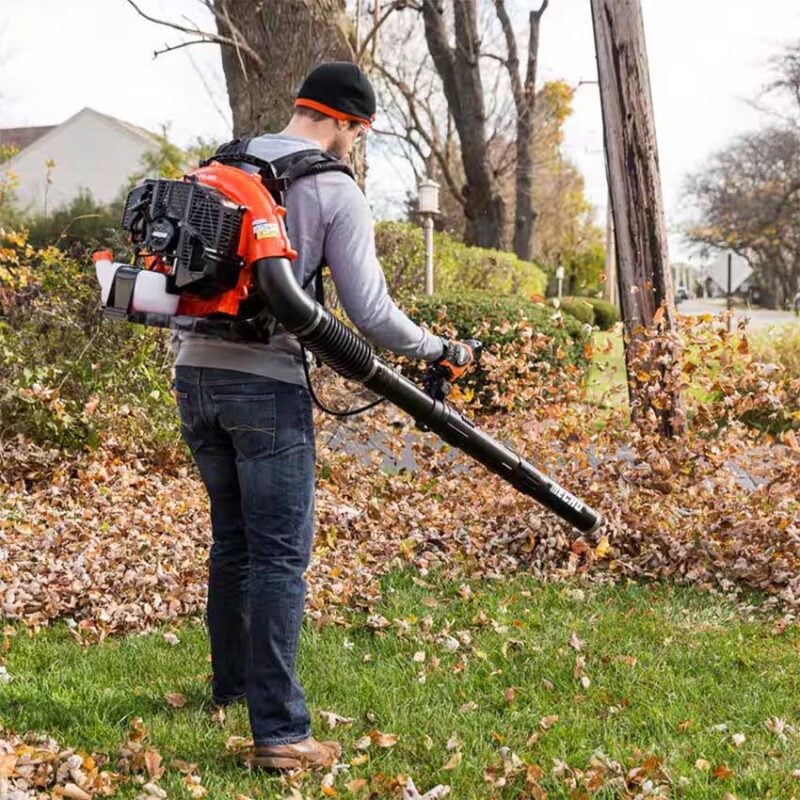
ECHO PB-580T
- Engine: 58.2 cc
- Air Speed: 216 MPH
- Air Flow: 517 CFM
- Blowing Force: 22 Newtons
- Noise Rating: 70 decibels
- Fuel Capacity: 62 fl oz
- Dry Weight: 22.7 lbs
- Price: $399.99
Highlighted Features
- Metal Pipe Ring: Reduces wear and helps get stubborn debris free.
Pros
- Generous fuel capacity
- Quieter than higher-performance models
- Excellent air flow around your back
Cons
- No hip strap
Entry-level backpack blowers have been hit hard with rising prices, and even I was surprised at some of the numbers. Before you compromise by going for a lower-cost residential-grade model that isn’t designed for the high hours of professional use, give ECHO’s PB-580T a look. Among the true Pro-grade options with the quality I’m looking for, it’s the only one that still has a price tag under $400.
With a blowing force of 22 Newtons, it’s a capable post-mowing and leaf wrangling option. Plus, its 58 cc engine sips fuel more slowly compared to its higher-performance counterparts and the 62-ounce fuel tank offers excellent runtime between fill-ups.
You won’t get all the creature comforts that high-end models have, but for less than half the price of some models, it gets the job done and has the build to stand up to professional use.
Most Powerful Backpack Leaf Blower
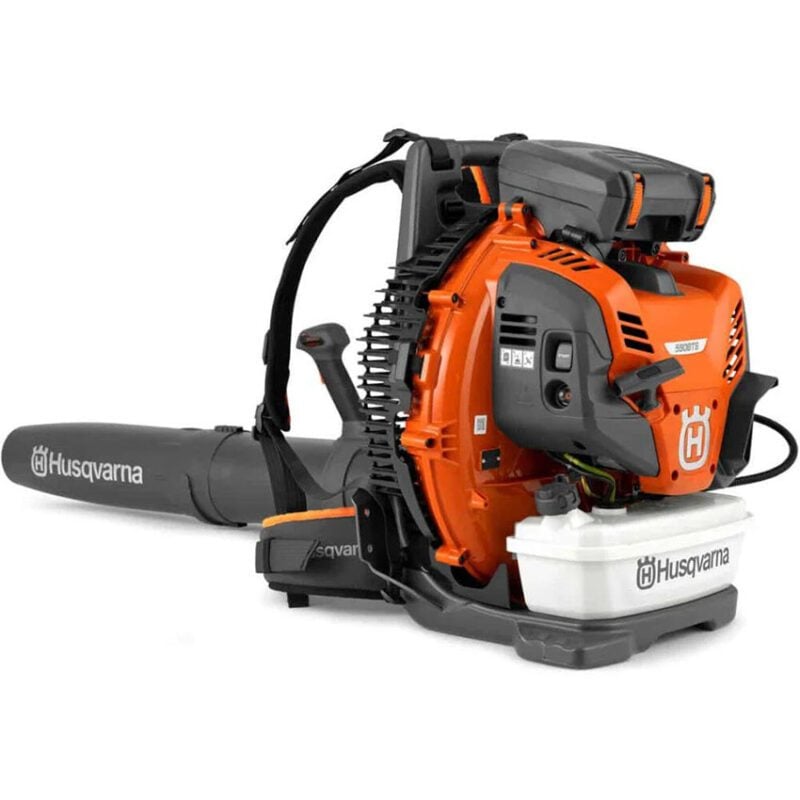
Husqvarna 590BTS (and Redmax EBZ9000-RH)
- Engine: 79.4 cc
- Air Speed: 216 MPH
- Air Flow: 1245 CFM
- Blowing Force: 56 Newtons
- Noise Rating: Not listed
- Fuel Capacity: 91.3 fl oz
- Dry Weight: 26.2 lbs
- Price: $889.99
Highlighted Features
- Advanced Anti-Vibration System: Reduces the amount of vibration you feel along with the fatigue that comes with it.
- Connectivity Ready: Install the option Husqvarna connectivity module for access to the blower’s digital services.
- Integrated Service Port: Gives service tech easy access to the Husqvarna Service Hub for quicker troubleshooting.
- Isolated Pull Cord: Makes access much easier for repair and replacement.
Pros
- Most powerful backpack blower available
- Large fuel tank
- Advanced tech features
Cons
- Expensive
- Heavy
If Chuck Norris owned a backpack blower, it would be the Husqvarna 590BTS or its brand group brother, the Redmax EBZ9000-RH. As the most powerful backpack blowers available, they have enough to blowing force to alter the course of an earth-killing asteroid. Okay, not really, but with 56 Newtons at wide open throttle, it feels like it.
To earn the accolade of most powerful, that’s all you have to be. However, Husqvarna adds a few bonuses on the comfort and tech sides to make ownership easier. You’ll feel less vibration thanks to an advanced dampening system, shop managers have optional access to digital services, and service techs can easily plug in to troubleshoot issues using Husqvarna’s Service Hub.
It goes without saying that the strongest backpack blower is also going to be at the high end of the price range. That’s true, as is a heavier weight. That’s compounded when you have a full fuel tank. Holding nearly 3/4 of a gallon keeps the engine running longer than you might expect for this powerful of a blower, but it also adds about 4.5 pounds when the tank is full.
Best Battery-Powered Backpack Leaf Blower
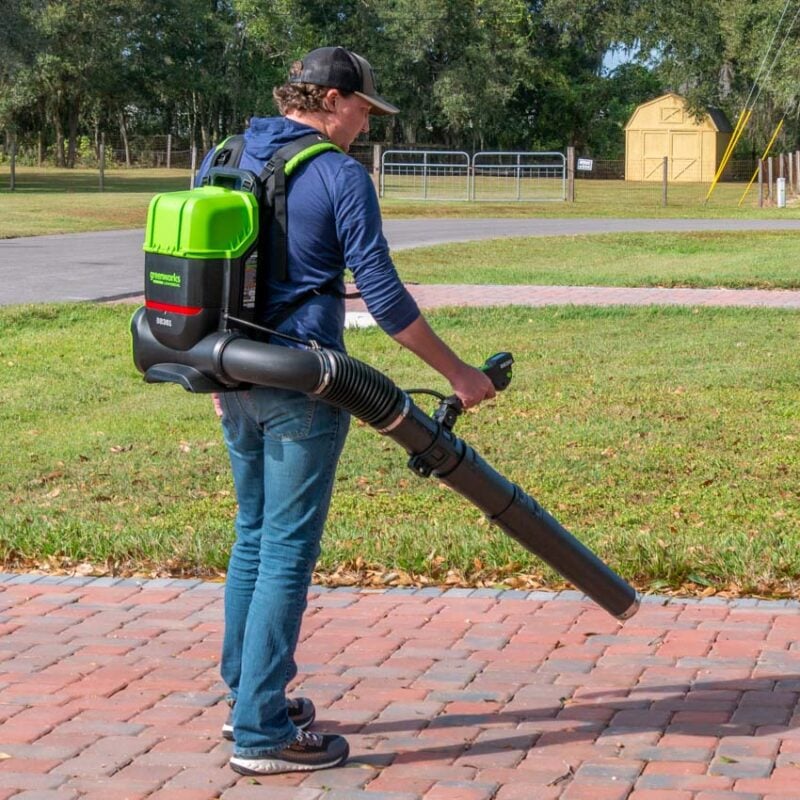
Greenworks Commercial BB361
- Motor: 82V brushless
- Air Speed: 225 MPH
- Air Flow: 755 CFM
- Blowing Force: 36 Newtons
- Noise Rating: Not listed
- Weight: 14.9 lbs bare, 31.9 lbs with batteries
- Price: $599.99 bare, $1499.99 – $1699.99 kit
Highlighted Features
- Rear LED Light: Helps keep you visible in low-light or crowded conditions.
Pros
- Legit gas-replacement performance
- Low noise
- No gas emissions
- Comfortable harness
- Low maintenance
- Longer service life than most gas models
Cons
- Expensive
- Heavy
At the moment, the Greenworks Commercial BB361 is the best battery-powered backpack blower available. With a 36-Newton blowing force rating (we measured a little higher in our tests), it can outperform most entry and mid-range gas models available.
However, this model is about to be eclipsed… by Greenworks Commercial. At a media event hosted by Greenworks in Tennessee, I was able to get my hands on a couple of new models that hit 40 and 50 Newtons, respectively. New battery technology in the form of an Optimus Core battery is capable of producing equivalent power to a 9.6HP gas engine and powers these high-performance models.
Together, the line of Optimus backpack blowers will cover each performance class without the need for gas. Plus, Greenworks Commercial now has the charging solutions to make switching to battery power a legitimate option for professional crews. Whether local regulations are forcing you to think about switching, you’re considering the higher long-term profits and convenience of going gas-free, check out what the Optimus system has to offer.
Thinking about ditching the gas can? See which models made our list of the best cordless leaf blowers!
Best Backpack Leaf Blower for Homeowners
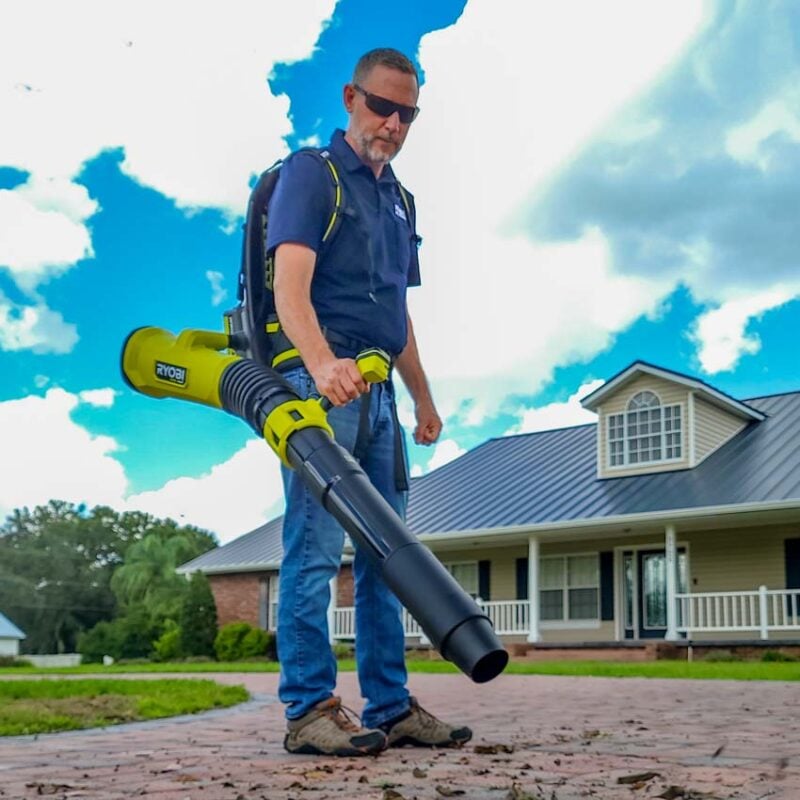
Ryobi 40V HP Brushless RY40HPLB02
- Motor: 40V brushless
- Air Speed: 180 MPH
- Air Flow: 850 CFM
- Blowing Force: 24.7 Newtons
- Noise Rating: 74 decibels (at operator’s ear)
- Weight: 12.9 lbs bare, 21.2 lbs with batteries
- Price: $599 kit
Pros
- More powerful than most residential gas models
- Low noise
- Lighter than other battery-powered competitors
- No gas emissions
- Low maintenance requirements
- Batteries work in all Ryobi 40V lawn care tools
Cons
- More expensive than most residential gas models
When it comes to backpack blowers for homeowners, I think battery power is the best option. Across the board, the grab-and-go convenience, no worries about gas maintenance issues, and cross-compatibility with other lawn care tools outweigh the additional cost. Add in low noise and no direct emissions, and it’s a compelling argument.
Among residential-focused models, Ryobi’s latest HP Brushless backpack blower is my top pick. It hit nearly 25 Newtons of blowing force on our meter, and its minimalist build puts the working weight right in line with what we expect from gas models in the residential class.
The kit is more expensive than gas models. However, if you’ve ever picked up your gas blower for the first time in a few months and had to lose project time and money while it visited the small engine repair shop, you know those costs can even out in a season or two.
Best Backpack Leaf Blower Brands
If you ask a group of professional lawn crew teams who the best backpack leaf blower brand is, prepare yourself for a fistfight between ECHO and Stihl loyalists. Both make excellent backpack blowers and they’re by far the top two brands we find on professional trailers in the Central Florida area where we live. Add in Husqvarna (or brand group member Redmax) as you branch out, and those are the most popular brands.
Keep in mind that a great ownership experience is more than just performance and features—you need service after the sale as well. Sometimes, the best brand for your crew is the one that offers the most convenient service to your shop.
More Backpack Blower Recommendations
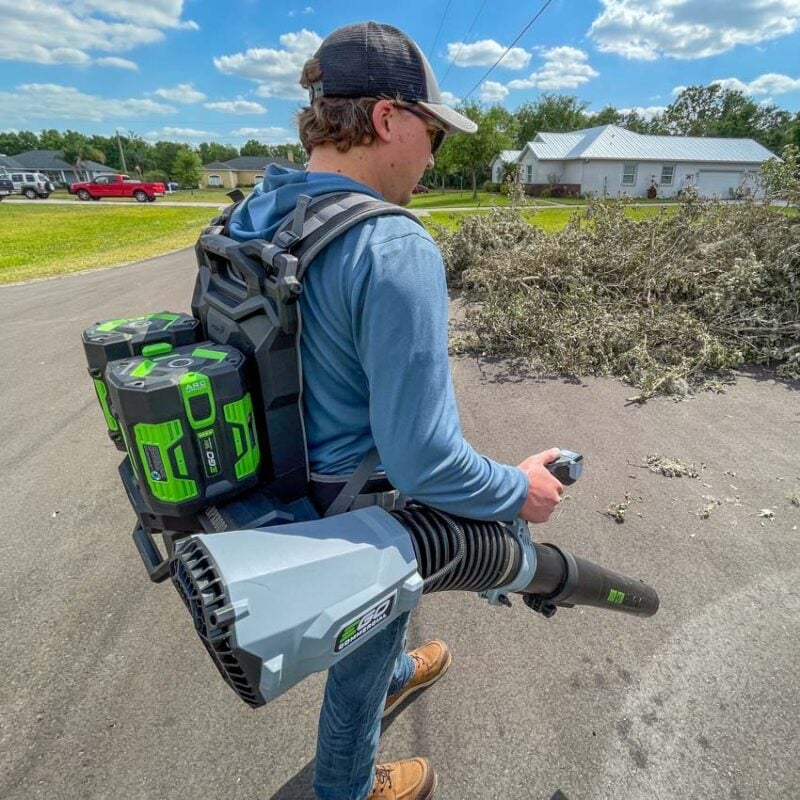
EGO 56V Commercial Backpack Blower
- Motor: 56V brushless
- Airspeed: 190 MPH
- Airflow: 800 CFM
- Blowing Force: 26 Newtons
- Noise Rating: 65 decibels
- Weight: 16.3 lbs bare
- Price: $439 bare, $769 – $1429 kit
Pros now have legit battery-powered backpack blower options from more than half a dozen brands. Among the models currently available, EGO’s Commercial model impressed us. Opting for the same batteries as its residential lawn care tools rather than the backpack battery we saw several years ago, it’s a powerful blower. Rated at 26 Newtons, this model hit 27.9 Newtons on our meter, giving it the power to replace entry and mid-range gas models.
In addition to its performance, there are upgraded components under the hood that give it a step up in quality from EGO’s residential line. Additionally, it’s highly maneuverable thanks to a design that essentially places an inline blower on a pivot and adds a flexible tube. Convenience features such as the digital display and a comfortable harness design put the icing on the cake.
Milwaukee MXF600 MX Fuel Backpack Blower
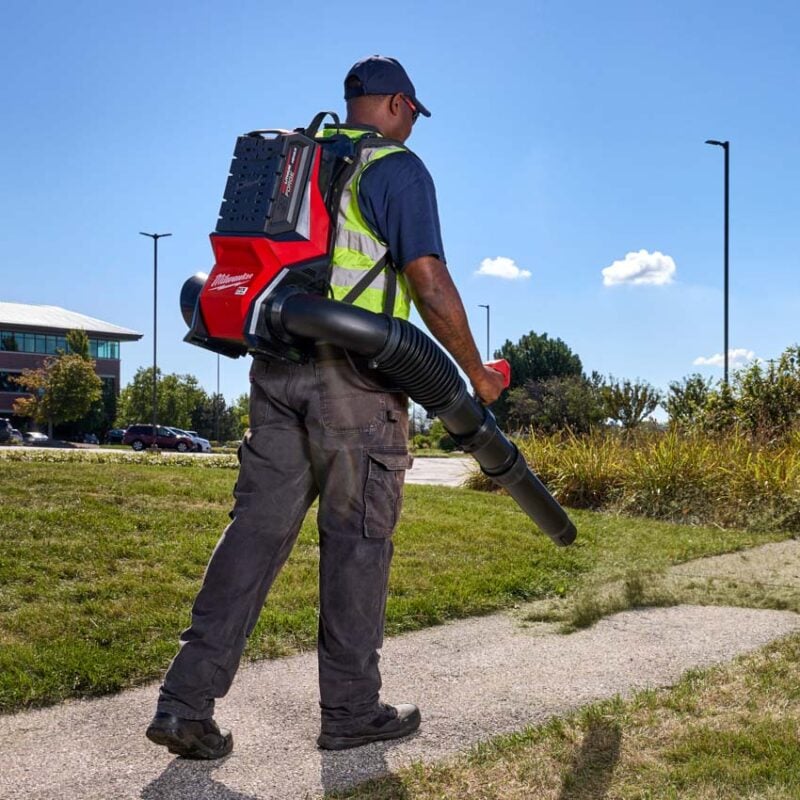
- Motor: 72V brushless
- Airspeed: 190 MPH
- Airflow: 800 CFM
- Blowing Force: 30 Newtons
- Noise Rating: 64 decibels
- Weight: 30.2 lbs with battery
- Price: $999 bare, $2999 kit
Milwaukee has two battery-powered backpack blowers to choose from. While the M18 Fuel Dual Battery model might have a wider appeal because of its M18 battery system compatibility, the MX Fuel MXF600 is significantly stronger. With 17 Newtons of blowing force in low and 30 Newtons at the top end, it’s a solid choice for large campuses and properties that want to eliminate the noise of gas engines.
Its high-capacity MX Fuel battery means it’s also heavier than its gas counterparts, but you get longer runtime for it. Milwaukee pays close attention to ergonomics, and you can be sure they designed the harness accordingly.
The MX Fuel system is a premium lineup designed for the high-hour use Pros put on their equipment, and this blower’s price tag reflects that. It also has One-Key built in, making it easier for larger lawn care firms to track and manage their equipment.
ECHO PB-9010T Backpack Blower
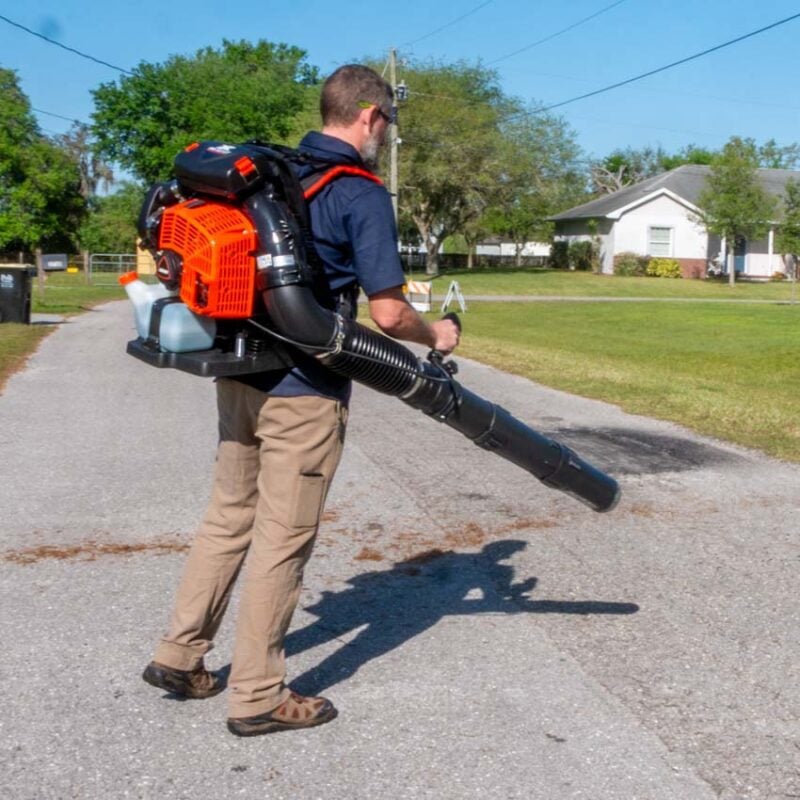
- Engine: 79.9 cc
- Airspeed: 220 MPH
- Airflow: 1110 CFM
- Blowing Force: 48 Newtons
- Noise Rating: 80 decibels
- Fuel Capacity: 83.8 oz
- Dry Weight: 26.7 lbs
- Price: $679.99
Up until Husqvarna released its 590BTS, ECHO’s PB-9010 held the crown as the most powerful backpack blower. Rated at 48 Newtons but registering higher on our force meter at 52 Newtons, it’s still a massive blowing force upgrade over what most crews are used to.
Even though ECHO has slipped to second in the power rankings, I expect it’s a better fit for most smaller crews. They’re less likely to reap the benefits of Husqvarna’s tech upgrades, and ECHO’s price tag is more than $200 less.
If you’re a Shindaiwa fan, you’re in luck as well. As part of the same group as ECHO, Shindaiwa’s EB910 offers the same performance.
What to Look for When You’re Shopping for a Backpack Leaf Blower
Why Buy a Backpack Blower?
The advantages of a backpack blower are typically higher performance and longer runtime per tank compared to handheld models. Gas models can have much larger engines than handheld blowers and generate higher performance. That adds more weight and higher fuel consumption, so we see the shift to a backpack harness to deal with the extra weight and larger fuel tanks.
The size property that’s appropriate to this type of blower varies on how much blowing you need to do. For example, an acre lot with no trees has different needs than one with many trees. In general, though, an acre is a good starting point to consider buying a backpack blower if you’re a homeowner.
Professional crews, on the other hand, rely on high blowing force to quickly clean up before they’re off to the next property, and the size of properties they hit in a day can vary widely. Because of that, they nearly always use backpack blowers rather than handheld.
Performance
Most people turn to backpack blowers for higher performance and that’s the highest priority for us as well. Large MPH and CFM numbers are great, but it’s Newton Force that tells a more complete blowing force story.
Runtime and Fuel Efficiency
Fuel efficiency directly affects your bottom line and it’s an important part of the equation. But so is work efficiency. Look for the best balance between fuel efficiency and runtime. The more often your crew has to stop and fill up the tank, the more time you’re spending on your properties. A larger fuel tank combined with an efficient engine keeps your team more productive.
Weight and Padding
When you have a blower strapped to your back, padded straps make a difference, and the longer you have to wear the blower, the more weight comes into play. It’s not just the weight of the blower, though. High-volume gas tanks offer longer runtime, but more fuel weight.
Look for a harness design that includes a hip strap to take the strain off your back and has padding to avoid pressure points during use. Models that maintain a gap between your back and the rear plate promote airflow to keep you cooler, and some even actively push air through.
Noise Levels
When using a backpack blower—mind your ears! No matter how you slice it, gas-powered leaf blowers are loud! ANSI testing requires measurements from 50 feet, but you’re not a bystander and the noise at your ear level is much higher—more than 100 decibels in some cases. In other words, you need hearing protection.
The exception is battery-powered models. Some can keep the noise level below OSHA’s threshold for hearing protection. In addition to the lower overall noise, it also lets you hear more of what’s going on around you.
Note on OSHA Exposure Limits for Sound Levels
OSHA allows a permissible exposure limit (PEL) of 90 dB (A-weighted) for an 8-hour workday. After that, the OSHA standard has a 5 dB “exchange rate”. That means that when the noise levels increase by 5 dB, the amount of time a person OSHA to be exposed at that level divides by two. Using this calculation, at 100 dB you could only work for two hours without hearing protection. If you work with the same blower for 8 hours, you need to wear hearing protection with an NRR rating of at least 10.
Value
Value is all about getting the best backpack leaf blower that fits your budget, not just the cheapest you can get your hands on. When you consider a blower’s value, weigh what you get against the price with your highest priorities as the most important.
Got $400 to spend and value performance? Look for the highest Newton force that fits your budget. Are you more concerned about weight? Start there.
Features to Look For
What we’ve talked about so far takes care of the meat and potatoes. Now let’s shift gears to what makes for a better operator experience. Here are some of the key features we look for:
- Harness design that actively pulls air across your back to cool you down
- Hip straps that shift the weight of the blower away from your shoulders
- Chest strap
- Effective harness padding
- Reduced emission engine design
- Reduced vibration design
- Throttle lock on/cruise control
- Side recoil start (the Stihl BR 800 Magnum C-E is the only blower we’ve tested with this feature)
- Hip and tube throttle options
Why You Can Trust Pro Tool Reviews
Ever check out a “review” site and you can’t tell if they actually test tools or if they’re just “recommending” the Amazon top sellers?
That’s not us. We only recommend what we’d actually use, even if we don’t earn a commission from it. It’s all about giving you a legitimate recommendation and our honest opinion of each product.
We’ve been in business since 2008 covering tools, writing reviews, and reporting on industry news in the construction, automotive, and lawn care industries. Our Pro reviewers work in the trades and have the skills and experience to know whether tools can perform well in the field.
Each year, we bring in and review more than 250 individual products. Our team will put our hands on hundreds of additional tools at media events and trade shows throughout the year.
We consult with innovators in the technology and design of tools to gain a broader grasp of where these products fit and how they work.
We’ll provide more than 500 pieces of new content this year absolutely free for our readers—including objective evaluations of individual tools and products.
The end result is information you can trust because of the editorial, scientific, and real-world professional experience we collectively utilize each and every time we pick up and test a tool.