
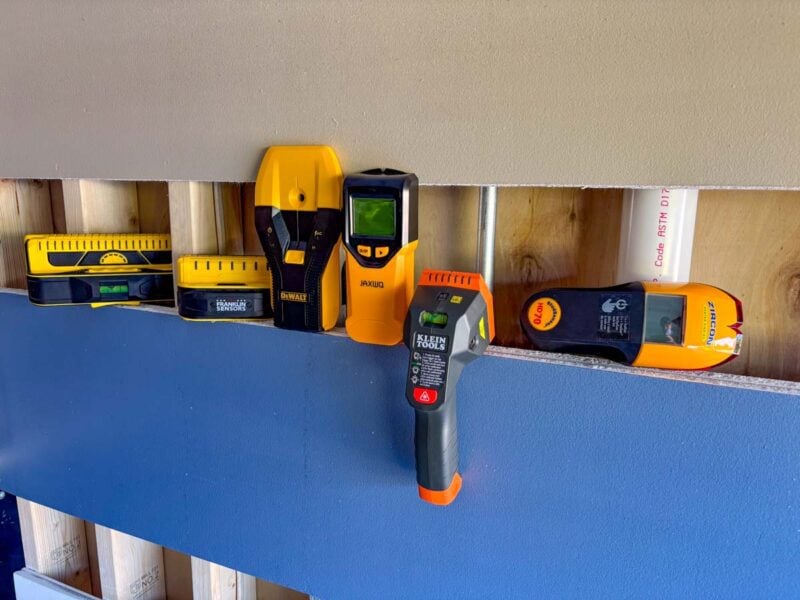
Stud finders can be a big help for locating the studs behind your walls. Grabbing one can help eliminate some of the frustration and repainting that comes from less modern methods, but which is the best stud finder?
We’ll help you answer that question. With a focus on residential and light commercial construction, our team uses stud finders all the time once the drywall is up. Even when we’re not using them professionally, there are always pictures and mirrors to hang, shelves to mount, and any number of projects going on around our homes.
We’ve used plenty of different models, but for this test, we got our hands on the top-selling models we found at retailers like Home Depot, Acme Tools, and Amazon. Just for kicks, I threw in the one I use most often to see how it stacks up against the others.
Best Stud Finders
Best Stud Finder According to Kenny
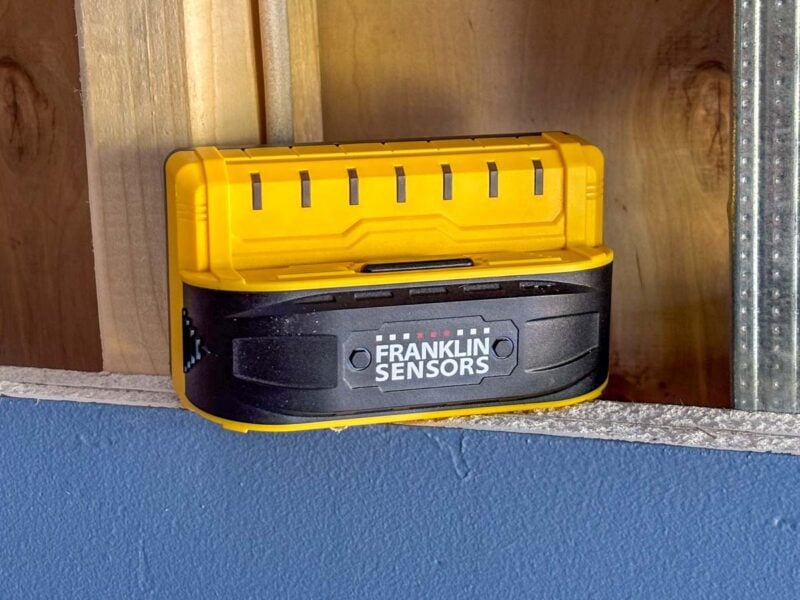
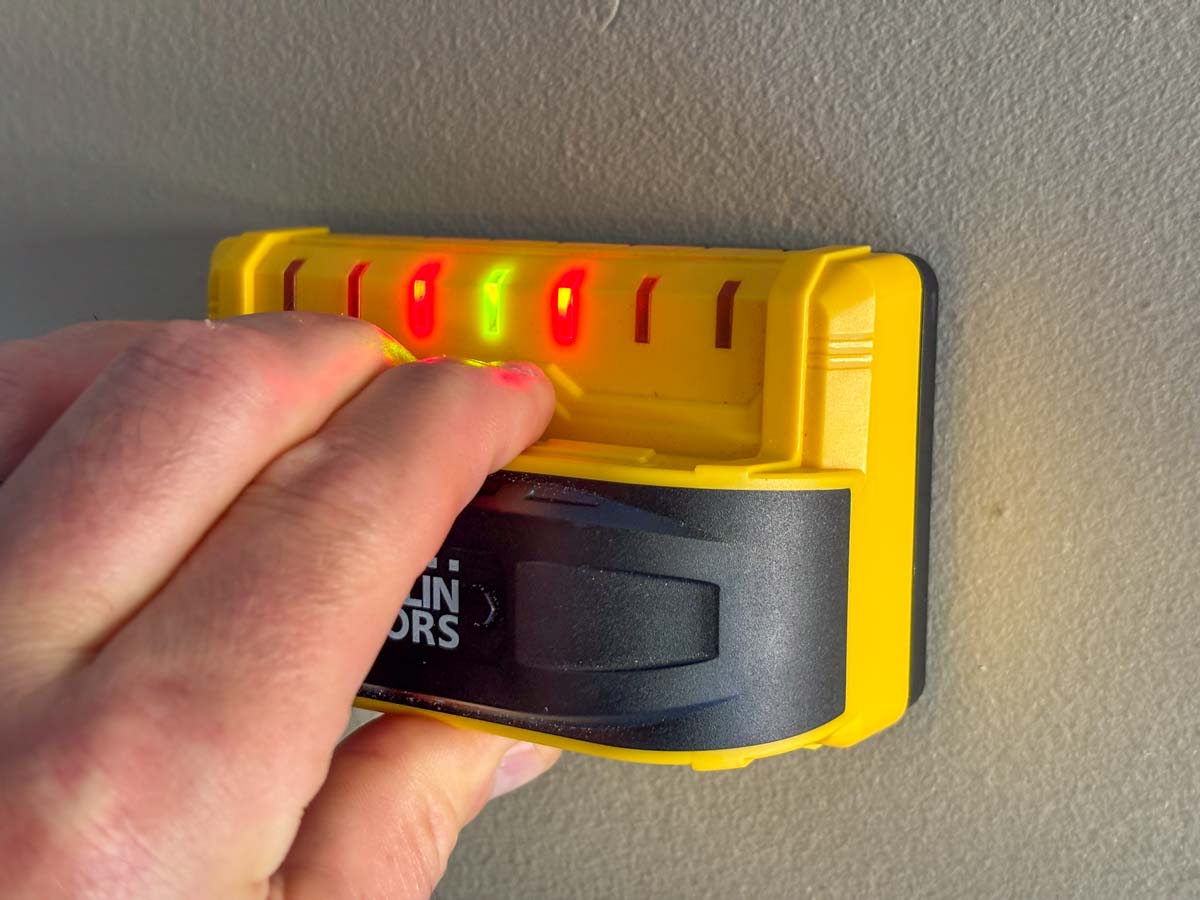
Franklin M70/X700
- Sensors: 7
- Detection Depth: 1.5 inches
- Display Width: 3 inches
- AC Detection: No
- Power Source: 2 x AAA battery
- Price: $21.99
Highlighted Features
- Center Indicator: Middle light turns green to indicate the center
- Whole Stud Detection: LEDs bracket the full stud width so you can see the center and edges
- No Calibration Required: You can start detecting anywhere, even over a stud
Pros
- Highest percentage of on-center detection in our tests
- Lowest percentage of false detections in our tests
- Perfect single-layer drywall detection
- Good double-layer drywall detection
- Good plaster detection
- Compact design is easy to use one-handed
- Made in the USA
Cons
- No AC detection
In most of our head-to-head testing, Tom and I agree on who the winner is. But after his initial tests, I wanted to see how the Franklin M70/X700 performed since it’s the stud finder I usually buy. So, I got the whole group out and dove deeper. Lo and behold, the $22 M70/X700 was the most accurate in my tests.
None of the models we tested is perfect. However, when I looked at the final data, this model had the highest percentage of on-center detections and the lowest percentage of false stud detections. It was perfect in our single-layer drywall tests and had good performance on double-layer drywall and plaster.
The only real downside to this model is that it doesn’t have AC detection. That’s okay with me. I naturally look for outlets, switches, and other indicators that AC is nearby when I’m looking for a stud.
With a reasonable price tag and ready availability online and in retail stores, it’s easy to get your hands on one when you need it. Plus, it’s Made in the USA.
* Note: The M70 and the X700 are essentially the same. The M70 is sold at Home Depot and Amazon, and the X700 is sold at Lowe’s.
Best Stud Finder According to Tom
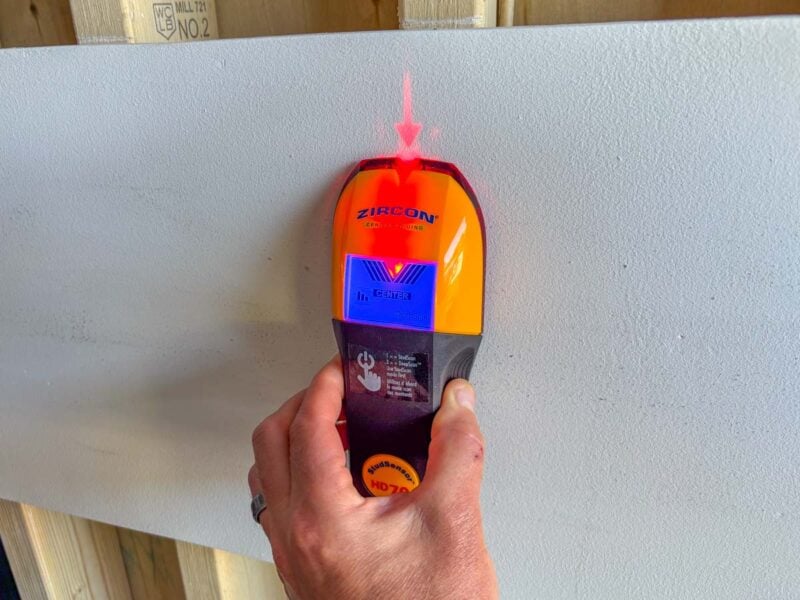
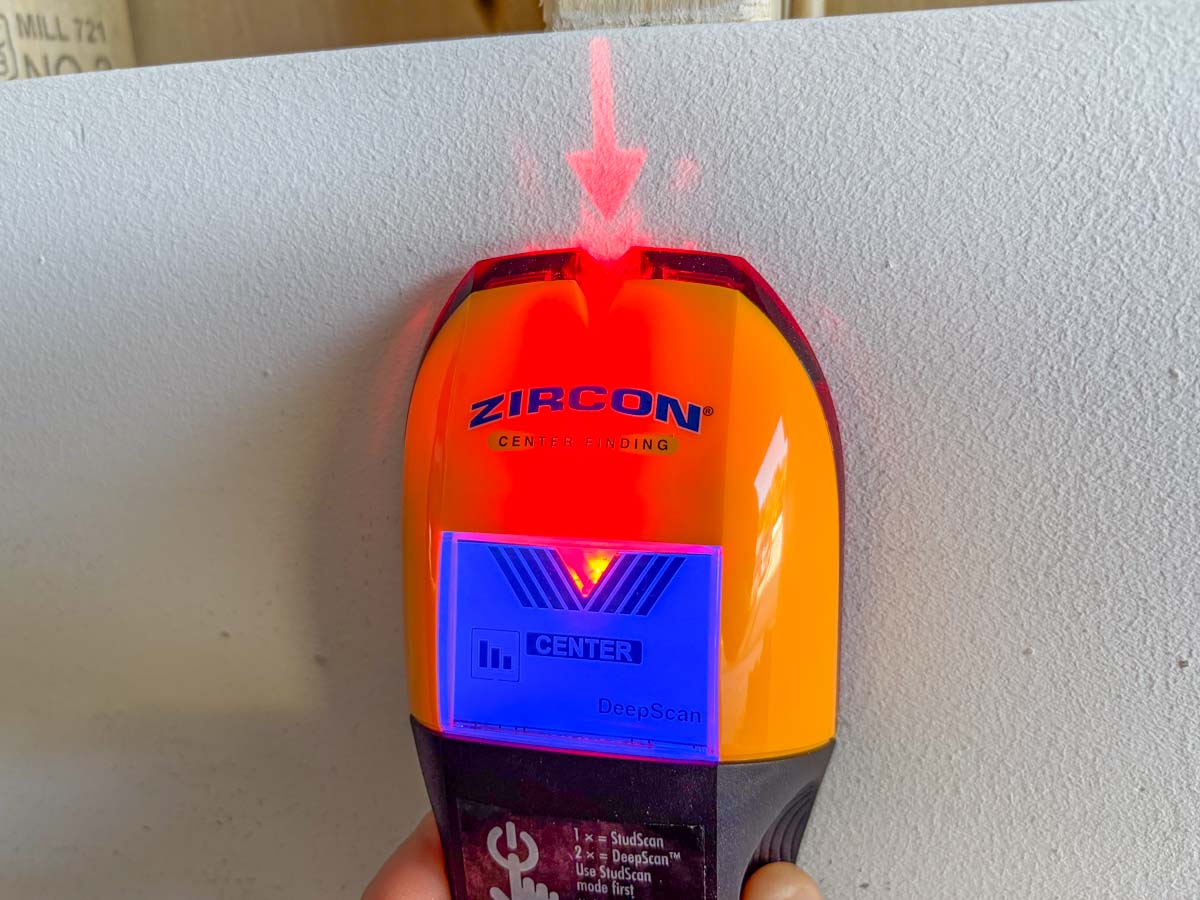
Zircon StudSensor HD70
- Sensors: Not listed
- Detection Depth: 1.5 inches
- Display Width: ~ 1.5 inches
- AC Detection: Yes
- Power Source: 9V battery
- Price: $29.99
Highlighted Features
- Two Scanning Modes: Shallow and deep modes to match the wall conditions
- Center Indicator: Red arrow illuminates to indicate the center
- Edge Sensing: See where the stud edges are
- Backlit LED Screen: Offers more comprehensive information than LED lights alone
- Auto Correction: Calibrates on the fly, so you can start detecting anywhere, even over a stud
- V-Groove: Makes marking the center easier
Pros
- Excellent single-layer drywall performance
- Decent plaster performance
- Clear stud center indicator
- Easy screen to read
Cons
- Struggled on double-layered drywall
- Less consistent on center finding when AC was present
- Screen isn’t large enough to see both edges of the stud at one time
- 9V battery not included
Tom’s choice as the best stud finder is Zircon’s HD70. Based on his testing (which didn’t include my top pick), it edged out the DeWalt DW0150 by a single point.
We both noted excellent performance on the single-layer drywall, though it drifted off-center in its detection when AC was present. Double-layer drywall was more of a struggle, as false positive stud detections popped up. I had more missed studs and AC readings, but Tom was getting steady indications.
This brings up an important point: technique matters. Even though Tom and I have both used stud finders extensively over the years, our techniques are varied enough that we got different results with the same models on the same rig. That’s actually very common, as things like speed and calibration frequency can affect the results.
Moving back to the results, the HD70 recovered on plaster, and while it wasn’t as accurate as it was on the single layer of drywall, it found the studs at a higher rate than the double-layer drywall section.
Best Stud Finder for Plaster
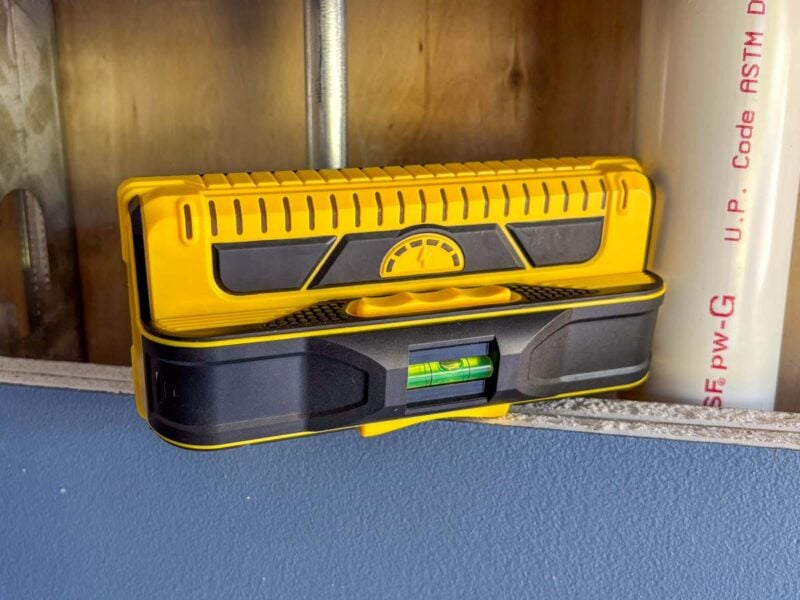
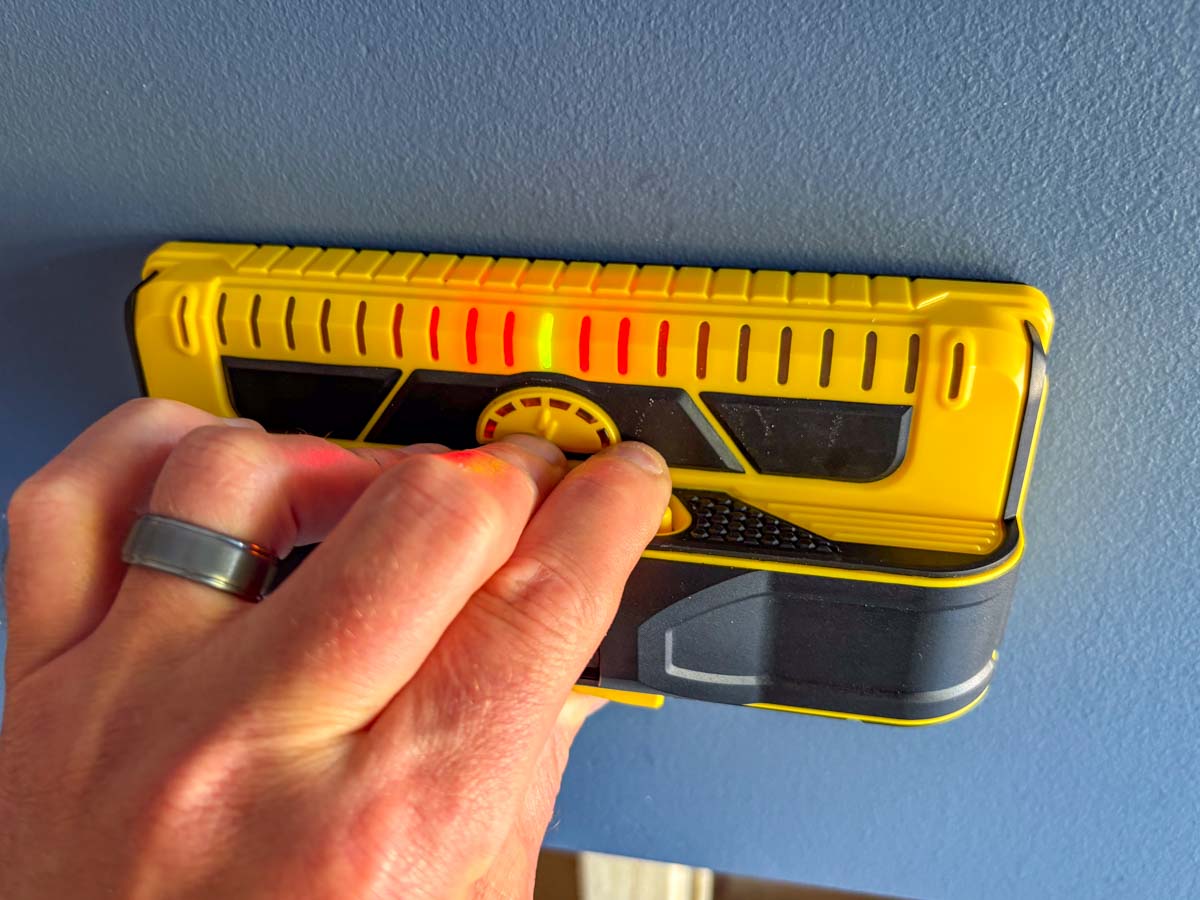
Franklin M210/X2100
- Sensors: 13
- Detection Depth: 1.7 inches
- Display Width: 7 inches
- AC Detection: Yes
- Power Source: 2 x AA battery
- Price: $59.99
Highlighted Features
- Center Indicator: Middle light turns green to indicate the center
- Whole Stud Detection: LEDs bracket the full stud width so you can see the center and edges
- No Calibration Required: You can start detecting anywhere, even over a stud
- Pencil Holder: No need to hold it in your mouth while you detect studs
- Bubble Level: Ensures you can make a level mark across the stud
Pros
- Excellent single-layer drywall detection
- Best detection performance in plaster
- Most consistent AC detection in our tests
- Made in the USA
Cons
- A bit inconsistent on double-layer drywall
- High number of false positives on non-stud materials
- Bulky size
If we’d have bet before we started testing, I would have put money on the Franklin M210/X2100 and its 13 sensors as the favorite. While it didn’t land as the best overall for Tom or me, it definitely is worth considering.
The biggest issue was the number of false positive stud indications. Many stud finders will show you that something is behind the wall that’s not a stud. That’s helpful, even if you don’t know exactly what it is. But we were getting centered stud detections, and that’s not what you want when it’s actually your water line back there.
As the material got thicker, the false positive rate dropped. In the double-layer drywall and plaster, the only one it tripped on was the EMT with live AC running.
Detection in plaster is where the M210 absolutely rocked. Its stud and AC detection was perfect in my tests, though Tom didn’t have as much success. The only chink in its armor was the aforementioned false positives over the EMT.
The size is something you should consider as well. It’s not as easy to manage with one hand as the others I tested. However, if you’re dealing with plaster and lath, it’s worth the extra effort.
* Note: The M210 and the X2100 are essentially the same. The M210 is sold at Home Depot and Amazon, and the X2100 is sold at Lowe’s.
Other Stud Finders We Tested
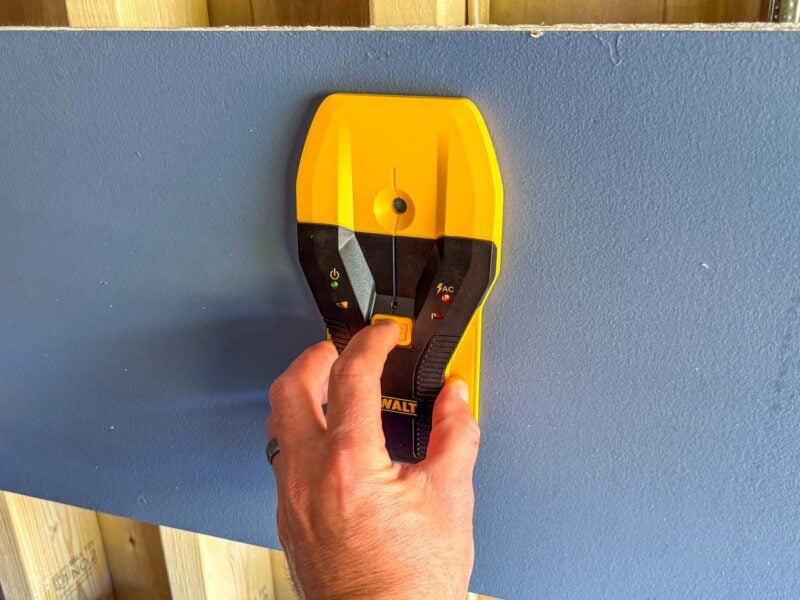
DeWalt DW0150
- Sensors: Not listed
- Detection Depth: 1.5 inches
- Display Width: ~ 1/8 inches
- AC Detection: Yes
- Power Source: 2 x AAA battery
- Price: $31.99
Highlighted Features
- Constant Calibration: Automatically calibrates as you work, even if you start over a stud
- Center Detection: Indicates when you reach the center of a stud, even at an angle
- Directional Arrows: Guide you toward the stud center
- Center Marking Channel: Makes marking the center easier
- Slim Profile: Stores easily in shallow drawers
Pros
- Very good detection on single-layer drywall detection
- Decent detection on plaster
- Excellent AC detection
- Good ergonomics
Cons
- Doesn’t show stud edges or whole stud
- Inconsistent on double-layer drywall
- High number of false positives on non-stud materials
DeWalt shook things up a bit when it launched a uniquely shaped stud finder. We were skeptical at the time, but once we got our hands on them, we really liked the ergonomics and ability to glide easily across walls.
From a performance standpoint, DeWalt has a couple of things going for it. For one, its AC detection was better than the rest, and it started picking it up from further away. It also did a fine job on plaster, and Tom preferred this model for that over the Franklin M210 that was my plaster pick.
Like some of the others, the double-layer drywall presented a challenge, and I picked up a higher rate of stud false positives than most of the group. However, with good technique (I’ll share some tips below) and a little patience, this is certainly a solid choice.
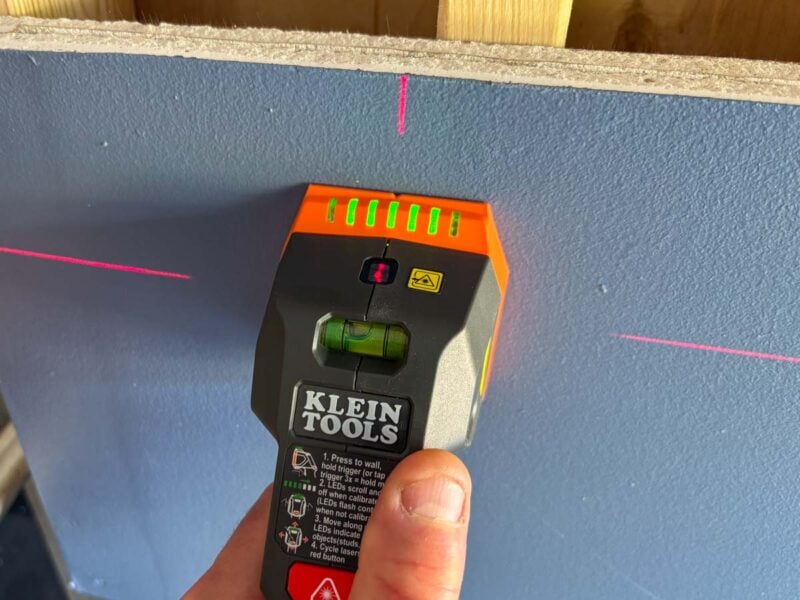
Klein ESF150LL
- Sensors: Not listed
- Detection Depth: 1.5 inches
- Display Width: ~ 2 inches
- AC Detection: No
- Power Source: 2 x AA battery
- Price: $64.99
Highlighted Features
- Integrated Cross Line Laser: Makes marking above, below, or to either side of the stud easier
- Whole Stud Detection: LEDs bracket the full stud width so you can see the center and edges
- Ergonomics Pistol Grip: More comfortable for your hands than traditional designs
- Bubble Level: Ensures you can make a level mark across the stud
Pros
- Comfortable grip
- No false positive hits on PVC, EMT, or copper pipe
Cons
- Inconsistent center finding
- High stud miss rate
- No AC detection
This was a rough test for Klein, as both Tom and I had highly inconsistent results across all three of our wall setups. Its unusual, yet comfortable design may play a part in that.
I dug deeper after a disappointing set of initial results. It seems that whenever you lift part of the sensor pad up, it throws off the calibration. I also noticed that when I pressed in more firmly along the top edge, it seemed to be more consistent. However, the pistol grip makes it easy to lift the pad slightly, especially on textured walls.
There are some genuinely good things about the design, but unfortunately, I can’t recommend this model with how much trouble we had getting good readings. That’s totally uncharacteristic for Klein, though. Their meters are typically rock solid, and our crew relies heavily on their voltage testers and multimeters.
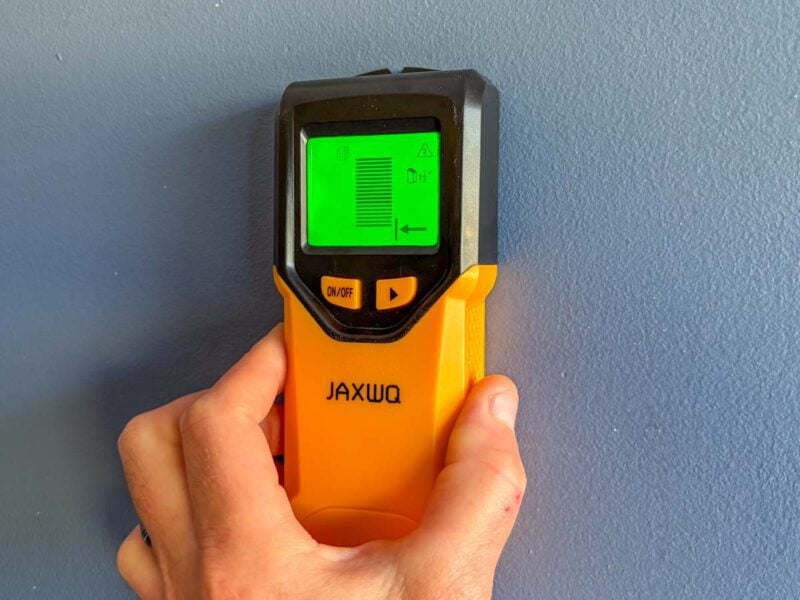
JAXWQ 139-FYELLOW
- Sensors: Not listed
- Detection Depth: 1.5 inches
- Display Width: ~ 1.5 inches
- AC Detection: Yes
- Power Source: 1 x 9V battery
- Price: $19.99
Highlighted Features
- Multiple Scanning Modes: Shallow, deep, and metal modes to match the wall conditions
- Center Indicator: Clearly indicate when you find the stud center
- Edge Sensing: See where the stud edges are
- Backlit LED Screen: Offers more comprehensive information than LED lights alone
- V-Groove: Makes marking the center easier
Pros
- Easy screen to read
- Good single-layer drywall detection
- Decent detection on plaster
- Solid AC detection
Cons
- Struggled on double-layer drywall
- Elevated number of false positives on non-stud materials
JAXWQ (how did they come up with that name?) was the #1 stud finder on Amazon when we built our list, and frankly, it was surprisingly effective. In terms of style, it mimics several design elements of the Zircon D70, but is less refined.
It’s a little quirky, having three depth modes plus a metal-specific mode. It also diverts from the norm of holding down a button to simply pressing once and letting go while the unit continues working.
Shifting to actual performance, it did a genuinely good job on the single-layer drywall and kept up with some of the name brands on plaster. Like most of the others, its performance dropped a bit on the double-layer drywall, but it actually matched DeWalt’s success rates on those tests.
The brightest spot is AC detection. It had the second-highest success rate there, second only to Franklin’s M210. However, it also tied for the second-highest stud false positive rate, so take that into consideration.
More Stud Finder Reviews
- Franklin T13 Stud Finder Review
- Ryobi Whole Stud Detector Review
- Franklin Prosensor T6 Stud Finder Review
- StudPop Magnetic Stud Finder Review
How We Test Stud Finders
The Rig
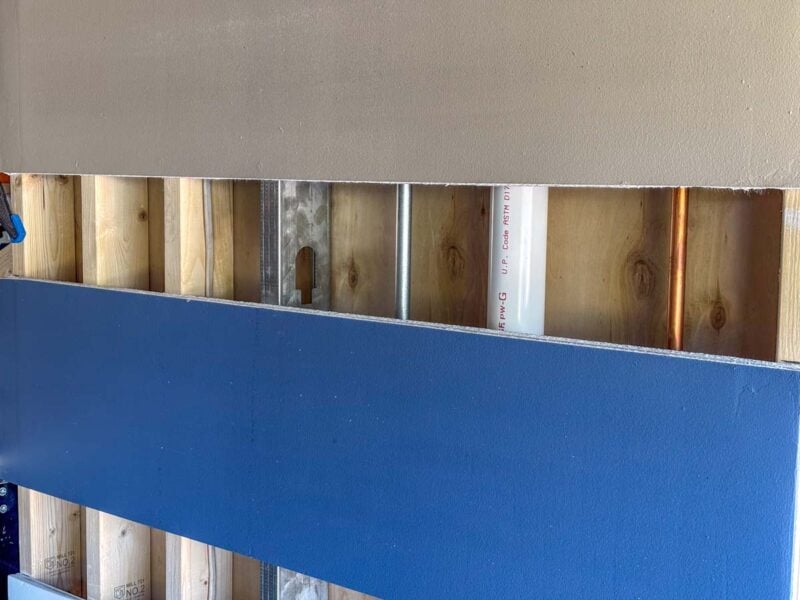
We designed and built a mock wall specifically for the purpose of testing stud finders. There are three sections:
- Single-layer Drywall: Mimics a typical residential setting
- Double-layer Drywall: Often used for sound dampening and/or firewall
- Plaster and Lath: Found in older homes and notoriously difficult for stud finder accuracy
Between each section, there’s a gap so we can see exactly where the studs are and how accurately the stud finder identifies them.
We not only want to see how well our stud finders detect studs, but we also want to see how they react to other objects behind the wall. So, we set up a series of six objects in our rig:
- 2×4 Pine Stud: The most basic and common stud for residential buildings
- 2×4 Pine Stud w/ Live AC: Helps us see how accurately stud finders detect AC presence and whether it throws off their stud center-finding accuracy
- Metal Stud: Common in the design of commercial buildings
- EMT w/ Live AC: Helps us see how accurately stud finders detect AC presence and whether it falsely indicates a metal stud
- PVC Pipe: Helps us see whether stud finders falsely indicate a stud around common plumbing pipes
- Copper Pipe Filled w/ Water: Helps us see whether stud finders falsely indicate a stud around common water lines
The Method
Once properly calibrated, we give each stud finder five opportunities to locate studs, their centers, and see how they react to EMT, PVC, and copper pipe.
As we do on real-world applications, we swipe to find the stud, and then continue moving left and right until the stud finder indicates the center. After each run, we start from the opposite side and adjust the vertical position in that section.
Once the first section is complete, we move to the second, and then the third.
Results
Interpreting the results:
- On-Center Detection: The percentage of times the center was successfully detected
- Off-Center Detection: The percentage of times the edge was indicated as the center
- Missed Stud: The percentage of times a center was not indicated
- AC Detection: The percentage of times AC was successfully detected
- False Stud Detection: The percentage of times the EMT, PVC, or copper pipe was indicated as a stud center
Note: Many stud finders indicate the presence of something behind the wall by lighting up their LEDs or screen graphs, but won’t settle in and indicate a center. We only consider it a false positive when it indicates a stud center.
Single-Layer Drywall
| On-Center Detection | Off-Center Detection | Missed Stud | |
|---|---|---|---|
| DeWalt | 87% | 7% | 7% |
| Franklin M70 | 100% | 0% | 0% |
| Franklin M210 | 93% | 7% | 0% |
| JAXWQ | 67% | 27% | 7% |
| Klein | 33% | 13% | 53% |
| Zircon | 53% | 40% | 7% |
| AC Detection | False Stud Detection | |
|---|---|---|
| DeWalt | 70% | 67% |
| Franklin M70 | Not Applicable | 0% |
| Franklin M210 | 100% | 67% |
| JAXWQ | 100% | 33% |
| Klein | Not Applicable | 0% |
| Zircon | 0% | 0% |
Double-Layer Drywall
| On-Center Detection | Off-Center Detection | Missed Stud | |
|---|---|---|---|
| DeWalt | 33% | 27% | 40% |
| Franklin M70 | 67% | 33% | 0% |
| Franklin M210 | 53% | 20% | 27% |
| JAXWQ | 33% | 27% | 40% |
| Klein | 13% | 13% | 73% |
| Zircon | 0% | 27% | 73% |
| AC Detection | False Stud Detection | |
|---|---|---|
| DeWalt | 100% | 53% |
| Franklin M70 | Not Applicable | 20% |
| Franklin M210 | 60% | 33% |
| JAXWQ | 100% | 67% |
| Klein | Not Applicable | 0% |
| Zircon | 0% | 33% |
Plaster and Lath
| On-Center Detection | Off-Center Detection | Missed Stud | |
|---|---|---|---|
| DeWalt | 67% | 7% | 27% |
| Franklin M70 | 67% | 33% | 0% |
| Franklin M210 | 100% | 0% | 0% |
| JAXWQ | 60% | 33% | 7% |
| Klein | 0% | 7% | 93% |
| Zircon | 67% | 27% | 7% |
| AC Detection | False Stud Detection | |
|---|---|---|
| DeWalt | 50% | 33% |
| Franklin M70 | Not Applicable | 0% |
| Franklin M210 | 100% | 33% |
| JAXWQ | 50% | 33% |
| Klein | Not Applicable | 0% |
| Zircon | 50% | 47% |
Total Accuracy (All Three Sections Combined)
| On-Center Detection | Off-Center Detection | Missed Stud | |
|---|---|---|---|
| DeWalt | 62% | 13% | 24% |
| Franklin M70 | 78% | 22% | 0% |
| Franklin M210 | 82% | 9% | 9% |
| JAXWQ | 53% | 29% | 18% |
| Klein | 16% | 11% | 73% |
| Zircon | 40% | 31% | 29% |
| AC Detection | False Stud Detection | |
|---|---|---|
| DeWalt | 73% | 51% |
| Franklin M70 | Not Applicable | 7% |
| Franklin M210 | 87% | 44% |
| JAXWQ | 83% | 44% |
| Klein | Not Applicable | 0% |
| Zircon | 17% | 27% |
Tips for Using a Stud Finder
- Make sure you know if your model needs calibration and how to do it.
- Keep your stud finder flat against the wall while you’re detecting.
- Keep your hands off of the wall to avoid interference.
- Mark your position from several directions to ensure the best accuracy. Use a piece of painter’s tape on the wall if you want to avoid marking directly on the paint.
- Combine a stud finder with a cross-line laser to mark the entire length of the stud or to hit the same height across multiple studs.
- Stud finders also work great on the ceiling for finding joists.
- Studs are typically 16 inches apart (walls) and occasionally 24 inches (ceilings). If you’re having trouble finding one, get a good reading on another part of the wall and measure over.
- Keep an extra set of batteries in your toolbox for electronic stud finders.
When a Stud Finder Isn’t Accurate Enough
There are other types of tools designed to detect objects beneath the surface of a wall. Advancing beyond the types of stud finders we recommend, you encounter wall scanners. These radar-like tools are more often used by professionals to “see” what’s behind the wall beyond just studs.
When you need to be 100% sure whether you’re seeing a stud, plumbing, conduit, or other objects in the wall cavity, wall scanners are the way to go. They’re significantly more expensive than stud finders, but they help prevent far more costly accidents.
A Note About Stud Finder Apps
With the evolution of technology, you can find stud finding apps for both iPhone and Android smartphones. They use the phone’s magnetometer (the sensor that drives the compass) to detect metal nails or screws behind the drywall. Presumably, those nails or screws will be in the middle of that stud you’re attempting to locate. In our experience, they’re not accurate enough to rely on.
Related Content
Why You Can Trust Pro Tool Reviews
Ever check out a “review” site and you can’t tell if they actually tested the tools or if they’re just “recommending” the Amazon top sellers? That’s not us. We won’t recommend anything unless we’d use it ourselves, and we don’t care who the primary retailer is. It’s all about giving you a legitimate recommendation and our honest opinion of each product.
We’ve been in business since 2008 covering tools, writing reviews, and reporting on industry news in the construction and lawn care industries. Our Pro reviewers work in the trades and have the skills and experience to know whether tools can perform well in the field.
Each year, we bring in and review more than 250 individual products. Our team will put its hands on hundreds of additional tools at media events and trade shows throughout the year.
We consult with innovators in the technology and design of tools to gain a broader grasp of where these products fit and how they work.
We work with professional contractors who review products for us on real job sites and consult with us on testing methods, categories, and weighting.
We’ll provide more than 500 pieces of new content this year absolutely free for our readers—including objective evaluations of individual tools and products.
The result is information you can trust because of the editorial, scientific, and real-world professional experience we collectively utilize each and every time we pick up and test a tool.


What do you recommend for plaster on metal lathing, roughly 1-1/4″ thick?
That’s really thick and is going to be a tough ask for any stud finder. Based on what I saw in our tests, the more sensors, the better. I’d start with the Franklin M210, especially if you can borrow one or return it if it doesn’t pick up well enough. The Franklin Prosensor Max might be the better way to go, though. It has the same number of sensors as the M210, but they’re stronger. The downside is that it’s quite a bit more expensive (~$120).
I have the Franklin X995, and it has by far been the best stud finder I’ve ever used. I was never too sure about using a stud finder because they were usually all over the place but I took a chance on the Franklin.
It has helped me on so many jobs It’s unbelievable. I have even used it on ceilings with 5/8 drywall to find the rafters spacing and it has been extremely accurate. I would highly recommend the x995 as it also has AC detection, and you’ll save a few bucks from buying the x2100 if you don’t need the extra bells and whistles.