
Cordless ratchets have become a staple for automotive techs and mechanics, but meaningful innovation in this category doesn’t come around very often. With the 20V Max Sealed Head Ratchet, DeWalt is looking to change that by pairing competitive performance with a handful of thoughtful design upgrades to improve versatility and durability.
We got some hands-on time with this ratchet to see how it stacks up against the competition and whether those features make a noticeable difference in everyday use. Here’s what we learned.
Pros
- Excellent power level
- Comfortable ergonomics
- Reduced maintenance
- Interchangeable anvils
- Large directional lever
Cons
- Large head profile
DeWalt 20V Max XR Sealed Head Ratchet Performance
Speed and Power
At its heart, the DeWalt DCF510 sports a brushless motor with top speed of 300 RPMs and churns out 75 ft-lbs of torque. This is slightly faster and stronger than DeWalt’s standard 20V Max Atomic DCF513, which tops out at 250 RPMs and 70 ft-lbs of torque. These specs make the DCF510 a serious contender in terms of power among other cordless ratchets on the market.
This is a great power level for tightening and loosening nuts, bolts, and seized fasteners. Like other cordless ratchets, you can always turn them manually when the motor’s power isn’t enough to initially break more stubborn bolts.
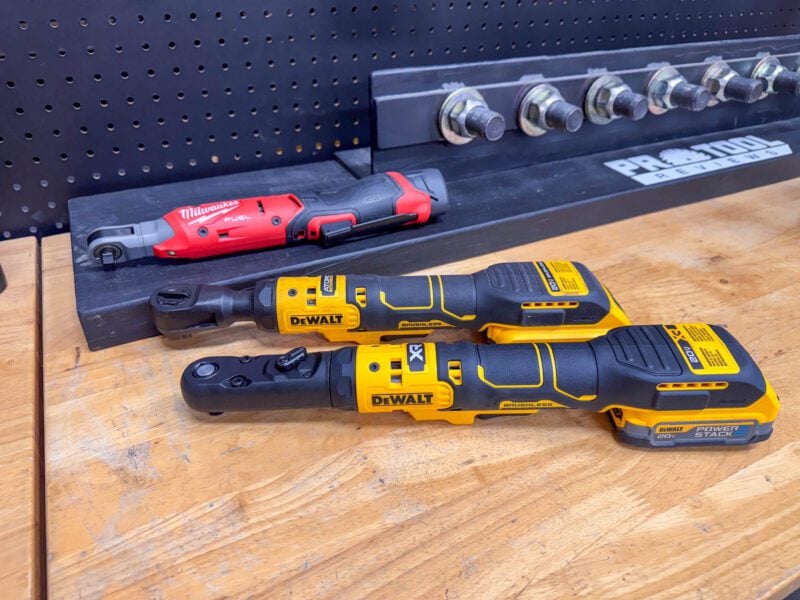
Here’s a quick look at how this ratchet compares to other models on the market:
| DeWalt DCF510 | DeWalt DCF513 | Milwaukee 3054 | |
|---|---|---|---|
| No-Load Speed | 300 RPM | 250 RPM | 300 RPM |
| Max Torque | 75 ft-lbs | 70 ft-lbs | 80 ft-lbs |
| Kit Tool Price | $379 | $309 | $329 |
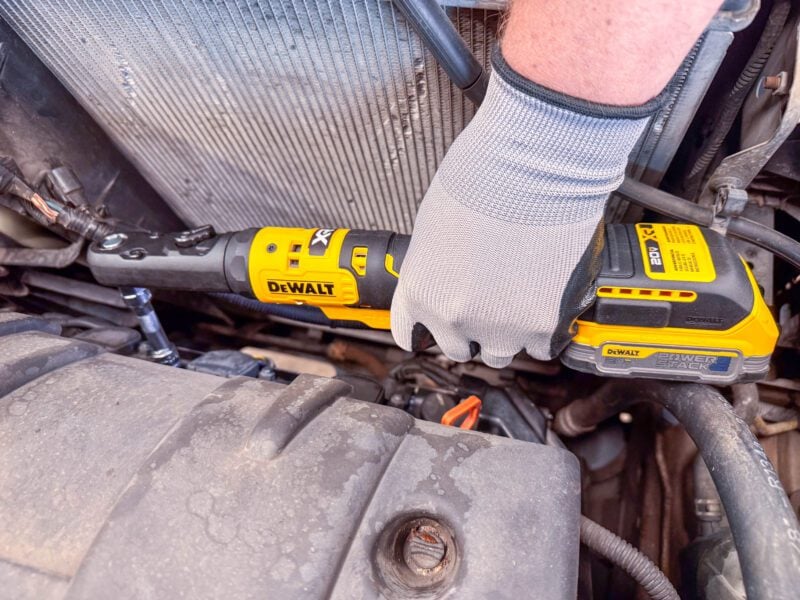
To me, the speed and power are exactly where I want them for longer fasteners, and the variable-speed trigger offers plenty of control and finesse when working under the hood. There’s also a trigger lock to prevent accidental activation during manual operation.
Hand-On Impressions
To get a feel for this ratchet’s true power level, I turned to our bolt-break rig, which consists of eight 1 1/2-inch semi-truck lug nuts. Normally, we torque these nuts down to 500 ft-lbs when testing high-powered impact tools, but in this case, I snugged them down to 55 ft-lbs. I believe this is well within reach for the DCF510, but for comparison, I broke out the Milwaukee 3053, which tops out at 70 ft-lbs.
Interestingly, the 3053 was only able to break 2 out of 8 nuts using the motor, while the DCF510 efficiently broke the rest without issue. I found this a little peculiar since these ratchets are so close in power levels. I guess DeWalt’s extra 5 ft-lbs of torque gave it the competitive edge in this situation.
As I mentioned earlier, you can always break the nuts and bolts manually, like a regular ratchet, and then advance them with the motor. Conversely, you can tighten your nuts and bolts with the motor, and then snug them down manually.
DeWalt 20V Max XR Sealed Head Ratchet Design Notes
Size and Weight
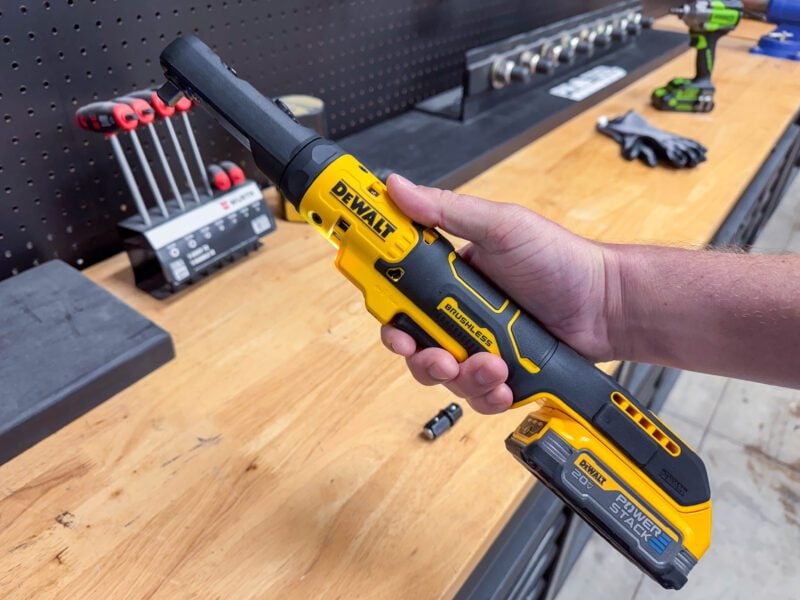
The DeWalt DCF510 weighs 2.6 pounds as a bare tool, 3.3 pounds with the recommended battery, and measures 15 inches from tip to tail. These specs are fairly similar to what we’ve seen from DeWalt’s prior cordless ratchets. Overall, the design is well-balanced and easy to maneuver, even with a larger 5.0Ah battery. However, the smaller 1.7Ah PowerStack battery that comes in the kit shaves some weight and size, both of which are helpful when you’re on your back reaching up into an engine bay.
I especially appreciate the grippy rubber overmolding. This inspires a lot of confidence, especially if your hands are greasy or you’re working in a cramped engine bay.
There is one downside to this design, though. Our 3/8-inch and 1/2-inch go-to ratchets from our Sonic Tools S9 Toolbox measure 1.1 and 1.5 inches deep, respectively. Like most cordless ratchets we’ve tested, the access is a little more restrictive on the DCF510, measuring 1.5 inches deep with the 3/8-inch anvil and 1.7 inches deep with the 1/2-inch.
There are obviously advantages to using a cordless ratchet, but if space is a limiting factor, you may still need to reach for a manual ratchet occasionally. However, if your engine bay has ample room, I say pull the trigger.
Interchangeable Anvil
The coolest design element of this ratchet is the interchangeable anvil. You can quickly go from a 3/8-inch drive to a 1/2-inch drive in a matter of seconds, and it’s all tool-free. These anvils feature a hex design with a pin detent that holds them firmly in place within the ratchet head.
When you want to swap them out, simply press the silver button on the back of the anvil to eject it from the ratchet head. This button releases the internal pin detent, allowing you to remove the anvil.
Sealed Head
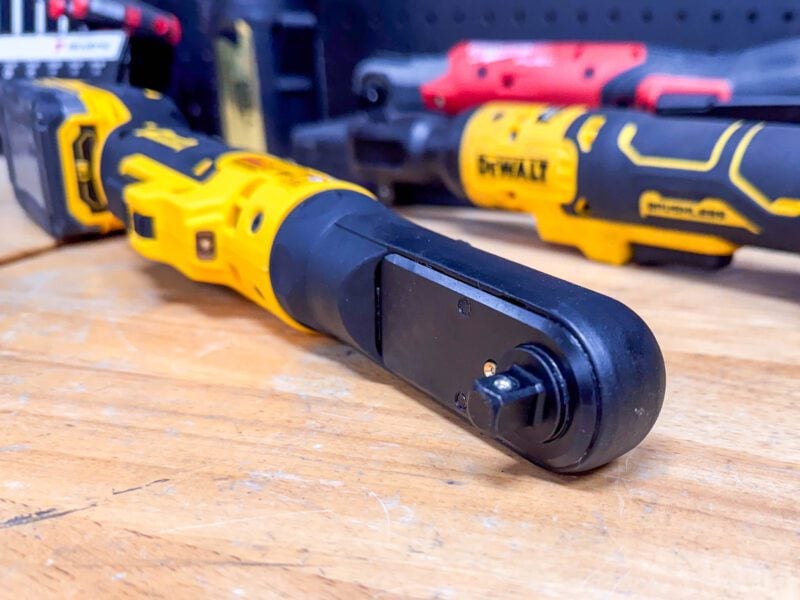
One standout feature on the DeWalt DCF510 is its sealed-head design, which provides added protection in harsh environments. By sealing the ratcheting mechanism, dirt, dust, debris, and grease can’t work their way into the head, helping protect the vital internal components. This is particularly useful for automotive and mechanical applications, where tools are more likely to encounter grime and debris.
Of course, no tool is completely maintenance-free, but this design helps limit exposure to contaminants and helps extend the tool’s overall service life. In practical terms, the DCF510’s sealed head provides automotive Pros with added durability and peace of mind, particularly for those who regularly use their tools in dirty, demanding environments.
Additional Features
- LED Work Light: Illuminates your work area.
- Oversized Forward/Reverse Controls: Change the rotation direction even with greasy or gloved hands with the flick of a lever
DeWalt 20V Max XR Sealed Head Ratchet Price
The DeWalt DCF510 sealed head ratchet retails for $279 as a bare tool and $379 as a kit. The kit includes an oil-resistant 1.7Ah PowerStack battery, a charger, and a soft storage bag.
DeWalt backs this ratchet with a 3-year limited warranty, 1-year of free service, and a 90-day money-back guarantee.
Should You Buy It?
The DeWalt DCF510 is a compelling option for Pros who want the convenience of a cordless ratchet without having to buy two tools to cover both 3/8-inch and 1/2-inch ratchets. Not to mention that it has enough speed and power to tackle the majority of the common tasks you’ll likely encounter in an automotive shop setting. On top of that, the sealed head design is another welcome touch for Pros who regularly work in dirty environments.
The biggest question is whether that versatility is worth the added size and $379 kit price. The DCF510’s head is noticeably bulky compared to a traditional manual ratchet, and there are situations where that extra width can complicate the situation, especially in tight spaces. But if you have room to work and want one cordless ratchet that can handle both 3/8-inch and 1/2-inch tasks, the DCF510 makes a strong case for itself.
For automotive Pros and serious DIYers already invested in DeWalt’s 20V battery platform, I’d say pull the trigger. Just make sure you keep a set of manual ratchets on hand if access becomes an issue.
Specs
- Model: DeWalt DCF510
- Power Source: DeWalt 20V battery
- No-Load Speed: 300 RPM
- Max Torque: 75 ft-lbs
- Anvil: 3/8 in. and 1/2 in.
- Weight: 2.6 lbs (bare tool), 3.3 lbs (with 1.7Ah PowerStack battery)
- Tool Length: 15 in.