
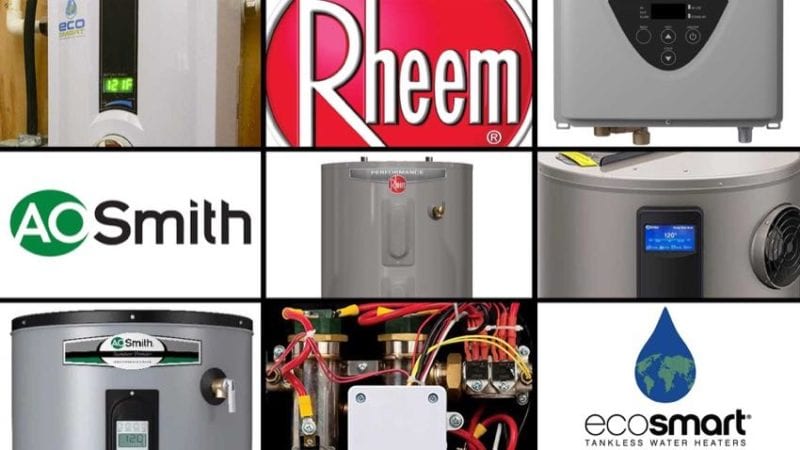
There are many different types of water heaters on the market. Knowing how to get the best water heater for your home isn’t easy. It requires knowing the strengths and weaknesses of each type and technology. Couple this with the presence of local and national rebates on energy savings and the decision to replace a water heater with a newer or different technology becomes a tad more difficult than just deciding on electric or gas.
The newest “fad” (if we can call it that) is to install a tankless water heating system that provides on-demand hot water to either a whole house or a local tap or appliance. However, as we’ll show you—that’s not always the best water heater choice. Analyzing the pros and cons of each technology will help you make the right decision. We also recommend specific products and lines based on our experience and knowledge of the products & technology, manufacturers, reputations, and their warranties.
Best Water Heaters by Type
We can make some recommendations for each of the different types of water heating systems. The best water heater should meet your needs and also match the requirements of your home. For this article, we plan to stick with water heaters intended for use in residential homes. These include electric and gas models in both tank and tankless styles. It also includes hybrid electric or heat pump styles.
After our recommendations, we’ll go over the Pros and Cons of each type of water heater as well to help you decide the best water heater for installation or replacement in your home. This may also help you decide whether to change from one style or power source to another.
Best Electric Water Heater (Tank Style)
Rheem 50-gallon Performance Series (WITHOUT Demand Response)
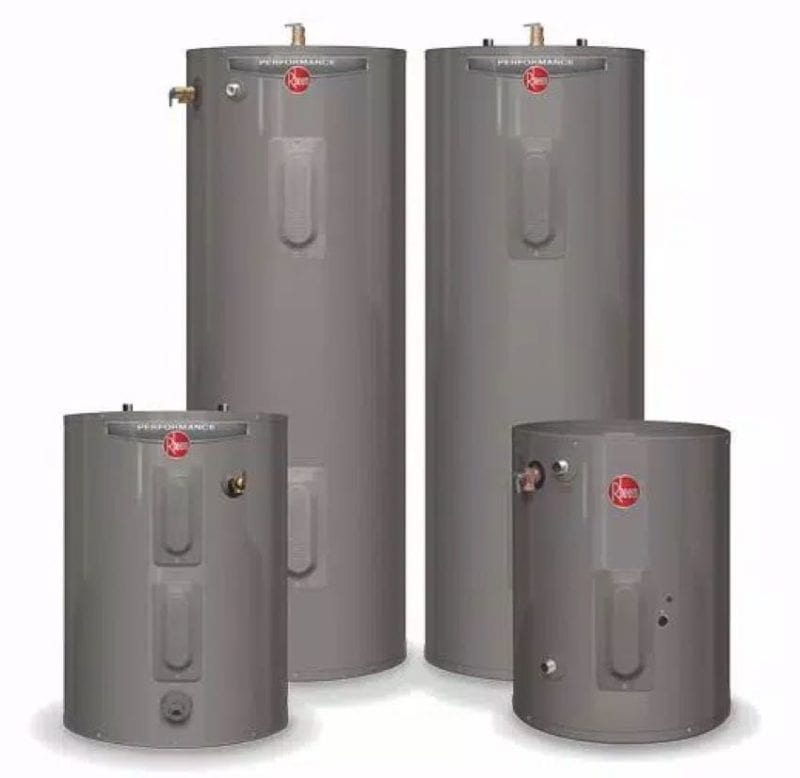
The Rheem Performance electric tank water heaters come in sizes ranging from 20 to 60 gallons. They also have tall and medium and short models. They feature a .92 – .93 Uniform Energy Factor (UEF). These models don’t complicate things with any fancy electronics or “Smart” systems. That keeps costs down—it also lets you heat your water without subjecting yourself to the whims of your power company to shut down your electronics. The Rheem Demand Response system does just that. Connecting to the power grid, it lets your electric company temporarily turn off your water heater during peak times.
A typical 50-gallon tank might run just $519. That 50-gallon tank delivers 61 gallons of hot water in the first hour. You also get a 6-year limited warranty.
Of course, if you want those fancy features (we don’t), you can certainly bump up to their Performance Plus, Platinum, or Gladiator lines. In addition to offering Demand Response technology, these can include WiFi functionality and app control. This lets you do more with your water heater…but do you really want more things that can break?
Best Gas Water Heater (Tank Style)
A.O. Smith Signature 50-gallon Tall
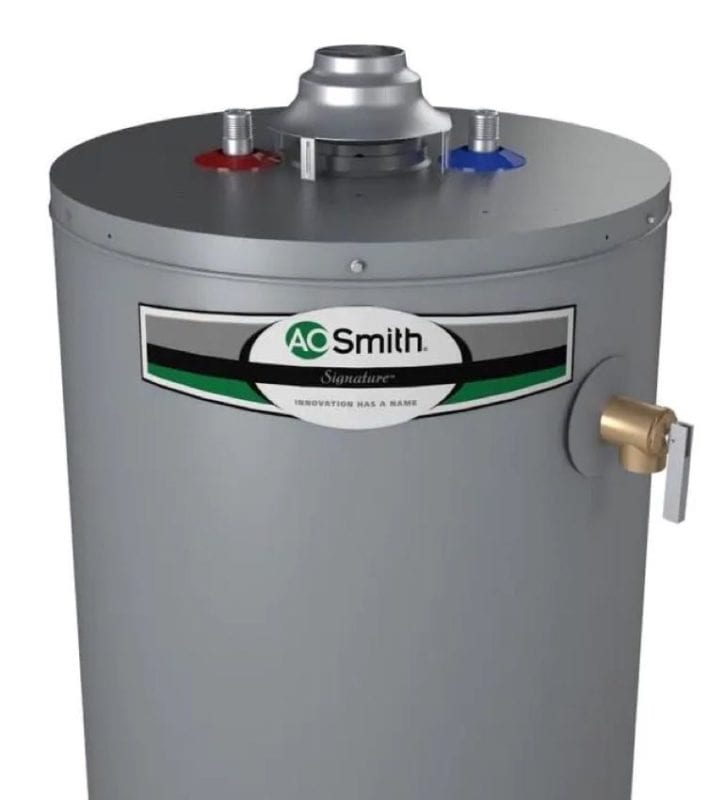
We consider the A. O. Smith Signature 50-gallon tall model our best gas water heater. It works very well for households with 5 or more people and puts out 50,000 BTUs. It delivers an astounding 81 gallons (or more) of hot water in the first hour. It also features an electronic gas valve for precise temperature control. The control also works without the need for an external power source.
While not a smart water heater, the AO Smith Signature 50-gallon model gives you a small LED status indicator for diagnostics reporting. A push-button ignition simplifies the initial startup process. We especially like the ceramic-fused tank shield that reduces corrosion, as well as the self-cleaning dip tube that reduces sediment build-up.
Finally, you get a 6-year limited warranty for peace of mind. Of course, A.O. Smith makes these in sizes ranging from 30 to 98 gallons. You can also find many sizes in both short and tall configurations.
For a “smarter” water heater, you can bump up to the Signature Premier line that offers vacation timers and automatic “usage-based” settings.
Best Hybrid Electric Heat Pump Water Heater
A. O. Smith Signature Hybrid Water Heater
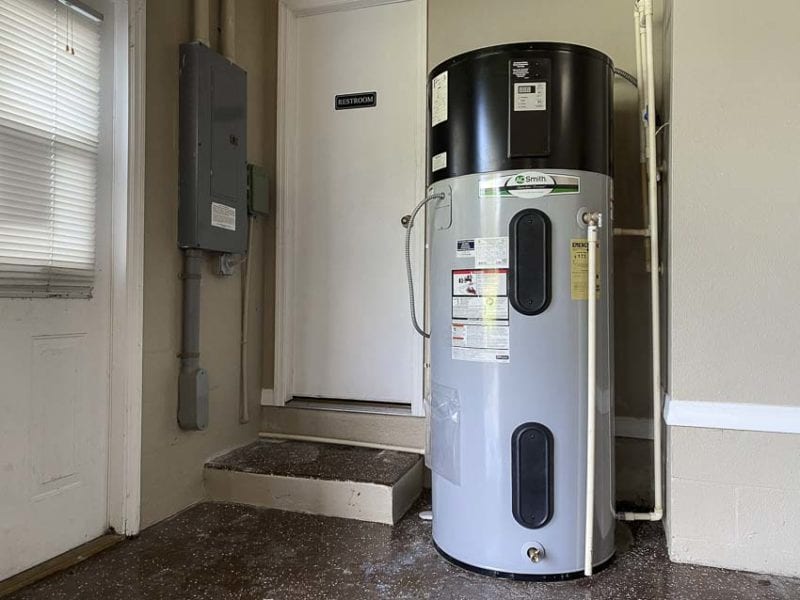
The sort of “Cadillac” of water heaters might be the hybrid electric heat pump model. The A. O. Smith Signature Electric Water Heater with Hybrid Heat Pump is a smart and efficient model. The hybrid heat pump design makes it 4X more efficient than even the best electric water heater. It saves enough money that—by the numbers— it should pay for itself in just 2-3 years. Over 10 years, the energy savings could top $4,500.
This water heater lacks built-in WiFi. Instead, it features a simple front-mounted control system to set it in Efficiency, Hybrid, Electric, or Vacation mode. We like that in a water heater—there’s less to break and worry about. For anyone in Washington or Oregon, these heaters also include Demand Response technology.
With this water heater, you get a 10-year limited warranty for peace of mind.
Best Gas Tankless Water Heater
Rinnai V75IN Indoor Tankless Water Heater
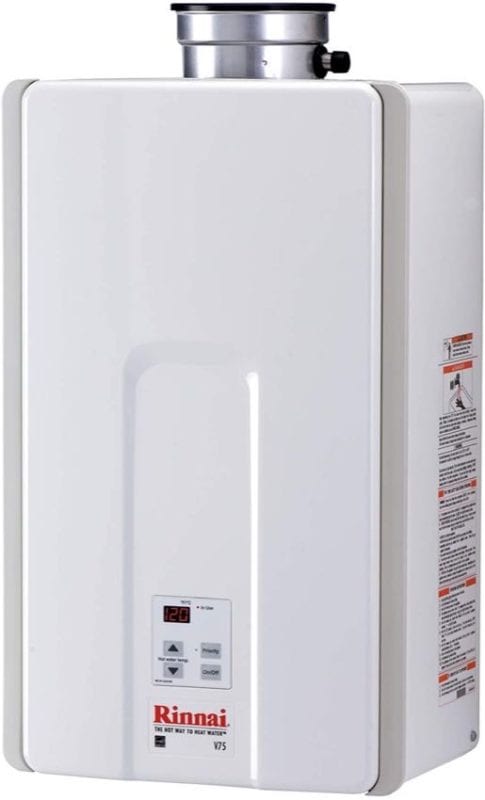
Rinnai has been a go-to brand for tankless water heaters for as long as I can remember. When it comes to tankless, we prefer indoor units when possible and I try to recommend at least 7.5 GPM on gas models. That’s sure to supply plenty of water for a family of 4-5—even when you have clothes in the washer and a dishwasher or shower running.
What we love about this system is its simplicity coupled with an excellent 10-year factory warranty on the heat exchanger. A Control-R 2.0 mobile app lets you set timers and schedules throughout the day as well as engage a vacation mode when you go away.
In addition to the 120-month heat exchanger warranty, you get 12 months of labor coverage and 60 months on parts.
If you need an outdoor unit, we recommend the Rinnai V75EN, which has the same 7.5 GPM flow rate but features an outdoor-rated venting system.
Best Electric Tankless Water Heater
EcoSmart Tankless Water Heaters
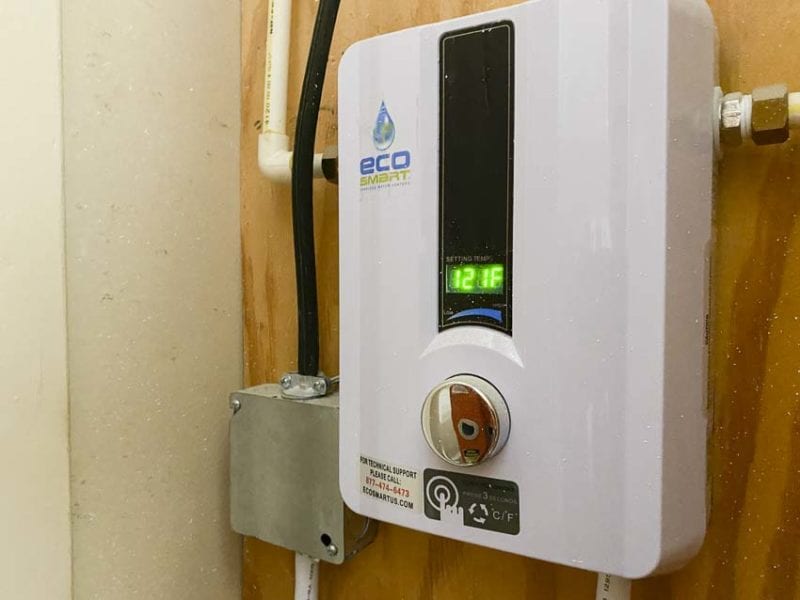
When we turn to electric tankless water heaters, we typically look for smaller units designed as point-of-use solutions. In our own Pro Tool Reviews Shop, we use an EcoSmart ECO 11 unit for the bathroom. This lets us get between 1.3 and 3.1 GPM, depending on the inlet water temperature. Since we live in Florida, the flow leans towards the highest end of the scale.
You can certainly buy whole-home electric tankless water heaters; however, they require several high-current breakers. This makes them difficult to retrofit into existing homes. Newer electric tank heaters have become so much more efficient over the years that electric tankless water heaters don’t always make fiscal or logistical sense as an aftermarket solution.
EcoSmart makes 10 different tankless water heaters, so you can get any size needed. The smallest units do really well for supplying water to a single bathroom sink or breakroom faucet.
Within the continental US and Canada, EcoSmart offers a Limited Lifetime Warranty on the heat exchangers and electronics for residential heaters. On point-of-use products, they offer a 1-year warranty on exchangers and electronics. For their ECO Mini line, you get a 5-year warranty.
Repairing and Replacing Water Heaters – Incentives
If your hot water heater breaks, typically you would just replace it with a gas or electric equivalent of the same type (usually conventional). With the continuing government rebates, however, homeowners replacing hot water heaters can receive Energy Star rebates. The rebate must be used on an existing home and your principal residence. It works as follows:
- Purchase a qualifying gas, oil, or propane water heater and get a $300 tax credit. This tankless system must have an Energy Factor >= 0.82 or a thermal efficiency of at least 90%. Currently, all Energy Star-compliant tankless water heaters qualify.
- Purchase a qualifying electric heat pump water heater and get a $300 tax credit. This system must have a Uniform Energy Factor (UEF) >= 2.2. Most ENERGY STAR-certified water heaters meet the requirements of this tax credit.
Pros and Cons of Electric Tank Water Heaters
Tank water heaters make hot water by heating the water in a large insulated tank. These units can typically heat 40-50 gallons. You can also find models designed for larger homes that heat up to 80 gallons of water or more. Commercial units go up to 120 gallons or larger. Electric water heaters use one or more heating elements and include a thermostat to control the temperature of water in the tank. We recommend pairing even the best electric water heaters with an external timer to save costs.
The exception to this, of course, are models that have electronic controls which let you program the thermostat on the unit or via an app.
- Pros: Simple to replace, inexpensive compared to alternatives, good for warm or cold weather climates
- Cons: Often inefficient compared to tankless (especially gas), prone to periodic failure, limited hot water supply
Pros and Cons of Tankless Water Heaters
This type of water heater uses a heating element (heat exchanger) to heat the water instantly as it flows through the system. Unlike a tank-based system, the lack of standing water in a tank means that the heat isn’t lost over time (standby loss) as the hot water sits waiting to be used. These systems are fairly new and claim to be more energy-efficient since the water is only heated when needed (the system is “flow controlled” in that the heating only occurs when the hot water is activated and pulled through the system.)
We don’t recommend the electric type as much for retrofit as it involves running 60-80 amps of service to the water heater location and is less efficient than gas models. Also, most homes aren’t designed with a centralized location for the water supply. That means a tankless system can actually take longer to send water to your faucet, shower, or tub compared to a tank with a hot water recirculation system.
- Pros: Efficient, rebates available, never runs out of hot water
- Cons: Expensive, requires special installation, can take longer to heat water in remotest parts of the home
Should You Buy a Heat Pump Water Heater
This is a lesser-known type of water heating system that draws heat from the surrounding air to heat water in a tank. Because of the unique way in which it works, it is really only suitable for warmer climates and must be located in a larger space, like a utility room, garage, shop, or basement. They can be up to 3x more efficient than an electric water heater, and they cool and dehumidify the air in the room, making them desirable for warmer climates. A typical residential heat pump water heater can heat 15 gallons of water per hour by 80 degrees F, with a final storage temperature between 120 and 140 degrees F.
For the size, these hybrid models also heat water more quickly, and in greater volume, than simple electric water heaters.
- Pros: Efficient, cools room during warm periods, quicker heating and more volume for the same size tank
- Cons: Expensive, not suitable for colder climates, requires larger space, limited hot water supply
Considering a Solar Water Heater?
Want to be energy efficient to the extreme? Why not use the sun to heat your water? Solar water heaters can work in various ways and be applied to heating a home’s water, or just heat water for a swimming pool. Due to cloudy days and such, these systems rely on some kind of backup system (either tankless or conventional) to handle hot water production when the solar system is unable to deliver enough heat. An active solar heating system heats fluid by routing it through what’s known as a “flat plate collector” which in turn returns to the storage tank and heats the water. A passive system actually stores the tank (as part of a “batch collector”) on the roof or on the ground where it is heated directly by the sun.
- Pros: Makes you feel all warm and fuzzy for being green and having a low cost of operation
- Cons: Expensive, not as suitable for colder climates, requires complex installation, limited hot water supply
Check for Additional Rebates
It’s also important to check with your local gas and electric company for additional rebates. For example, your local gas provider might give you $450 if you replace a conventional gas water heater with a tankless system. With that being the case, your savings might look something like this:
- $1,200 (cost of tankless water heater) – $300 (tax credit) – $450 (local rebate) = $450
At that price, it’s almost ridiculous NOT to update and upgrade your hot water heater with something more efficient. Your ultimate decision will be up to you and the requirements of your home and water heating needs. Take a look at all of the options and take all of the potential tax savings into consideration before making a final decision.