
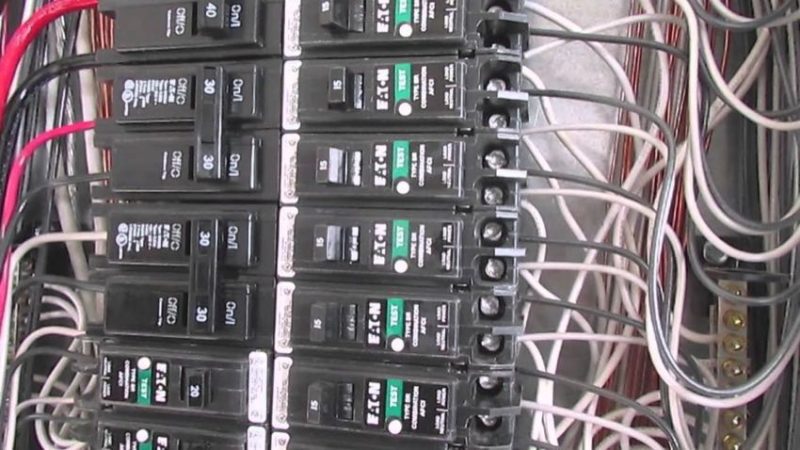
Arc fault circuit breakers (AFCI) may still seem new to homeowners who haven’t dealt with electrical codes in a while. They’re the result of research in the industry on how home fires start and what might prevent them. Some studies* reveal that electrical wiring issues account for over 150 home fires across the United States each day. An arc fault breaker differs from a GFCI outlet or circuit breaker in that it detects slow electrical leaks. A slow leak typically occurs when wiring is compromised but not completely shorted.
A good example of this would be when a nail punctures a wire behind a wall, and a small electrical current begins to build up heat. Another occurs when a wire nut loosens, and a small arc allows the temperature to build between the wire and nearby ground. This can even happen when an outlet or switch connection becomes loose.
Table of Contents
Why Were AFCI Circuit Breakers Created?
AFCI circuit breakers were originally designed in response to a U.S. Consumer Product Safety Commission report conducted by UL in the early 1990s. It identified a specific electrical problem in residential wiring systems that had caused a high number of residential fires. Less than 7 years later, AFCI protection became a requirement in the National Electrical Code (NEC) in 1999.
According to a 2017 National Fire Protection Association report, between 2010 and 2014, U.S. municipal fire departments responded to 45,210 home structure fires involving electrical failure or malfunction. These fires caused an average of 420 civilian deaths, 1370 injuries, and $1.4 billion in direct property damage per year.
Why Traditional Circuit Breakers Don’t Suffice
Since small arcs differ from huge amounts of electrical energy rapidly going to ground (as with a short), a typical circuit breaker will not detect the leak. You can think of arc faults as sparks or small amounts of electrical energy that generate heat but not a large amount of energy flow. Obviously, they can quickly consume nearby wood and plastic to create a fire.
The design of traditional circuit breakers doesn’t allow them to detect arc faults. They only trip when a lot of energy suddenly flows to ground or passes through the circuit due to a short. They also fail to extend protection to connected electrical cords or extension cords plugged into wall outlets.
How an Arc Fault Circuit Breaker Works
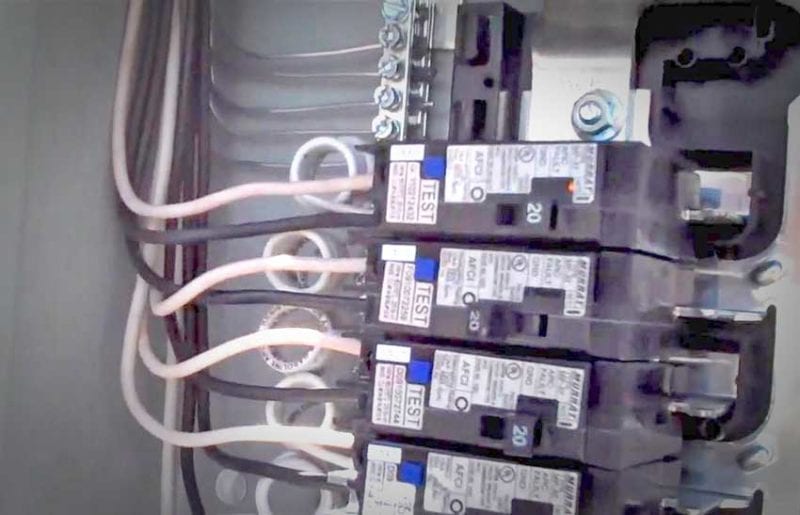
These new arc fault circuit interrupters function more like “smart” breakers. They actually contain small filters and logic devices. This lets them detect an arc before it produces the heat and sparking that can cause a fire. Once it does, it shuts down the circuit—instantaneously. Even a GFCI (Ground Fault Circuit Interrupter) doesn’t have the capability to sense arcs, so homeowners shouldn’t mistakenly add these, thinking that they will provide the same level of protection.
Interestingly, the technology has found success in upstream AFCI outlets like Leviton AFCI receptacles. These let you integrate AFCI technology after the breaker panel and also protect downstream outlets in a room or area.
Editor’s Note: Be sure to read our article on the Klein AFCI/GFCI outlet tester
Updates on NEC Requirements for AFCI Usage
As noted above, the new arc fault circuit breakers first showed up in section 210-12 of the 1999 edition of the NEC. As of 2002, the code required them in residential homes for any bedroom circuits. Bedrooms presented the main source for dangerous and life-threatening arcs according to research at the time. Some municipalities then took it one step further, requiring arc fault protection on all circuits that feed residential living areas.
As of January 2008, only “combination type” AFCIs meet the NEC requirement. The 2008 NEC requires the installation of combination-type AFCIs in all 15 and 20-amp residential circuits with the exception of laundries, kitchens, bathrooms, garages, and unfinished basements, though many of these require GFCI protection.
The 2014 NEC added kitchens and laundry rooms to the list of rooms requiring AFCI circuitry, as well as any devices (such as lighting) requiring protection.
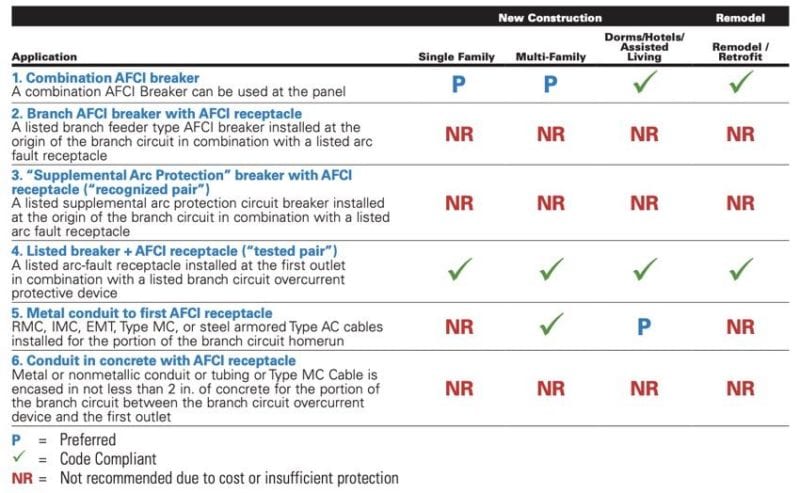
2008 and 2014 marked the most drastic NEC expansion on the usage of AFCIs. They are now required in virtually every living area. This includes bedrooms, family rooms, dining rooms, living rooms, sunrooms, kitchens, dens, hallways, laundry rooms, and more. The NEC also expanded the rules for arc fault circuit interrupters. They are also required in college dorms and hotel/motel rooms featuring permanent cooking appliances.
AFCI Breaker Recommendations
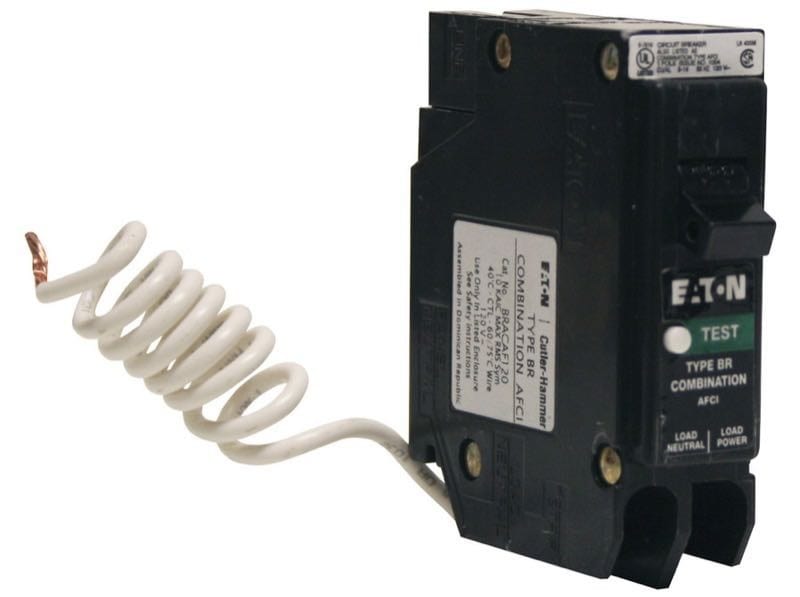
Arc fault breakers are similar in size to regular circuit breakers. They simply replace any circuit breaker that feeds a bedroom. Arc fault breakers include a separate neutral wire, which connects to the Neutral bus bar in the panel. They cost anywhere from $25–$50 (the cost varies depending upon which panel box you have).
Quite possibly, arc fault breakers present the cheapest fire insurance you can give your home.
We recommend consumers consider replacing their existing breakers with arc fault circuit interrupters, even if they aren’t doing anything that requires an inspection. It takes just minutes. If you’re uncertain as to how to safely accomplish this, please consult a licensed electrician.
As an invention, the new arc fault circuit interrupter breaker actually has the potential to save lives. While it costs homeowners a little more upfront, the insurance it provides makes it well worth the small investment.
*See this CPSC report on AFCIs