
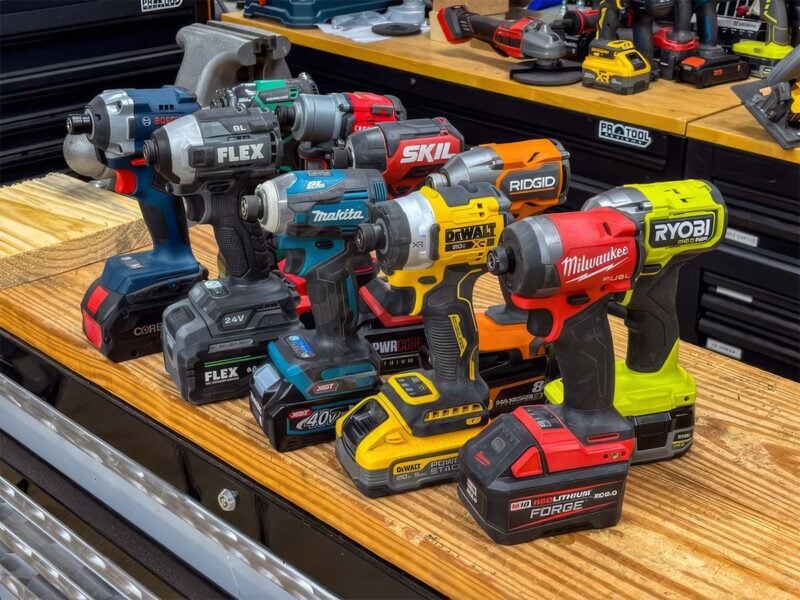
While there was a time when impact drivers were primarily thought of as useful for smaller wood screws and self-tapping screws, fastening technology has changed. Today, fasteners such as GRK’s rugged structural screws (RSS) have the structural holding power to replace lag screws. In addition to their strength advantages, changes in the tip and threads also mean you can drive them with an impact driver instead of an impact wrench.
We could test impact driver speed using deck screws or self-tapping screws, but frankly, the actual time differences are relatively small. On the other hand, driving RSS screws is a tougher job. While all of the impact drivers we tested are capable of doing the job, some are clearly faster than others. It takes a combination of strength, speed, and impact rate to rise above the rest.
So, which impact drivers have the right formula as structural fastening specialists?
Let’s see what the data says.
READ
Best Impact Driver Head-to-Head Review
Testing Impact Driver Structural Fastening Speed
For this test, we drove 3/8-inch x 8-inch GRK RSS screws into stacked and glued OSB subfloor sheets. While you might fasten OSB onto joists, I realize that fastening stacks of it isn’t a normal application. However, OSB is far more consistent than dimensional lumber, and our goal is to control the material density variable.
We also strayed slightly in our fastener use. GRK’s Zip-Tip eliminates the need to pre-drill holes for the fastener. However, we drill a 2-inch pilot hole and set each screw to the bottom of it so they get a straight start.
Each impact driver has three chances to drive as fast as it can in its highest speed mode, and we average the results for its overall time.
For batteries, we selected the most advanced 2P (2 rows of lithium cells) packs we had available. This offers a noticeable boost in performance over 1P batteries without making the tool impact drivers too heavy or out of balance. While the smaller batteries are definitely our preference for lighter fastening jobs, the larger RSS screws really do benefit from moving to a larger battery. Before starting the test, we made sure each battery was fully charged.
READ
How Pro Tool Reviews Tests Impact Drivers
| Impact Driver | Average Driving Speed |
|---|---|
| Flex 24V FX1372 | 5.84 sec |
| Milwaukee M18 Fuel 2953 | 5.96 sec |
| Ryobi HP Brushless PBLID04 | 6.80 sec |
| Ridgid 18V R862312 | 6.83 sec |
| DeWalt 20V Max XR DCF860 | 7.54 sec |
| Hercules 20V Max HCB81B | 7.78 sec |
| Metabo HPT 36V WH36DC | 9.54 sec |
| Bosch 18V GDR18V-215 | 9.76 sec |
| Greenworks 24V Pro ID5250 | 10.13 sec |
| Hilti 22V Nuron SID 6-22 | 10.37 sec |
| Craftsman V20 Brushless RP CMCF830 | 10.71 sec |
| Makita 40V max XGT GDT01 | 13.11 sec |
| Skil PWRCore 20 ID6739B | 15.55 sec |
Analysis
In this test, Flex’s newest flagship impact driver edged out Milwaukee for the win. The new model’s speed turned out to be extremely close to the previous version’s (FX1371), at just 0.02 seconds slower. So, whether you have the original or the new model, Flex outperforms every other brand we’ve tested.
That said, Milwaukee was within the margin of error and trailed Flex by only 0.12 seconds. If we want to apply an actual statistical analysis, it’s effectively a tie. Don’t worry, though, I won’t subject you to the math.
From there, Ryobi and Ridgid finished very close to one another in third and fourth place before the rest of the pack fell away.
What’s interesting is that Milwaukee, Ryobi, and Ridgid are all made by TTI. It seems the product teams for those brands have developed a solid formula for applied impact driver performance.
Personally, I wouldn’t be disappointed to use any of those four, considering the time difference from first place to fourth is less than a second. If you’re not sure which direction to go, focus on the platform first and then the price. Here’s some guidance:
| Platform Focus | Platform Size | Impact Driver Price | |
|---|---|---|---|
| Flex | Professional | Medium | $299 kit |
| Milwaukee | Professional | Large | $179 bare, $319 kit |
| Ridgid | Value Pro | Medium | $134 bare, $209 kit |
| Ryobi | Prosumer/DIY | Large | $129 bare |
Listed prices are current at the time of writing.
We want to know what you think. Are you surprised by the results? Which impact driver would be your top choice for structural fastening? Let us know in the comments!