
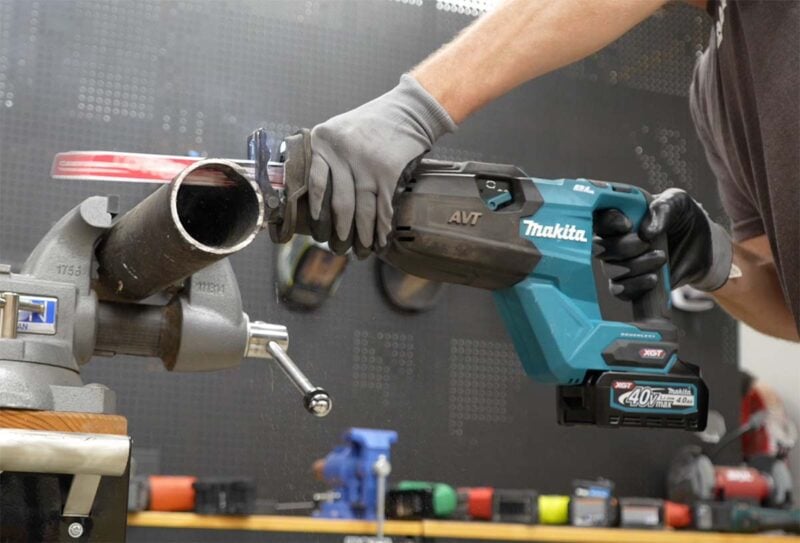
After testing dozens of options over the years and weighing them against our collective decades of experience, we’ve narrowed down the absolute best cordless reciprocating saws (AKA Sawzalls) from manufacturers we trust the most. We rounded up the newest, most advanced models and tested them head-to-head in a series of experiments to help you decide which model is the best or simply see how well your favorite brand competes.
Best Cordless Reciprocating Saws

Scoring
Note that the scoring is different from our normal rating system. The scores are based on how each reciprocating saw performed and compared in this specific group and this set of tests only. Our typical rating system offers a comparison of the tool to the entire range of what is available. Here’s how to interpret the scores from this test:
- 90 – 100: Outstanding. You’ll love using this reciprocating saw.
- 80 – 89: Excellent. There may be minor tradeoffs.
- 70 – 79: Very good, but there are more significant tradeoffs.
- 60 – 69: Good. Notable tradeoffs, but still earns our recommendation.
- < 60: Not recommended for Professional use, but good for DIYers.
Also In This Article
- How the Rest of the Field Fared
- Recommended Reciprocating Saw Blades
- More Cordless Reciprocating Saws We Recommend
- How We Tested Head-to-Head
- What to Look for When You’re Shopping
- Why You Can Trust Pro Tool Reviews
Best Cordless Reciprocating Saw Overall

Makita 40V max XGT GRJ02
Score: 100 Points
- Max Stroke Rate: 3000 SPM
- Stroke Length: 1.25 in
- Orbital Action: Yes
- Tool Length: 17.0 in
- Weight: 8.7 lbs bare, 10.9 lbs as tested
- Price: $324 bare, $559 kit
| Test | Result |
|---|---|
| 4-inch PVC | 2.79 seconds (1st place) |
| Clean Wood | 8.29 seconds (3rd place) |
| Wall Sandwich | 18.58 seconds (3rd place) |
| 3-inch Cast Iron | 41.24 seconds (1st place) |
| Vibration Control | 1 out of 5 (1st place, tie) |
Pros
- Top-tier cutting performance in all materials
- Outstanding vibration control
- Full feature set
Cons
- Heavier than average
- Expensive
It’s extremely rare that any tool manages a perfect score in our head-to-head tests, but Makita’s 40V max XGT reciprocating saw did just that. While it wasn’t in first place in every test, it was close enough to the leader to still earn full marks. Better still, it displayed the best vibration control of the group in a tie with Metabo HPT and is the only saw to check off every feature we were looking for.
Like you’ll see with all of the highest-performing models in our tests, it’s heavier than most. It’s also pricey. However, if you’re looking for the best overall cordless reciprocating saw, Makita claims the crown.
Best Cordless Reciprocating Saw Runner-Up

Metabo HPT 36V CR36DA
Score: 99 Points
- Max Stroke Rate: 3000 SPM
- Stroke Length: 1.25 in
- Orbital Action: Yes
- Tool Length: 18.0 in
- Weight: 8.7 lbs bare, 10.8 lbs as tested
- Price: $199 bare, $399 kit
| Test | Result |
|---|---|
| 4-inch PVC | 2.85 seconds (2nd place) |
| Clean Wood | 8.23 seconds (2nd place) |
| Wall Sandwich | 18.11 seconds (2nd place) |
| 3-inch Cast Iron | 54.54 seconds (6th place) |
| Vibration Control | 1/5 (1st place, tie) |
Pros
- Excellent overall cutting performance
- Top-tier wood cutting performance
- Outstanding vibration control
- Available AC adapter for corded operation
- Lifetime warranty
Cons
- Heavier than average
- Shaft-mounted blade release
Narrowly coming in second place, Metabo HPT’s 36V reciprocating saw is an impressive demo tool. It went toe-to-toe with Makita in our wood cutting tests, though it slipped slightly when it came to cutting cast iron. Still, it shared the lead with Makita in vibration control.
An available AC adapter makes it the only hybrid corded/cordless option in our test group. Plus, Metabo HPT’s lower pricing and lifetime warranty add a tremendous boost to the value proposition. If you’re a Pro who wants the best cordless reciprocating saw for the money, this is it.
About the only thing we didn’t like was the shaft-mounted blade release. We greatly prefer having a lever on the outside of the housing.
Third Place Cordless Reciprocating Saw

Bosch 18V Brushless GSA18V-126
Score: 88 Points
- Max Stroke Rate: 3000 SPM
- Stroke Length: 1.25 in
- Orbital Action: Yes
- Tool Length: 18.4 in
- Weight: 8.1 lbs bare, 10.2 lbs as tested
- Price: $259 bare
| Test | Result |
|---|---|
| 4-inch PVC | 3.62 seconds (5th place) |
| Clean Wood | 9.46 seconds (6th place) |
| Wall Sandwich | 29.70 seconds (7th place) |
| 3-inch Cast Iron | 44.71 seconds (4th place) |
| Vibration Control | 2/5 (3rd place, tie) |
Pros
- Good overall cutting performance
- Top-tier cast iron cutting performance
- Kickback control
- Excellent vibration control
Cons
- Shaft-mounted blade release
Bosch’s last couple of cordless reciprocating saws stepped up their demo game significantly. The previous hawkbill-style GSA18V-125 was a favorite of ours since its launch, but the new GSA18V-126 boosted the performance even higher. Overall, its cutting performance is solid, and it earned top marks in our cast iron test. The saw’s excellent vibration control also makes it comfortable to use for longer durations.
We’re not crazy about the blade release being on the shaft, and there’s no kit option to add some extra value. But if you’re already on Bosch’s 18V battery system, this is a quality choice that does demo well.
More Cordless Reciprocating Saws We Tested

Hilti Nuron 22V SR 6-22
Score: 83 Points
- Max Stroke Rate: 2600 SPM
- Stroke Length: 1.25 in
- Orbital Action: No
- Tool Length: 18.5 in
- Weight: 6.9 lbs bare, 9.8 lbs as tested
- Price: $359 bare
| Test | Result |
|---|---|
| 4-inch PVC | 4.34 seconds (8th place) |
| Clean Wood | 8.74 seconds (4th place) |
| Wall Sandwich | 27.36 seconds (5th place) |
| 3-inch Cast Iron | 42.59 seconds (3rd place) |
| Vibration Control | 3/5 (5th place, tie) |
Pros
- Top-tier cast iron cutting performance
- Excellent wood cutting performance
- Available dust collection and stabilizer accessories
- 20-year warranty
Cons
- No selectable orbital action
- No selectable speed control
- Expensive
Despite not having orbital action to give a boost in wood cutting speed, Hilti notched a solid 4th place finish. Excellent wood cutting performance combined with top marks in our cast iron test proved it’s a worthy contender for general demo work. Of course, Hilti has made a name for itself in the commercial construction sector, and the tool’s 20-year warranty certainly is a nod to that.
You lose out on a couple of features, like speed selection and the aforementioned orbital action. However, it doesn’t seem to suffer too much from not having them. Plus, optional dust collection and material stabilization accessories offer some bonus opportunities other saws don’t.

Milwaukee M18 Fuel Super Sawzall 2722
Score: 78 Points
- Max Stroke Rate: 3000 SPM
- Stroke Length: 1.25 in
- Orbital Action: Yes
- Tool Length: 18.8 in
- Weight: 8.2 lbs bare, 11.8 lbs as tested
- Price: $279 bare, $499 kit
| Test | Result |
|---|---|
| 4-inch PVC | 2.96 seconds (3rd place) |
| Clean Wood | 8.18 seconds (1st place) |
| Wall Sandwich | 18.05 seconds (1st place) |
| 3-inch Cast Iron | 41.54 seconds (2nd place) |
| Vibration Control | 5/5 (10th place, tie) |
Pros
- Top-tier cutting performance in all materials
- Exceptionally wide range of compatible trade-focused tools
Cons
- Higher vibration than most
- Heavier than most
- Shaft-mounted blade release
- Expensive
Milwaukee’s M18 Fuel Super Sawzall was the only other saw to notch top marks in all of our performance tests alongside Makita. There’s no question it’s in a very small, very elite performance group.
Normally, that’s enough to get a tool on the podium. However, demo is a different animal, and Milwaukee’s weight and higher vibration made it more fatiguing to use as our testing days got longer.
You can mitigate some of the weight by going with an 8.0Ah Forge battery instead of the 12.0Ah that comes with the kit. With Milwaukee’s Super Charger, you can still cycle batteries effectively without having to stop and wait.
For Pros, the best bet is to pair this model alongside the M18 Fuel 2821 (or 2822 if you want One-Key). Use the Super Sawzall when you need the fastest, most aggressive cuts. Shift to the lighter Sawzall when you’re cutting overhead or trying to minimize vibration.

Flex 24V Brushless FX2271
Score: 77 Points
- Max Stroke Rate: 3000 SPM
- Stroke Length: 1.25 in
- Orbital Action: Yes
- Tool Length: 17.5 in
- Weight: 7.0 lbs bare, 9.7 lbs as tested
- Price: $219 bare, $279 kit
| Test | Result |
|---|---|
| 4-inch PVC | 3.08 seconds (4th place) |
| Clean Wood | 9.31 seconds (5th place) |
| Wall Sandwich | 22.32 seconds (4th place) |
| 3-inch Cast Iron | 66.45 seconds (8th place) |
| Vibration Control | 3/5 (5th place, tie) |
Pros
- Excellent wood cutting performance
- Lighter than average
- Excellent value
- Lifetime warranty
Cons
- Slow cast iron cutting performance
- Shaft-mounted blade release
- No selectable speed control
Flex’s 24V brushless reciprocating saw didn’t light the world on fire in our tests, but when you consider the whole package, it’s a compelling option. Competitive in wood cutting, it has a working weight under 10 pounds, making it a bit easier to use than the heavier models further up the list.
It’s just $279 for the kit, which is attention-grabbing for a Pro-targeted model. If you register your purchase, you also get a lifetime warranty, and that makes this the best value among professional saws.
The trade-off is that you have to give up selectable speed control and a lever blade release, and it cuts slower in thick metal. But it’s about half the price of Makita’s class-leading model, and there’s something to be said for saving money these days.

DeWalt 60V Max DCS389
Score: 68 Points
- Max Stroke Rate: 3000 SPM
- Stroke Length: 1.25 in
- Orbital Action: No
- Tool Length: 17.6 in
- Weight: 7.6 lbs bare, 10.8 lb as tested
- Price: $299 bare, $399 kit
| Test | Result |
|---|---|
| 4-inch PVC | 4.59 seconds (9th place) |
| Clean Wood | 9.98 seconds (7th place) |
| Wall Sandwich | 28.97 seconds (6th place) |
| 3-inch Cast Iron | 51.92 seconds (5th place) |
| Vibration Control | 4/5 (9th place) |
Pros
- Good overall cutting performance
Cons
- Heavier than most
- Higher vibration than most
- No selectable orbital action
- No selectable speed control
- No adjustable shoe
- No rafter hook
DeWalt’s flagship cordless reciprocating saw offers solid cutting performance thanks to the boosted performance of its 60V max battery system. It’s a dependable workhorse that’s proven itself in the years since its launch.
However, it’s somewhat basic compared to other saws on this list. The lack of an orbital mode handicaps its wood cutting somewhat, and as we’ve noted with previous models, it really needs an update to its vibration control design. The rest of the missing features are arguably no big deal, but if DeWalt addresses orbital action and vibration control on the next model, it’ll certainly shake up our list.

Ryobi 18V One+ HP Brushless PBLRS02
Score: 68 Points
- Max Stroke Rate: 3200 SPM
- Stroke Length: 1.25 in
- Orbital Action: No
- Tool Length: 18.5 in
- Weight: 6.6 lbs bare, 8.1 lbs as tested
- Price: $139 bare
| Test | Result |
|---|---|
| 4-inch PVC | 3.78 seconds (6th place) |
| Clean Wood | 11.47 seconds (9th place) |
| Wall Sandwich | 31.65 seconds (9th place) |
| 3-inch Cast Iron | 101.25 seconds (10th place) |
| Vibration Control | 3/5 (5th place, tie) |
Pros
- Lightweight
- Excellent value
- Extensive range of compatible tools, home improvement, and lifestyle products
Cons
- Slow cast iron cutting performance
- No selectable orbital action
- No selectable speed control
- No adjustable shoe
Finishing a point in front of Ridgid, it’s clear that the HP Brushless line has bridged the gap to Ridgid in some tool classes. The HP Brushless reciprocating saw offers a nice boost in performance from previous models and performed admirably in most of our tests, though it struggled cutting cast iron. The big highlight is how light this model is—just over 8 pounds with a battery.
This is an excellent choice for handymen and building maintenance crews who are willing to tackle some demo as they handle repairs, or for serious DIYers going after remodeling projects. As long as you’re not demoing a structure with cast iron pipes, it’ll handle other materials just fine.

Ridgid 18V Brushless R8647
Score: 67 Points
- Max Stroke Rate: 3200 SPM
- Stroke Length: 1.25 in
- Orbital Action: Yes
- Tool Length: 17.9 in
- Weight: 6.8 lbs bare, 9.0 lbs as tested
- Price: $169 bare
| Test | Result |
|---|---|
| 4-inch PVC | 5.60 seconds (11th place) |
| Clean Wood | 10.71 seconds (8th place) |
| Wall Sandwich | 29.28 seconds (7th place) |
| 3-inch Cast Iron | 92.95 seconds (9th place) |
| Vibration Control | 3/5 (5th place, tie) |
Pros
- Good wood cutting performance
- Lightweight
- Lifetime Service Agreement
Cons
- Slow cast iron cutting performance
- No selectable speed control
While Ridgid and Ryobi may be close in the results, they’re targeting different users. Focused on value-minded Pros, Ridgid’s flagship reciprocating saw has an advantage in wood cutting thanks to its selectable orbital action. It didn’t fare so well in our cast iron test, but as a lightweight option, we’re not surprised. Most of the fastest cutting models in that test are significantly heavier.
As it stands, Ridgid is still a value leader that’s perfectly capable of getting the job done. While it doesn’t challenge the top performers, it’s also nowhere near their prices. Plus, Ridgid’s Lifetime Service Agreement means they’ve got your back if anything happens.

Skil PWRCore 20 Brushless RS5884
Score: 57 Points
- Max Stroke Rate: 3000 SPM
- Stroke Length: 1.13 in
- Orbital Action: Yes
- Tool Length: 17.3 in
- Weight: 6.3 lbs bare, 7.9 lbs as tested
- Price: $169 kit
| Test | Result |
|---|---|
| 4-inch PVC | 4.32 seconds (7th place) |
| Clean Wood | 14.07 seconds (11th place) |
| Wall Sandwich | 41.7 seconds (11th place) |
| 3-inch Cast Iron | DNF (11th place) |
| Vibration Control | 2/5 (3rd place, tie) |
Pros
- Lightweight
- Excellent vibration control
- Excellent value
Cons
- Slower cutting than most
- No selectable speed control
- No selectable speed control
- No rafter hook
Skil offers DIYers a lot of bang for their buck, and we were curious how their flagship reciprocating saw would compare to the top brands. Unsurprisingly, it didn’t challenge the leaders, but it did prove it can handle the majority of cuts you’ll need to make if you’re doing your own home repairs or remodeling.
What’s great about using this saw is how light it is and how low the vibration is. Whether you’re cutting a stud overhead or working on a plumbing repair in a crawlspace, it’s a lot easier to use to than the heavier models we tested. There’s no question it cuts slower, and I’d advise against cutting thick metal with it, but for DIYers, it’s a good pick that carries an excellent value.

Craftsman V20 Brushless RP CMC5351
Score: 54 Points
- Max Stroke Rate: 3200 SPM
- Stroke Length: 1.13 in
- Orbital Action: No
- Tool Length: 15.3 in
- Weight: 5.1 lbs bare, 8.1 lbs as tested
- Price: $149 bare
| Test | Result |
|---|---|
| 4-inch PVC | 4.78 seconds (10th place) |
| Clean Wood | 12.98 seconds (10th place) |
| Wall Sandwich | 34.32 seconds (10th place) |
| 3-inch Cast Iron | 55.91 seconds (7th place) |
| Vibration Control | 1/5 (10th place, tie) |
Pros
- Lightweight
- Most compact saw we tested
Cons
- Slower cutting than most
- Higher vibration than most
- Shaft-mounted blade release
- No selectable orbital action
- No selectable speed control
- No selectable speed control
- No rafter hook
Craftsman doesn’t pack many bells and whistles on its Brushless RP reciprocating saw, but that’s okay if you’re targeting a DIY user base. Given its lightweight and compact design, it’s a lot less intimidating than most of the other models we tested.
Realistically, Craftsman’s biggest downside is its vibration. The saw was able to complete all of our tests, including cutting through cast iron at a very reasonable pace. But the higher vibration makes it fatiguing to use, and in the case of less-experienced users, a rather frustrating experience. Still, it’ll get the job done—just take your time and use good technique.
Best Reciprocating Saw Blades

We heartily recommend Milwaukee Sawzall Blades and used them exclusively in our testing. From basic bi-metal to cutting-edge Nitrus Carbide, Milwaukee has a broad range that meets the needs of every cutting application you’ll run into on the job. Here’s a quick look at the blades we like to keep on hand:
- Carbide Ax for Clean Wood/Pruning: Long-lasting blade we use for clean wood that won’t dull like a chainsaw when you’re cutting tree roots in the dirt
- Nitrus Carbide Ax for Nail-Embedded Wood: Our go-to super-durable, high-performance demo blade for wood when there’s a risk of hitting nails or screws (which is most of the time)
- Nitrus Carbide Wrecker for Multi-Materials: Perfect long-lasting, high-performance blade for demo cuts when you don’t know what’s behind the wall, or you know there’s a mix of wood, metal, and/or cement board
- Bi-Metal Torch: Affordable, fast-cutting blade for cutting plastics, like PVC, and thin metal, like EMT
- Nitrus Carbide Torch for Medium Metal: An outstanding general-purpose metal-cutting blade that makes a ton of cuts while maintaining high performance
- Nitrus Carbide Torch for Thick Metal/Cast Iron: The blade we lean on for the toughest cuts in cast iron and other thick metal
Did You Know… Milwaukee manufactures many of their Sawzall blades and hole saws in the USA—more than 1.5 billion to date!
More Cordless Reciprocating Saws We Recommend

Festool RSC 18 Reciprocating Saw
- Max Stroke Rate: 3000 SPM
- Stroke Length: 1.25 in
- Orbital Action: Yes
- Tool Length: Not listed
- Weight: 9.0 lbs bare
- Price: $391.14 bare, $634.94 kit
Festool is steadily making its way deeper into general construction, and the RSC 18 reciprocating saw is one of the most refined models we’ve seen. Plus, it’s packed with features. Here’s a quick list of the highlights:
- Two-speed selection switch
- Variable orbital intensity
- Shoe-mounted dust port adapter
- Lever blade release with active ejection
- Advanced vibration control
Of course, it’s Festool, so the ergonomics are dialed in to the highest level. However, all that refinement comes with a higher price tag than most brands. You’ll want to make sure you’re committed to the Festool platform before you pull the trigger.
Greenworks 24V Brushless Reciprocating Saw
- Max Stroke Rate: 2700 SPM
- Stroke Length: 1.13 in
- Orbital Action: No
- Tool Length: 18.3 in
- Weight: 6.1 lbs bare, 7.8 lbs with 4.0Ah battery
- Price: $99.99 kit
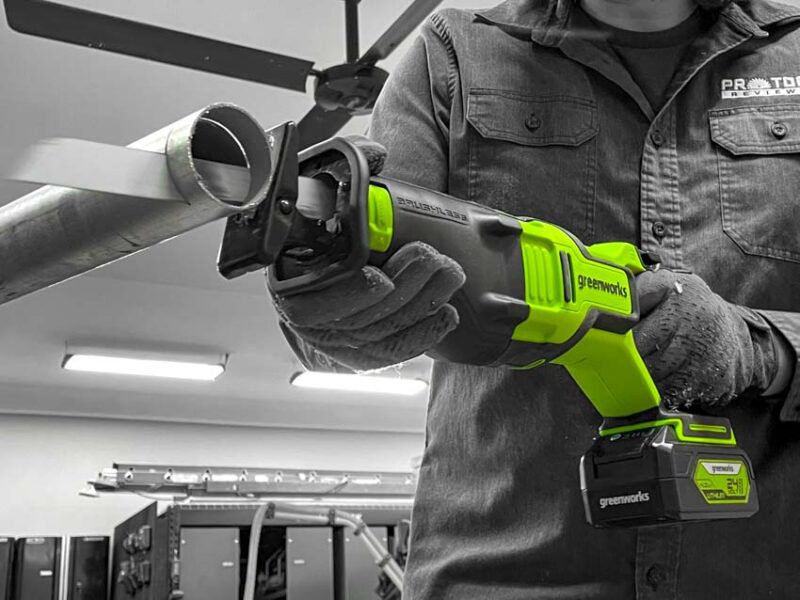
Greenworks offers a lightweight, affordable option for DIYers who are ready to tackle their own repairs and remodeling projects. While I’d avoid some of the toughest cuts we ask of our Pro saws, basic demo in wood, metal, PVC, cement board, and other materials are no problem.
Best of all is the price tag. As of the time I’m writing, the kit is just under $100, including a 4.0Ah battery, charger, and blades to get you started. You’ll have a hard time finding a brushless model from another reputable brand anywhere near that price.
Kobalt 24V XTR Brushless Reciprocating Saw
- Max Stroke Rate: 3100 SPM
- Stroke Length: 1.25 in
- Orbital Action: Yes
- Tool Length: Not listed
- Weight: 6.4 lbs bare
- Price: $182 bare
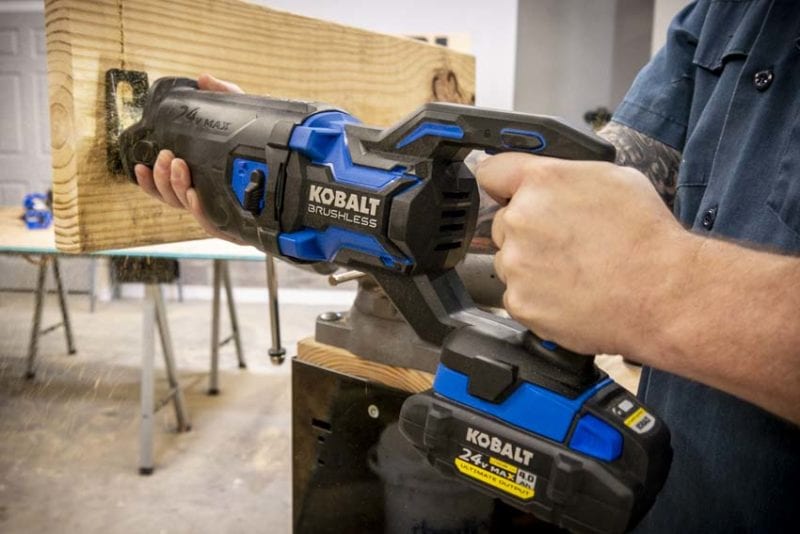
Kobalt launched its XTR line of high-performance brushless tools more than five years ago, and it’s still a go-to option for Pros and serious DIYers. The reciprocating saw in the line is solid, sporting excellent performance stats and a solid feature set to go with it.
It needs to be impressive, though. With a price tag creeping up near brands like Metabo HPT and a limited number of XTR products available, it’ll make some folks consider stepping up to a brand with a broader Pro-focused portfolio. Also, note that you’ll need to pair this (and other XTR tools) with Kobalt’s advanced Ultimate Output batteries to achieve the best performance.
How We Tested Head-To-Head
Battery Selection
For each saw, we chose the battery that offered the best performance without getting too heavy or out of balance. Here are the batteries we paired with each model:
| Model | Tested Battery |
|---|---|
| Bosch GSA18V-126 | 8.0Ah Core18V |
| Craftsman CMC5351 | 6.0Ah V20 |
| DeWalt DCS389 | 12.0Ah/4.0Ah FlexVolt |
| Flex FX2271 | 6.0Ah Stacked Lithium |
| Hilti SR6-22 | 7.9Ah 22V Nuron |
| Makita GRJ02 | 4.0Ah 40V max XGT |
| Metabo HPT CR36DA | 4.0Ah T-PWR MultiVolt |
| Milwaukee 2722 | 8.0Ah M18 Forge |
| Ridgid R8647 | 8.0Ah Max Output EXP |
| Ryobi PBLRS02 | 4.0Ah High Performance Edge |
| Skil RS5884 | 5.0Ah PWRCore 20 |
PVC Pipe

Kicking things off with a relatively easy test, we cut through 4-inch Schedule 40 PVC pipe. Each saw had a 5-pound weight hanging from it for consistency, and we ensured control and proper engagement with the pipe without adding additional downforce.
To cut, we used Milwaukee’s 9-inch Torch Thick Metal Sawzall blades. Obviously, PVC isn’t thick metal, but the 10 TPI tooth configuration and bi-metal design is good when you want to make quick cuts through PVC.
The result is the average speed of three cuts.
| Model | Average Cut Time |
|---|---|
| Makita GRJ02 | 2.79 seconds |
| Metabo HPT CR36DA | 2.85 seconds |
| Milwaukee 2722 | 2.96 seconds |
| Flex FX2271 | 3.08 seconds |
| Bosch GSA18V-126 | 3.62 seconds |
| Ryobi PBLRS02 | 3.78 seconds |
| Skil RS5884 | 4.32 seconds |
| Hilti SR6-22 | 4.34 seconds |
| DeWalt DCS389 | 4.59 seconds |
| Craftsman CMC5351 | 4.78 seconds |
| Ridgid R8647 | 5.60 seconds |
Clean Wood

Stepping up in effort, our clean wood test involved cross cutting 2 x 12 dried yellow pine lumber. We used Milwaukee’s 5 TPI, 9-inch Carbide Ax for Wood with Nails for the blade, and fit each saw with a 5-pound weight for consistent downforce.
The result is the average of three tests.
| Model | Average Cut Time |
|---|---|
| Milwaukee 2722 | 8.18 seconds |
| Metabo HPT CR36DA | 8.23 seconds |
| Makita GRJ02 | 8.29 seconds |
| Hilti SR6-22 | 8.74 seconds |
| Flex FX2271 | 9.31 seconds |
| Bosch GSA18V-126 | 9.46 seconds |
| DeWalt DCS389 | 9.98 seconds |
| Ridgid R8647 | 10.71 seconds |
| Ryobi PBLRS02 | 11.47 seconds |
| Craftsman CMC5351 | 12.98 seconds |
| Skil RS5884 | 14.07 seconds |
Wall Sandwich

To demonstrate a common real-world demo application, we made a 12-inch wall sandwich consisting of:
- Three 2 x 4 studs with three nails in each (nine nails total)
- 7/16-inch OSB
- Hardie board siding
We used Milwaukee’s 6 TPI, 9-inch Nitrus Carbide Wrecker for Multi-Material as our blade and used 5 pounds of weight for consistent downforce.
The result is the average of three cuts.
| Model | Average Cut Time |
|---|---|
| Milwaukee 2722 | 18.05 seconds |
| Metabo HPT CR36DA | 18.11 seconds |
| Makita GRJ02 | 18.58 seconds |
| Flex FX2271 | 22.32 seconds |
| Hilti SR6-22 | 27.36 seconds |
| DeWalt DCS389 | 28.97 seconds |
| Ridgid R8647 | 29.28 seconds |
| Bosch GSA18V-126 | 29.70 seconds |
| Ryobi PBLRS02 | 31.65 seconds |
| Craftsman CMC5351 | 34.32 seconds |
| Skil RS5884 | 41.70 seconds |
Cast Iron Pipe

One of the toughest cuts you’ll ever have to make on a demo job is cast iron pipe. While it’s not a common material in new construction, you’ll still come across it often in older structures. We used a 3-inch cast iron pipe in our testing.
Because of the tough nature and long duration of the cut, it wasn’t practical to control the blade by using a weight for downforce, so we shifted to cutting freehand on this one. Downforce wasn’t as consistent because some of the saws clearly don’t have as much muscle to keep the blade moving, so we cut at the most efficient rate we could for each saw.
The result is the time it took to complete one cut using a Milwaukee 8 TPI, 9-inch Nitrus Carbide Torch for Thick Metal and Cast Iron blade.
| Model | Cut Time |
|---|---|
| Makita GRJ02 | 41.24 seconds |
| Milwaukee 2722 | 41.54 seconds |
| Hilti SR6-22 | 42.59 seconds |
| Bosch GSA18V-126 | 44.71 seconds |
| DeWalt DCS389 | 51.92 seconds |
| Metabo HPT CR36DA | 54.54 seconds |
| Craftsman CMC5351 | 55.91 seconds |
| Flex FX2271 | 66.45 seconds |
| Ridgid R8647 | 92.95 seconds |
| Ryobi PBLRS02 | 101.25 seconds |
| Skil RS5884 | DNF |
Vibration
Quantifying vibration is tough without expensive equipment that we don’t have access to. Instead, we rate vibration on a 1 – 5 scale, with 1 being the best and 5 being the worst.
As we make our initial cuts, we’re able to start determining which saws have the lowest and highest vibration. We continue to evaluate vibration throughout our tests as the extended use helps us group them accordingly.
The important thing to note here is that we’re evaluating vibration during active cuts, not under no-load situations.
| Model | Vibration Under Load (Lower is Better( |
|---|---|
| Makita GRJ02 | 1 out of 5 |
| Metabo HPT CR36DA | 1 out of 5 |
| Bosch GSA18V-126 | 2 out of 5 |
| Skil RS5884 | 2 out of 5 |
| Hilti SR6-22 | 3 out of 5 |
| Flex FX2271 | 3 out of 5 |
| Ridgid R8647 | 3 out of 5 |
| Ryobi PBLRS02 | 3 out of 5 |
| DeWalt DCS389 | 4 out of 5 |
| Milwaukee 2722 | 5 out of 5 |
| Craftsman CMC5351 | 5 out of 5 |
What to Look For When You’re Buying a Cordless Reciprocating Saw
Motor: A brushless motor offers significantly better performance, longer runtime, and tool life than brushed. The trade-off is a higher price tag. While DIYers can get away with a brushed motor, professionals (and those who want Pro performance) need a brushless motor.
Stroke Length: A longer stroke length means faster material removal. We prefer full-size saws to have 1 1/8-inch to 1 1/4-inch stroke lengths.
Stroke Speed: Measured in strokes per minute, a higher stroke rate offers faster cutting. Full-size saws we recommend range from 2800 to 3200 SPM.
Pro Tip: Stroke speed and length are great numbers to know, but it’s the motor’s ability to keep the stroke rate up that determines how fast you can cut. Some of the DIY and Prosumer saws have specs that match or exceed some of our Pro saws, but they still cut slower head-to-head.
Orbital Action: This feature introduces an elliptical motion to the stroke, increasing the aggressiveness and speed of the cut. We prefer this to be a selectable feature you can turn on or off. It’s usually on professional saws, but something that’s not as common at the Prosumer and DIY levels.
Length: The length of the saw helps you determine how small of a space you can cut in. There’s a direct correlation between the size of the saw and its performance level. Larger motors, vibration control mechanisms, and other components dictate that high-performance cordless reciprocating saws are larger. Typical lengths are 17 to 19 inches for full-size models.
Weight: We want to work with as light of a saw as possible to reduce fatigue. Finding the right balance of weight, performance, and vibration control is key to doing the job efficiently. Professional saws can have a working weight (saw and battery) in the 9 to 12-pound range, while Prosumer and DIY models tend to drop below that.
Additional Features to Consider
Blade Changes: Virtually all modern cordless reciprocating saws now have tool-free blade changes. Models that include a lever release on the outer housing a much easier to change than those with a twist lock directly on the shaft. Spring-loaded active ejection and automatic locking when you insert the blade are also nice features to have.
Vibration Control: Advanced vibration control greatly reduces the amount of fatigue your arms experience while you’re cutting with a cordless reciprocating saw.
Speed Dial: This feature adjusts the maximum speed of the saw when a lower speed is advantageous, especially when cutting hard metals.
Pivoting Shoe: A reciprocating saw shoe’s ability to pivot helps you keep it in contact with the cutting surface on long cuts or round materials. It’s critical to keep the shoe engaged with the material to minimize vibration; a pivoting shoe makes it much easier.
Adjustable Shoe: Having the ability to adjust the length of the shoe allows you to engage unused teeth and get more life from the blade. It’s most helpful when you’re cutting material 1 1/2 inches or less so you can get a full set of unused teeth in play. The best cordless reciprocating saws will have a tool-free adjustment.
Rafter Hook: Having a rafter hook enables you to hang your saw in a variety of places, including rafters. Most models have one, and it’s a must-have feature for professional saws.
Dust Collection: Having the option to connect a dust extractor can reduce the amount of debris that collects around your workspace or becomes airborne. It’s especially helpful when you’re cutting cement board, concrete, and masonry products.
Smart Connectivity: Connecting to an app can add the ability to track your cordless reciprocating saw as part of a larger inventory management program. In some cases, it can open up customizable controls.
Related Content
- Best Reciprocating Saws and Sawzalls
- What is a Reciprocating Saw Used For?
- Sawzall vs. Reciprocating Saw: Are They the Same?
- What to Look for in a Reciprocating Saw
Why You Can Trust Pro Tool Reviews
Ever check out a “review” site and you can’t tell if the author has any real experience with tools or if they’re just “recommending” the Amazon top sellers? That’s not us. We won’t recommend anything unless we’d use it ourselves. It’s all about giving you a legitimate recommendation and our honest opinion of each product.
We’ve been in business since 2008 covering tools, writing reviews, and reporting on industry news in the construction and lawn care industries. Our Pro reviewers work in the trades and have the skills and experience to know whether tools can perform well in the field.
Each year, we bring in and review more than one hundred individual products. Our team will put our hands on hundreds more at media events and trade shows throughout the year.
Pro Tool Reviews consults with innovators in the technology and design of tools to gain a broader grasp of where these products fit and how they work.
We work with professional contractors around the United States who review products for us on real job sites. We consult with them extensively on testing methods, categories, and practical applications.
Our site will provide several hundred pieces of new content this year absolutely free for our readers. That includes objective evaluations of individual tools and products.
The result is information you can trust because of the editorial, scientific, and real-world professional experience we collectively utilize each and every time we pick up and test a tool.


The Milwaukee 2821-20 may be faster than the 2722-20 even though the latter is a Super Sawzall. Refer to the following YouTube test video:
https://www.youtube.com/watch?v=ozF4e-tlMsg
We know Andrew–great guy! The differences he experienced seem to be due to his choice in activating or not using the orbital mode in the Super SawZall. For best speed/performance, you want to turn it off when cutting metal and leave it on for cutting wood or doing demo.