
We Tested 11 of the Top Cordless String Trimmers in One Epic Review!
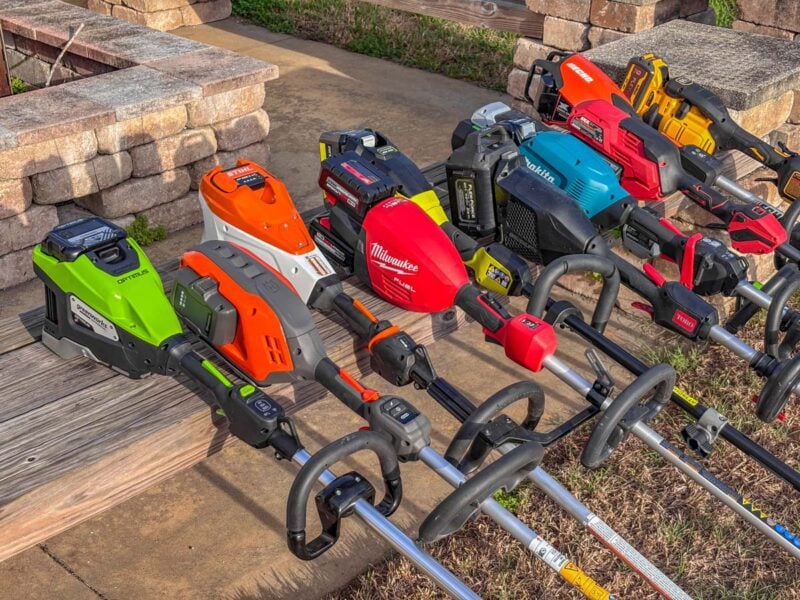
Are you ready to cut the cord or kick the gas can on your outdoor power equipment? String trimmers are a great gateway product, and we’ve tested eleven of the best battery-powered string trimmer models head-to-head to help you determine which ones stand out from the pack.
In this article, I’ll share what we learned from our testing, show you what to look for when you’re shopping, and offer our recommendations based on those tests and other standalone reviews we’ve done. From high-performance professional models to high-value homeowner options, we’ve packed a ton of information to help you on your way to cordless freedom.
Scoring
Note that the scoring is different from our normal rating system. The scores are based on how each string trimmer performed and compared in this specific group and this set of tests only. Our typical rating system offers a comparison of the trimmer to the entire range of what is available. Here’s how to interpret the scores from this test:
- 90 – 100: Outstanding. You’ll love using this string trimmer.
- 80 – 89: Excellent. There may be minor tradeoffs.
- 70 – 79: Very good, but there are more significant tradeoffs.
- 60 – 69: Good. Notable tradeoffs, but still earns our recommendation.
- < 60: Not recommended.
Top Scoring Battery-Powered String Trimmers
Jump to These Sections
- Other Trimmers We Tested
- Best Battery-Powered String Trimmers for Homeowners
- More Models We Recommend
- Testing Methods and Full Results
- What to Look for When You’re Shopping
- Why You Can Trust Pro Tool Reviews
Best Battery-Powered String Trimmer

Husqvarna 36V 525iLST
Score: 93 Points
- Max Speeds: 5500 RPM (three speeds)
- Max Line Diameter: 0.105 in.
- Cutting Swath: 18.1 in.
- Stock Head: Dual-line, rapid load
- Length: 70.8 in.
- Weight: 13.1 lbs w/9.0Ah battery
- Bare Price: $429.99
- Kit Price: Not available
Pros
- Largest cutting swath
- Excellent cutting speed
- Excellent vibration control
- Outstanding runtime
- 0.105-in. line capable
- Good balance
Cons
- Line loading isn’t as easy as other rapid load heads
- No tether point for a shoulder strap
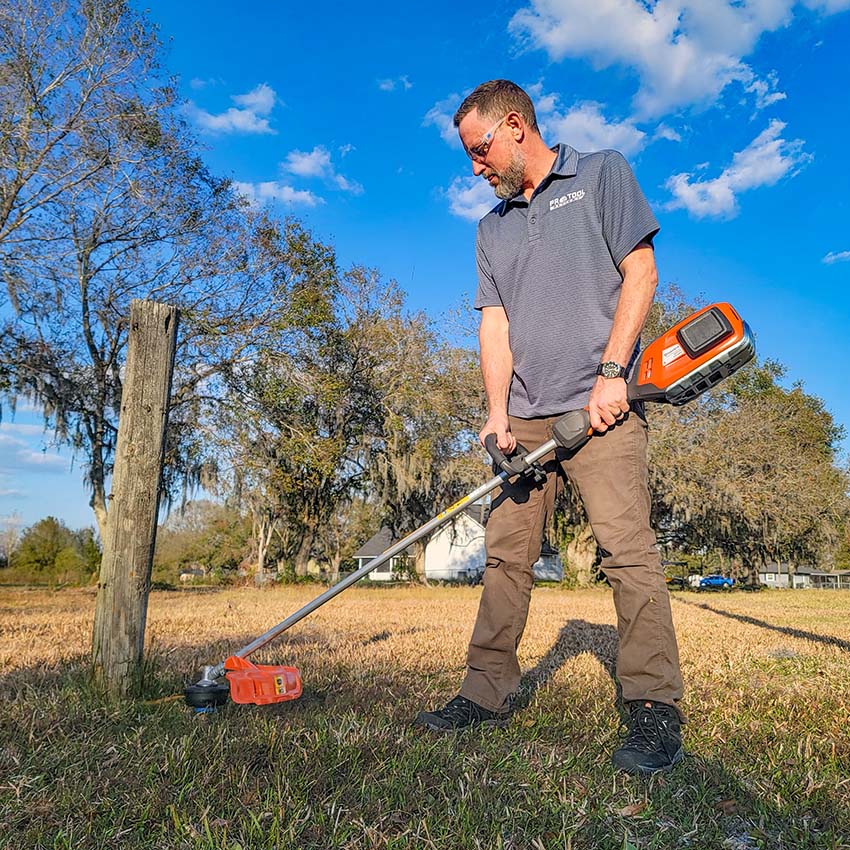
While we love Husqvarna’s 520 iLX for its balance of light weight, low vibration, and maintenance cutting, the 525iLST offers more muscle and a larger swath to make quick work of roadside, ditch, and large area cutting. However, while its 25cc gas equivalent power is excellent for maintenance and moderate overgrowth, it doesn’t have as much power as some of the others on our list.
We tested with Husqvarna’s 9.0Ah battery and measured impressive cutting speed and runtime while keeping the weight manageable near the 13-pound mark. With backpack battery options also available, you can substantially extend that runtime and significantly reduce the amount of weight in your hands. It’s an excellent choice for Pro crews who need mid-range power and long runtime.
| Result | Ranking (out of 8) | |
|---|---|---|
| Battery Used | 9.0Ah | |
| Tested Top Speed | 5490 RPM | 7th |
| Cutting Speed | 8.8 sec. | 3rd |
| Runtime | 40.3 min. | 1st |
| Battery Efficiency | 7.0 sec/Wh | 2nd (tie) |
| Vibration Control | 2 out of 5 | 2nd (tie) |
| Balance | 4.3 lbs., front bias | 3rd (tie) |
| Line Loading | 2 out of 5 | 7th |
Best Battery-Powered String Trimmer Runner Up

ECHO 56V eForce X-Series DSRM-2600
Score: 88 Points
- Speeds: 3000 – 5680 RPM (three speeds)
- Max Line Diameter: 0.095 in.
- Cutting Swath: 17 in.
- Stock Head: Dual-line, rapid load
- Length: 73.5 in.
- Weight: 12.0 lbs w/5.0Ah battery
- Bare Price: $499.99
- Kit Price: $619.99 w/5.0Ah battery
Pros
- Large cutting swath
- Outstanding vibration control
- Excellent balance
- Includes a rapid load head
- Also available in a bike handle version
Cons
- Expensive
- No tether point for a shoulder strap
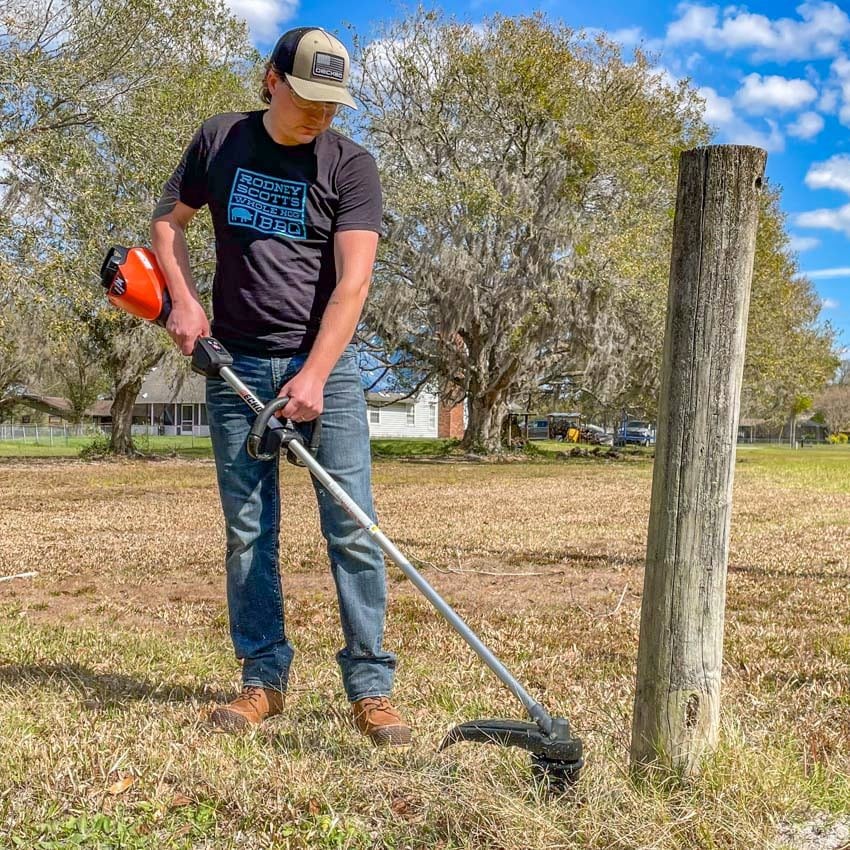
At 12 pounds with a 5.0Ah battery, ECHO’s DSRM-2600 is our pick as the best lightweight battery-powered string trimmer for professional crews. If you go with the kit that comes with a 2.5Ah battery and don’t mind swapping batteries more often, it’s an easy-to-manage 10 pounds.
At the same time, the performance of this model is impressive. The 2600 has legit gas-replacement power, plus a Pro build, excellent balance, and top-tier vibration control, making it an easy recommendation with either battery configuration.
While it has a 17-inch cutting swath that’s great for quick clearing, the lack of 0.105-inch line capability is limiting in heavy overgrowth. Still, it’s a great choice for mow and blow or large campus crews looking to balance high performance with lower weight.
| Result | Ranking (out of 8) | |
|---|---|---|
| Battery Used | 5.0Ah | |
| Tested Top Speed | 5691 RPM | 5th |
| Cutting Speed | 9.1 sec. | 4th |
| Runtime | 17.0 min. | 6th (tie) |
| Battery Efficiency | 4.0 sec/Wh | 7th (tie) |
| Vibration Control | 5 out of 5 | 1st |
| Balance | 2.8 lbs., front bias | 2nd |
| Line Loading | 3 out of 5 | 3rd (tie) |
Third Place Battery-Powered String Trimmer

Greenworks Commercial 82V ST161
Score: 87 Points
- Speeds: 4500 – 5500 RPM (three speeds)
- Max Line Diameter: 0.095 in.
- Cutting Swath: 17 in.
- Stock Head: Dual-line, rapid load
- Length: 72.5 in.
- Weight: 16.2 lbs w/4.0Ah battery
- Bare Price: $599.99
- Kit Price: $649.99 w/4.0Ah battery
Pros
- Large cutting swath
- Outstanding cutting speed and power
- Reverse rotation mode
- 36cc gas equivalent power
- Good runtime
- Includes a rapid load head
Cons
- Expensive
- Heavy
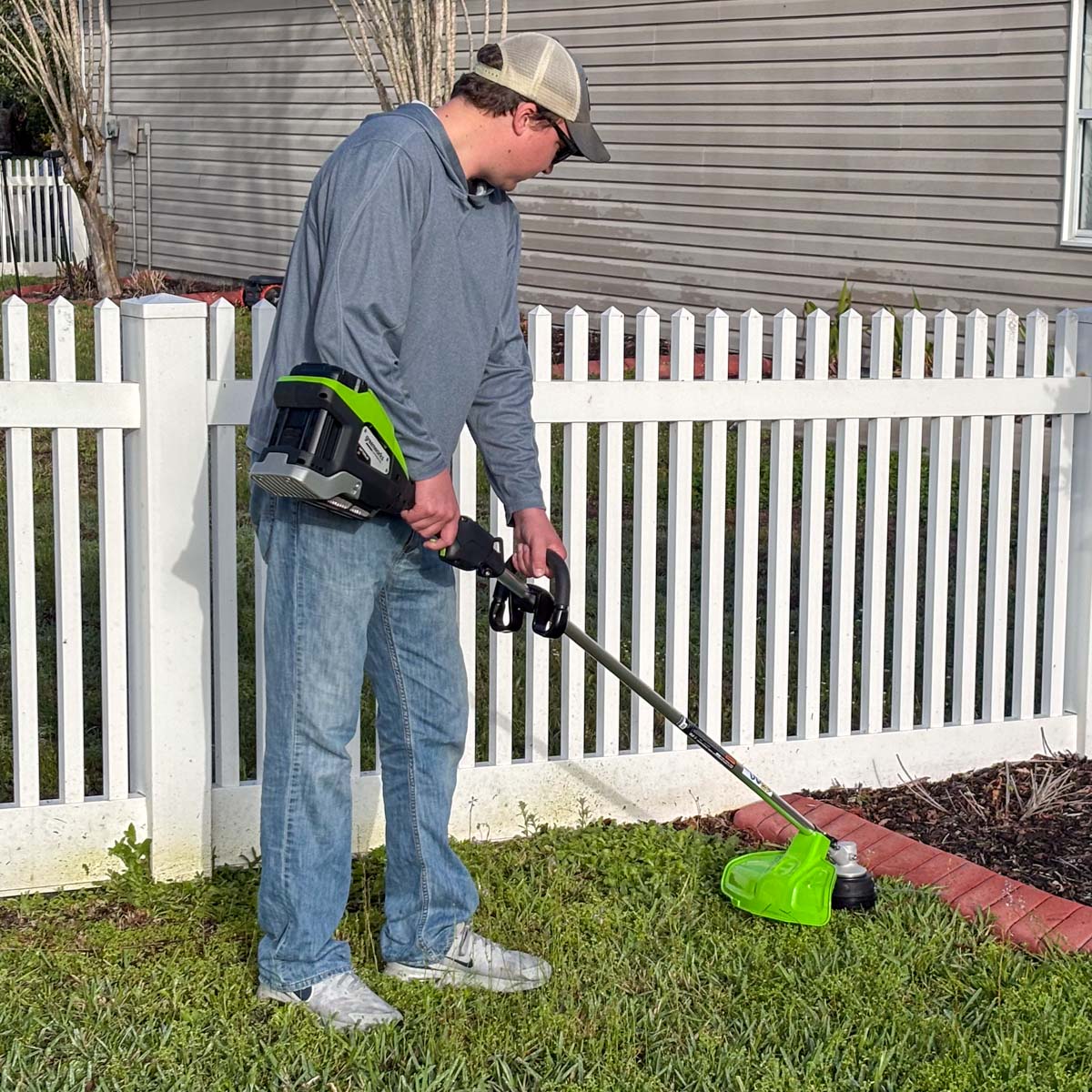
With the Greenworks Commercial’s Optimus line of Pro-grade lawn care products now fully enveloping all your landscaping needs, we had high hopes for the ST161 string trimmer and weren’t disappointed.
Boasting 36cc gas-equivalent power, this trimmer is a beast, setting a new record on our cutting speed test rig and earning our thumbs up if the strongest performance and fastest cutting are your highest priorities. It’s great for clearing thick overgrowth and still gives you plenty of confidence if you want to kick it down to medium or low to increase your runtime for regular maintenance cuts. However, it’s only rated for 0.095-inch line, which is curious since it’s so strong.
As we expected, the high performance does come with some extra weight, and this is one of the heaviest in our test group. So, don’t be afraid to use that tether point and add a shoulder strap if you start feeling it in your lower back.
Positioned as a premium professional option, it’s expensive compared to some of your other options. However, the 4.0Ah kit is only a $50 premium over the bare tool. That’s the configuration we tested and came away impressed. However, you can also get the ST161 paired with a Core300 battery if you want a more advanced setup.
| Result | Ranking (out of 8) | |
|---|---|---|
| Battery Used | 4.0Ah | |
| Tested Top Speed | 5481 RPM | 8th |
| Cutting Speed | 7.0 sec. | 1st |
| Runtime | 29.4 min. | 3rd |
| Battery Efficiency | 5.5 sec/Wh | 5th |
| Vibration Control | 3 out of 5 | 6th (tie) |
| Balance | 11.4 lbs., front bias | 8th |
| Line Loading | 4 out of 5 | 2nd |
More Battery-Powered String Trimmers We Tested

Makita 40V max XGT GRU07
Score: 84 Points
- Speeds: 0 – 5700 RPM (infinitely variable cruise control)
- Max Line Diameter: 0.105 in.
- Cutting Swath: 18.0 in.
- Stock Head: Dual-line, rapid load
- Length: 76.4 in.
- Weight: 14.7 lbs w/5.0Ah battery
- Bare Price: Not available
- Kit Price: $999 w/two 5.0Ah batteries
Pros
- Large cutting swath
- Outstanding cutting speed and power
- 0.105-in. line capable
- Reverse rotation mode
- 35cc gas equivalent power
- High-torque boost mode
- Cruise control lever
Cons
- Heavy
- Expensive
Makita does a fantastic job of bracketing user needs in its battery-powered string trimmer lineup with lightweight, mid-range, and high-torque options. We tested the high-torque GRU07 as part of our head-to-head review, and it’s incredibly strong. Touting the power of a 35cc gas model, it feels like it has all the power of a high-end brushcutter while employing a string trimmer head. With its 18-inch cutting swath, it’s well-suited for clearing large areas quickly.
The downside to that much power is a lower runtime, but an infinitely variable cruise control can help you manage it by dialing in the power you need for what you’re cutting. The trimmer’s high-torque boost mode can help you deal with tough patches you might come across before returning to the power level you previously set.
While this trimmer is heavier than most in our test and has a premium price tag, crews who regularly have to tame overgrowth on roads and large properties will enjoy the GRU07’s serious time-saving performance.
| Result | Ranking (out of 8) | |
|---|---|---|
| Battery Used | 5.0Ah | |
| Tested Top Speed | 5626 RPM | 6th |
| Cutting Speed | 8.4 sec. | 2nd |
| Runtime | 17.0 min. | 6th (tie) |
| Battery Efficiency | 5.7 sec/Wh | 4th |
| Vibration Control | 3 out of 5 | 6th (tie) |
| Balance | 8.0 lbs., front bias | 7th |
| Line Loading | 3 out of 5 | 3rd (tie) |
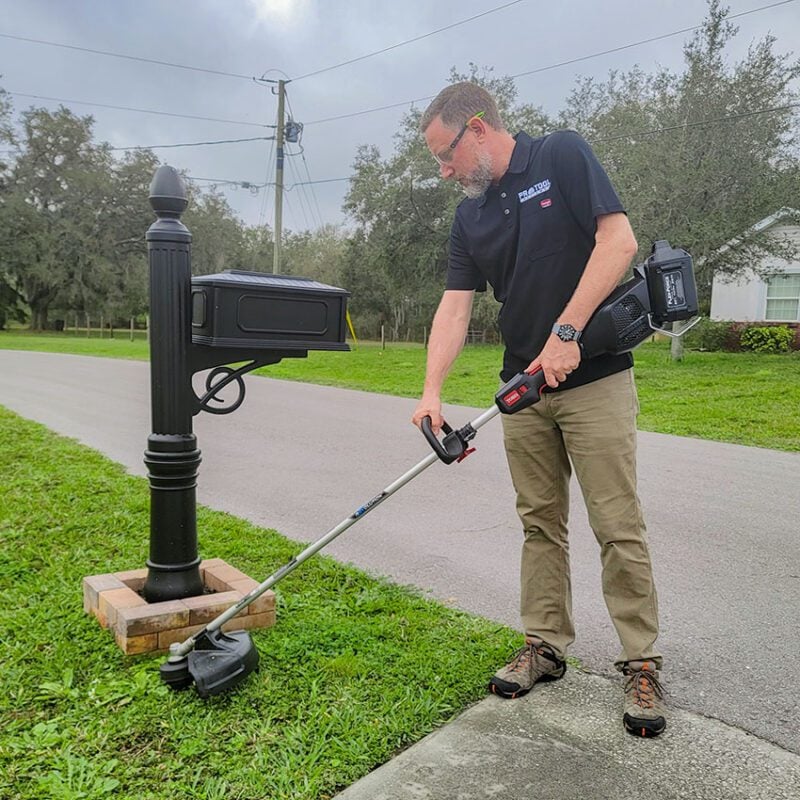
Toro 60V Revolution 66110T
Score: 80 Points
- Speeds: 5300/6400 RPM
- Max Line Diameter: 0.095 in.
- Cutting Swath: 16.0 in.
- Stock Head: Dual-line, rapid load
- Length: 74.5 in.
- Weight: 15.1 lbs w/4.0Ah battery
- Bare Price: $399.99
- Kit Price: Not available
Pros
- Excellent cutting speed
- Excellent vibration control
- Good runtime
- Rapid load head
- Optional backpack for batteries
Cons
- Expensive
- Heavy
While we’ve enjoyed Toro’s 60V products for residential use, the Revolution series pushes into the Pro market with a commercial-grade build. The line’s initial string trimmer comes out with mid-range power, good cutting speed, and solid runtime numbers in our tests.
The tougher build comes with a weight penalty. Just over 15 pounds with a 4.0Ah battery, you may want to take advantage of adding a shoulder strap when you’re working on larger properties. Better yet, grab the backpack that holds two batteries and take the battery weight off the tool altogether.
In a big win for this relatively new line, the Revolution string trimmer had the highest battery efficiency of our Pro models. You can legitimately run a 2.0Ah battery if you want to shave some weight. More importantly for your business, this trimmer needs fewer total watt-hours worth of batteries to get through the day compared to other brands.
The Revolution system is designed to customize for your unique business needs, so there aren’t any kits available for the handheld tools. You’ll need to grab the batteries and chargers separately and build out your trailer the way you need it.
| Result | Ranking (out of 8) | |
|---|---|---|
| Battery Used | 4.0Ah | |
| Tested Top Speed | 5850 RPM | 2nd |
| Cutting Speed | 9.5 sec. | 5th |
| Runtime | 28.1 min. | 4th |
| Battery Efficiency | 7.8 sec/Wh | 1st |
| Vibration Control | 2 out of 5 | 2nd (tie) |
| Balance | 4.5 lbs., rear bias | 4th |
| Line Loading | 3 out of 5 | 3rd (tie) |

Milwaukee M18 Fuel Dual Battery 3006
Score: 78 Points
- Max Speeds: 4900/6200 RPM
- Max Line Diameter: 0.105 in.
- Cutting Swath: 17 in.
- Stock Head: Dual-line, rapid load
- Length: 73.4 in.
- Weight: 16.8 bs w/2 x 8.0Ah batteries
- Bare Price: $399
- Kit Price: $699 w/two x 8.0Ah High Output batteries
Pros
- Extremely powerful
- High cutting speed
- Large cutting swath
- 0.105-in. line capable
- Includes a rapid load head
- Includes a shoulder strap
- Accelerators to full speed in less than 1 second
- 2.5 Nm peak torque
- 2.5HP peak power
Cons
- Heavy
- Frequent line breaks when cutting heavy cover
- Expensive
Milwaukee’s M18 Fuel Dual-Battery String Trimmer emerged as the most powerful model we tested. While its cutting swath isn’t quite as large as Makita’s GRU07 and Husqvarna’s 525iLST, we could feel the additional muscle Milwaukee’s brushless motor produced.
Its two-battery design puts 288Wh of capacity on board when you use a pair of 8.0Ah High Output batteries that netted more than 30 minutes of runtime during our review. From an efficiency standpoint, it’s solid as well, tying for second place. That’s impressive considering the noticeable power difference.
The downside is that it’s also the heaviest model in this group. However, there’s a shoulder strap that comes with the tool that I highly recommend you take advantage of when you’re trimming larger properties.
We ran into an issue during our cutting speed test where the line was frequently breaking against the tough material. That’s not something we saw from the other models or that we experienced on regular grass and moderate overgrowth. By using a line like Echo’s Black Diamond rather than the round line we used for our tests, you can likely avoid the problem.
| Result | Ranking (out of 8) | |
|---|---|---|
| Battery Used | 2 x 8.0 Ah High Output | |
| Tested Top Speed | 6175 RPM | 1st |
| Cutting Speed | 10.9 sec. | 6th |
| Runtime | 33.5 min. | 2nd |
| Battery Efficiency | 7.0 sec/Wh | 2nd (tie) |
| Vibration Control | 3 out of 5 | 6th (tie) |
| Balance | 5.2 lbs., front bias | 5th |
| Line Loading | 5 out of 5 | 1st |

Stihl 36V FSA 135 R
Score: 75 Points
- Max Speeds: 5900 RPM (three modes)
- Max Line Diameter: 0.105 in.
- Cutting Swath: 16.5 in.
- Stock Head: Dual-line, manual load
- Length: 74.1 in.
- Weight: 14.8 lbs w/AP 300 S battery
- Bare Price: $529.99
Pros
- Near-perfect balance
- Excellent vibration control
- 0.105-in. line capable
- Good runtime
- Cordless version of the Pro-grade FS 91 R
- Belt and backpack battery options available
Cons
- Manual loading stock head
- Expensive
- Heavy
Stihl designed its FSA 135 R to be an electrified version of its popular FS 91 R gas model. Using most of the same components aside from the powerplant, it’s an excellent option for Pro lawn crews who need a workhorse maintenance trimmer on a reliable battery platform. Plus, the servicing dealer network offers unmatched support after the sale.
Confident under load, this model also has near-perfect balance and very low vibration. It’s not as powerful as Greenworks Commercial’s ST161 or Milwaukee’s 3006, so keep that in mind if you’re tackling heavy overgrowth often.
While this trimmer is heavy, Stihl has options to shift the battery to your belt or back. It’s something to keep in mind for both weight savings and customizing your workflow.
Stihl’s website says the FSA 135 R now comes with the AutoCut C EasySpool, but ours came with the standard manual-loading head. Double-check with your dealer, and be sure to upgrade the head if the EasySpool isn’t included.
| Result | Ranking (out of 8) | |
|---|---|---|
| Battery Used | 7.2Ah | |
| Tested Top Speed | 5786 RPM | 4th |
| Cutting Speed | 12.7 sec. | 7th |
| Runtime | 23.5 min. | 5th |
| Battery Efficiency | 5.4 sec/Wh | 6th |
| Vibration Control | 2 out of 5 | 2nd (tie) |
| Balance | 0.2 lbs., rear bias | 1st |
| Line Loading | 1 out of 5 | 8th |

DeWalt 60V Max Attachment Ready DCST972
Score: 69 Points
- Max Speeds: 4650/5800 RPM
- Max Line Diameter: 0.095 in.
- Cutting Swath: 17 in.
- Stock Head: Dual-line, rapid load
- Length: 70.0 in.
- Weight: 12.7 lbs w/3.0Ah battery
- Bare Price: $289
- Kit Price: $369 w/3.0Ah FlexVolt battery
Pros
- High max cutting speed
- Large cutting swath
- Excellent vibration control
- Includes a rapid load head
- Universal attachment capable
- 60V Max battery also works on 20V Max tools
Cons
- Low runtime
- No tether point for a shoulder strap
If you’re looking for a multi-head system from a Pro-focused brand, DeWalt’s DCST972 is a viable option. Built on the foundation of a wide-swath string trimmer and thankfully going with a universal attachment interface, you have a wide range of ways to customize it to your needs.
The main concern is low runtime. With less than 10 minutes on high speed with the kitted 3.0Ah battery, you’ll need to manage your batteries more carefully than with other options.
However, don’t miss the price. $329 for the kit is awfully attractive and less than half the cost of some of our top picks. It’s low enough that even homeowners who like DeWalt power tools may want to pull the trigger.
| Result | Ranking (out of 8) | |
|---|---|---|
| Battery Used | 3.0Ah FlexVolt | |
| Tested Top Speed | 5793 RPM | 3rd |
| Cutting Speed | 13.7 sec. | 8th |
| Runtime | 9.3 min. | 8th |
| Battery Efficiency | 3.4 sec/Wh | 8th |
| Vibration Control | 2 out of 5 | 2nd (tie) |
| Balance | 7.0 lbs., front bias | 6th |
| Line Loading | 3 out of 5 | 3rd (tie) |
Best Battery-Powered String Trimmers for Homeowners
We ran three of our favorite homeowner-focused string trimmers through the same set of tests as the Pro models above.
Note that their scoring and rankings are based on how they competed against each other, but not against the Pro models.

Ryobi 40V HP Brushless RY402110
Score: 90 Points
- Speeds: Two (RPMs not listed)
- Max Line Diameter: 0.105 in.
- Cutting Swath: 17.0 in.
- Stock Head: Dual-line, rapid load
- Length: 76.1 in.
- Weight: 13.3 lbs w/6.0Ah battery
- Bare Price: $249
- Kit Price: $329 w/6.0Ah battery
Pros
- Large cutting swath
- Excellent power
- 0.105-in. line capable
- Good runtime
- Rapid load head
- Carbon fiber shaft
Cons
- Most vibration in the group
- No tether point for a shoulder strap
Homeowners with larger properties to maintain and who want the best performance will love what Ryobi’s RY40211 has to offer. Its ability to handle 0.105-inch line and the muscle behind its brushless motor set it apart from other residential-focused models we’ve used.
Even among the Pro models we tested in our head-to-head, Ryobi’s cutting speed didn’t lag far behind. Plus, we were able to get nearly 30 minutes of continuous runtime in high speed using 0.095-inch line, so you’ll have plenty of trigger time when you’re trimming larger areas.
The vibration was the highest of the group but not obnoxious. If you’ve used older Ryobi battery-powered string trimmer models, you’ll notice the vibration control is far better than it was a few years ago.
One downside is that with no tether point, there’s no easy way to add a shoulder strap if you’re hoping to transfer some of the weight out of your hands.
| Result | Ranking (out of 3) | |
|---|---|---|
| Battery Used | 6.0Ah | |
| Tested Top Speed | 5621 RPM | 2nd |
| Cutting Speed | 12.0 sec. | 1st |
| Runtime | 27.3 min. | 2nd |
| Battery Efficiency | 7.6 sec/Wh | 2nd |
| Vibration Control | 5 out of 5 | 3rd |
| Balance | 13.3lbs., front bias | 3rd |
| Line Loading | 4 out of 5 | 2nd |

EGO 56V Line IQ ST1623T
Score: 86 Points
- Max Speeds: 4800/5500 RPM
- Max Line Diameter: 0.095 in.
- Cutting Swath: 16 in.
- Stock Head: Dual-line, auto-feed
- Length: 72.3 in.
- Weight: 12.7 lbs w/4.0Ah battery
- Bare Price: $249
- Kit Price: $359 w/4.0Ah battery
Pros
- Excellent vibration control
- Outstanding runtime
- PowerlLoad automatic line loading
- Line IQ automatic line feeding
- Telescoping carbon fiber shaft
Cons
- Not all lines load or feed well
- Doesn’t handle thick overgrowth well
If you’re looking for the easiest, most convenient cordless string trimmer to use, EGO’s ST1623T is the way to go. Its telescoping carbon fiber handle lets you adjust the length of the tool rather than just shifting the handle position. Plus, Line IQ takes care of automatically feeding line, PowerLoad makes reloading line a breeze, and its low vibration keeps things more comfortable.
As easy as it is, you may need to stick to using EGO’s line, though. We’ve tried several others, and not all lines load or feed as reliably as EGO’s.
Beyond the convenience, this model easily had the longest runtime in our tests. Even if you use a 2.5Ah battery to shave some weight, you’ll still have close to 30 minutes of trigger time at the highest cutting speed.
That efficiency comes with a trade-off, though. With the lowest RPM of the entire test group, this model does a great job on most tasks, but it does struggle when you get to heavy overgrowth. If that’s something you encounter often, you may want to step up to a more powerful option.
| Result | Ranking (out of 3) | |
|---|---|---|
| Battery Used | 4.0Ah | |
| Tested Top Speed | 5406 RPM | 3rd |
| Cutting Speed | 16.2 sec. | 3rd |
| Runtime | 51.1 min. | 1st |
| Battery Efficiency | 15.2 sec/Wh | 1st |
| Vibration Control | 2 out of 5 | 1st |
| Balance | 6.1 lbs., front bias | 1st |
| Line Loading | 5 out of 5 | 1st |

Skil PWRCore 40 PLT1500C-10
Score: 83 Points
- Max Speeds: 5900 RPM (two speeds)
- Max Line Diameter: 0.095 in.
- Cutting Swath: 16.0 in.
- Stock Head: Dual-line, rapid load
- Length: 69.4 in.
- Weight: 12.2 lbs w/4.0Ah battery
- Bare Price: Not available
- Kit Price: $219 w/4.0Ah battery
Pros
- High cutting speed
- Universal attachment ready
- Excellent value
Cons
- Not as strong as other models
Skil emerges with another best value win with one of its newest PWRCore 40 string trimmers. On the performance side, it does a nice job, and its brushless motor had respectable cutting speed in our tests and was downright impressive against its residential competition. Its 16-inch cutting swath clears larger areas faster than the 12 – 15-inch models we usually find in the residential class.
Even though the trimmer is only rated for 0.080-inch line, we tested it with 0.095-inch to keep things fair against its competition. From a power standpoint, it did fine, though the runtime suffered a bit. You’ll get more than we did by sticking with the rated line.
For homeowners, I really like that this model is attachment-ready and accepts universal attachments. With only one powerhead to deal with, you can grab the additional attachments you need to keep your lawn and landscaping looking great while keeping the overall cost and storage footprint more manageable.
| Result | Ranking (out of 3) | |
|---|---|---|
| Battery Used | 4.0Ah | |
| Tested Top Speed | 5902 RPM | 1st |
| Cutting Speed | 13.6 sec. | 2nd |
| Runtime | 13.6 min. | 3rd |
| Battery Efficiency | 5.7 sec/Wh | 3rd |
| Vibration Control | 3 out of 5 | 2nd |
| Balance | 6.3 lbs., front bias | 6nd |
| Line Loading | 3 out of 5 | 3rd |
More Battery-Powered OPE Guides
- Best Battery-Powered Lawn Mowers
- Best Battery-Powered Leaf Blowers
- Best Battery-Powered Chainsaws
- Best Battery-Powered Hedge Trimmers
Best Line for Battery-Powered String Trimmers
Echo Black Diamond 0.095-Inch Trimmer Line
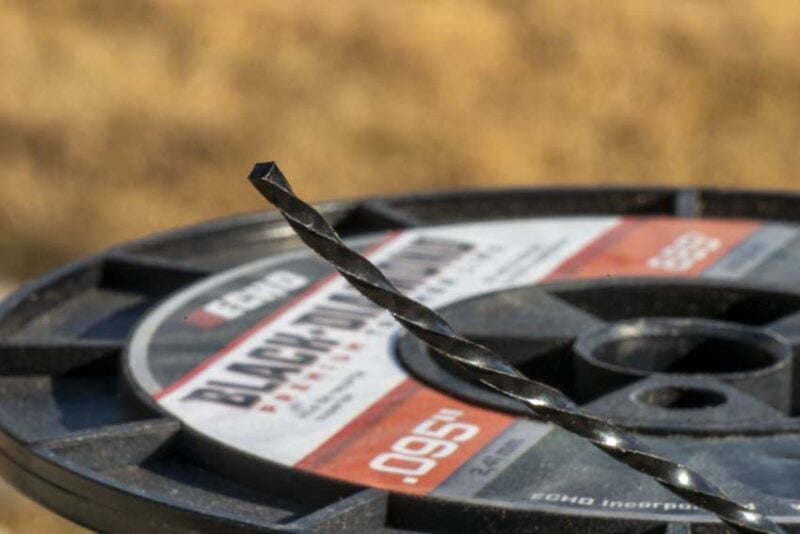
Echo Black Diamond trimmer line is denser than others and has sharper cutting edges in its design. For battery-powered string trimmers, you can use Black Diamond 0.095-inch line that cuts like it’s thicker without killing your runtime. There’s some runtime reduction because of the increase in mass, but not as much as when it combines with the increased air resistance of thicker lines. It’s the line we prefer on our gas trimmers and with cordless models being as capable as they are today, we’re able to use it on those as well.
Price: $20.99 – $79.99
Looking for Something Else? Here are More Battery-Powered String Trimmers We’ve Reviewed
Not every brand we recommend participated in our head-to-head testing. Here are a few more brands and models to consider if one of our other picks doesn’t quite meet your needs.
Greenworks 80V 17-Inch String Trimmer
If you’re a homeowner that wants Pro performance without the Pro price tag, Greenworks has an 80V model that’s awfully attractive.
It has the equivalent power of a 30cc gas engine, which puts you in mid-range Pro performance. With 5800 RPM in high, 0.105-inch line capability, and a 17-inch cutting swath, you can tackle long fence lines and overgrowth confidently.
One of the nice things is that it’s not overweight for the performance level. Weighing 11.2 pounds with a 2.0 battery on our scale, it also has low vibration, which translates to less fatigue while you’re working.
If you’re on Greenworks’ 60V battery system, you’re still covered. You can grab the 17-inch ST60L for similar performance, and it has the bonus of a carbon fiber shaft.
Milwaukee M18 Brushless String Trimmer
If you’re on the hunt for something with a Pro-grade build but lightweight and more affordable, Milwaukee’s M18 Brushless String Trimmer may be right up your alley.
Sporting the equivalent of ~25 cc gas engine and pushing 6200 RPM in high mode, it has solid performance for regular maintenance trimming and can handle moderate overgrowth.
With a 6.0Ah High Output battery, it weighs a reasonable 11.5 pounds, and the head-mounted motor helps keep the balance forward.
What’s eye-opening is the price tag—$249, and that includes a 6.0Ah High Output battery and charger. It’s a price that’s much easier than many Pro-grade options and could certainly tempt homeowners who prefer Milwaukee’s M18 system for their power tools.
Ridgid 18V Brushless String Trimmer R1201
Ridgid fans no longer have to consider a separate battery system to join the cordless lawn care craze. Fully compatible with Ridgid 18V power tool batteries, there’s a nice range to get started with. The string trimmer is on the smaller side, featuring a 12 – 14-inch cutting swath but still capable of using 0.095-inch line. It’s also on the lighter side, weighing less than 10 pounds with a 4.0Ah battery. It’s a nice option for Ridgid fans who want a lightweight string trimmer.
Price: $189 bare, $249 with a 4.0Ah battery and charger
Ryobi 40V HP Brushless Attachment Capable String Trimmer
If you’re a homeowner who wants the space and cost savings of a multi-head attachment system, consider Ryobi’s 40V HP Brushless RY40HPST02.
This iteration pushes the performance level to a 32cc gas equivalent, giving it plenty of muscle if you’re looking to use stronger attachments like a cultivator. That strength translates to a better string trimmer, too, and this one has a 17-inch cutting swath. If you’re trimming fence lines or reclaiming overgrown areas, this model can handle it.
If you need another reason to pull the trigger, the carbon fiber shaft helps keep the weight in check and absorbs some of the vibration, so it’s less fatiguing to use than some of the competition.
Grab this one for $249 as a kit with a 4.0Ah battery, or $189 if you only need the bare tool.
How We Test Battery-Powered String Trimmers with Full Results
Battery Pairings
For our testing, we paired each trimmer with the battery that comes in the kit, if one is available. This is the most common way people purchase battery-powered string trimmers, and we wanted our tests to reflect the most likely way you’ll experience them in the field.
Professional Models
| Model | Series | Tested Battery |
|---|---|---|
| DeWalt SDCST972 | 60V Max FlexVolt | 3.0Ah / 162Wh |
| ECHO DSRM-2600 | 56V | 5.0Ah / 252Wh |
| Greenworks Commercial ST161 | 82V | 4.0Ah / 320Wh |
| Husqvarna 525ILST | 36V | 9.0Ah / 344Wh |
| Makita GRU07 | 40V max XGT | 5.0Ah / 180Wh |
| Milwaukee 3006 | M18 RedLithium Forge | 2 x 8.0Ah /288Wh |
| Stihl FSA135R | 36V | 7.2Ah / 259Wh |
| Toro 66110T | 60V | 4.0Ah / 216Wh |
Homeowner Models
| Model | Series | Tested Battery |
|---|---|---|
| EGO ST1623T | 56V | 4.0Ah / 202Wh |
| Ryobi RY402110 | 40V | 6.0Ah / 216Wh |
| Skil PLT1500C-10 | PWRCore 40 | 4.0Ah / 144Wh |
Max Cutting Swath
Note that many battery-powered string trimmer models have reversible cutters. Set for the longer string length, you can cut a wider swath. Set to the shorter length, you’ll get better runtime. This list shows the maximum cutting swath each trimmer can be set to.
Professional Models
| Model | Max Cutting Swath |
|---|---|
| DeWalt SDCST972 | 17 in. |
| ECHO DSRM-2600 | 17 in. |
| Greenworks Commercial ST161 | 17 in. |
| Husqvarna 525ILST | 18.1 in. |
| Makita GRU07 | 18 in. |
| Milwaukee 3006 | 17 in. |
| Stihl FSA135R | 16.5 in. |
| Toro 66110T | 16 in. |
Homeowner Models
| Model | Max Cutting Swath |
|---|---|
| EGO ST1623T | 16 in. |
| Ryobi RY402110 | 17 in. |
| Skil PLT1500C-10 | 16 in. |
Pro Tip: Cutting without the guard is a common way professional crews get more cutting swath, but it subjects the motor to a much greater load than it was tuned for. Whether you’re using gas, battery, or electric, leave the guard and cutter in place to get the best performance and life from your trimmer.
Max Line Diameter and Tested Line
While most of our battery-powered string trimmers are capable of using 0.095-inch line, some are able to step up to a beefier 0.105-inch that’s better at cutting tough overgrowth. We tested each model with the maximum line diameter it was rated for, with the exception of Skil. Even though it’s only rated for 0.080-inch line, we bumped it up to 0.095-inch to better test its cutting power.
While ECHO’s Black Diamond line is our favorite because it offers the best cutting performance, we decided to do our testing with round lines from Husqvarna. The 0.095-inch line was Titanium Force, and the 0.105-inch line was Titanium X Pro.
Professional Models
| Model | Max Line Diameter |
|---|---|
| DeWalt SDCST972 | 0.095-in. |
| ECHO DSRM-2600 | 0.095-in. |
| Greenworks Commercial ST161 | 0.095-in. |
| Husqvarna 525ILST | 0.105-in. |
| Makita GRU07 | 0.105-in. |
| Milwaukee 3006 | 0.105-in. |
| Stihl FSA135R | 0.105-in. |
| Toro 66110T | 0.095-in. |
Homeowner Models
| Model | Max Line Diameter |
|---|---|
| EGO ST1623T | 0.095-in. |
| Ryobi RY402110 | 0.105-in. |
| Skil PLT1500C-10 | 0.095-in. |
Pro Tip: Cut with the maximum line diameter to get the strongest cutting performance. Step down to a lower diameter for longer runtime or to lower the risk of damaging material such as vinyl fence.
Length
We measured each string trimmer’s length with the battery installed.
Professional Models
| Model | Length with Battery |
|---|---|
| DeWalt SDCST972 | 70.0 in. |
| ECHO DSRM-2600 | 73.5 in. |
| Greenworks Commercial ST161 | 72.5 in. |
| Husqvarna 525ILST | 70.8 in. |
| Makita GRU07 | 76.4 in. |
| Milwaukee 3006 | 73.4 in. |
| Stihl FSA135R | 74.1 in. |
| Toro 66110T | 74.5 in. |
Homeowner Models
| Model | Length with Battery |
|---|---|
| EGO ST1623T | 72.3 in. |
| Ryobi RY402110 | 76.1 in. |
| Skil PLT1500C-10 | 69.4 in. |
Weight and Balance
We weighed each string trimmer, including the same battery we tested it with. We also checked the balance.
Good balance is critical, but objectively testing it is difficult. The front handles are adjustable, so you can customize the fit to your specific arm length and height. Any adjustment you make changes the balance of the tool, so take these results with a grain of salt.
With the front handle in the stock position (many trimmers have a mark for this), we weighed how much of the trimmer’s weight was in the front handle and how much was at the trigger handle. Perfect balance would have an equal amount at each one, regardless of the total weight.
Once we had the numbers, we scored them from 1 to 5. 1 is the most neutral between the two handles, and 5 has all the weight on one.
You can make the argument that you want all the weight on the front handle, putting the center of balance directly on it. This would leave your front arm bearing all the weight while your trigger hand is can maneuver the head freely. However, we believe that an equal weight distribution between both arms helps fight fatigue better over the course of the day.
The score for each model is the measure of how much the weight was biased towards the front or back. For example, consider the following hypothetical measurements:
- Total Weight: 11.0 lbs
- Front Handle: 4.5 lbs
- Trigger Handle: 6.5 lbs
This model would have a balance rating of 2.0 lbs, rear bias, indicating that your trigger hand would hold 2 more pounds than your front hand.
Professional Models
| Model | Weight with Battery | Balance |
|---|---|---|
| DeWalt SDCST972 | 12.7 lbs. | 7.0 lbs., front bias |
| ECHO DSRM-2600 | 12.0 lbs. | 2.8 lbs., front bias |
| Greenworks Commercial ST161 | 16.2 lbs | 11.4 lbs, front bias |
| Husqvarna 525ILST | 13.1 lbs. | 4.3 lbs., front bias |
| Makita GRU07 | 14.7 lbs. | 8.0 lbs., front bias |
| Milwaukee 3006 | 16.8 lbs. | 5.2 lbs., front bias |
| Stihl FSA135R | 14.8 lbs. | 0.2 lbs., rear bias |
| Toro 66110T | 15.1 lbs. | 4.5 lbs., rear bias |
Homeowner Models
| Model | Weight with Battery | Balance |
|---|---|---|
| EGO ST1623T | 12.7 lbs. | 6.1 lbs., front bias |
| Ryobi RY402110 | 13.3 lbs. | 13.3 lbs., front bias |
| Skil PLT1500C-10 | 12.2 lbs. | 6.3 lbs., front bias |
Line Loading
As we changed out the stock lines for our Husqvarna test lines, we noted the style of each head design and how easy it is to change the line out. Even though rapid loading heads are common, there are some differences in design that make some easier to use than others.
Note that for the rating, the score is on a 1 – 5 scale and a higher score is better.
Professional Models
| Model | Head Design | Line Change Rating |
|---|---|---|
| DeWalt SDCST972 | Dual-line, rapid load | 3 |
| ECHO DSRM-2600 | Dual-line, rapid load | 3 |
| Greenworks Commercial ST161 | Dual-line, rapid load | 2 |
| Husqvarna 525ILST | Dual-line, rapid load | 2 |
| Makita GRU07 | Dual-line, rapid load | 3 |
| Milwaukee 3006 | Dual-line, rapid load | 5 |
| Stihl FSA135R | Dual-line, manual load | 1 |
| Toro 66110T | Dual-line, rapid load | 3 |
Homeowner Models
| Model | Head Design | Line Change Rating |
|---|---|---|
| EGO ST1623T | Dual-line, rapid load | 5 |
| Ryobi RY402110 | Dual-line, rapid load | 4 |
| Skil PLT1500C-10 | Dual-line, rapid load | 3 |
Pro Tip: Hate the head that came on your string trimmer? In most cases, you can swap it out for another one. Some brands are interchangeable and there are also third-party replacement heads available.
Vibration
Since we don’t have a vibration meter, we have to test it more subjectively than some of our other tests. For this, we run the trimmer at high speed with the longest cutting swath under no load and feel how much vibration it has. We keep testing side-by-side until we find the ones with the lowest vibration levels and separate them into categories from 1 – 5, with 1 having the best vibration control and 5 having the worst. For this test, a lower score is better.
Professional Models
| Model | Vibration |
|---|---|
| DeWalt SDCST972 | 2 |
| ECHO DSRM-2600 | 1 |
| Greenworks Commercial ST161 | 3 |
| Husqvarna 525ILST | 2 |
| Makita GRU07 | 3 |
| Milwaukee 3006 | 3 |
| Stihl FSA135R | 2 |
| Toro 66110T | 2 |
Homeowner Models
| Model | Vibration |
|---|---|
| EGO ST1623T | 2 |
| Ryobi RY402110 | 5 |
| Skil PLT1500C-10 | 3 |
RPM Testing
Using a tachometer, we tested each model’s maximum RPM with its largest rated line at its largest cutting swath under no load. This may differ from the rated speed, considering that the aerodynamics, mass, and length of the line come into play.
Since every unit in this test uses an electronically controlled brushless motor, it’s possible that some can better adjust to the changes and keep the speed up than others.
Professional Models
| Model | Max Speed Rating | Max Speed Tested |
|---|---|---|
| DeWalt SDCST972 | 5800 RPM | 5793 RPM |
| ECHO DSRM-2600 | 5680 RPM | 5691 RPM |
| Greenworks Commercial ST161 | 5500 RPM | 5481 RPM |
| Husqvarna 525ILST | 5500 RPM | 5490 RPM |
| Makita GRU07 | 5700 RPM | 5626 RPM |
| Milwaukee 3006 | 6200 RPM | 6175 RPM |
| Stihl FSA135R | 5900 RPM | 5786 RPM |
| Toro 66110T | 6400 RPM | 5850 RPM |
Homeowner Models
| Model | Max Speed Rating | Max Speed Tested |
|---|---|---|
| EGO ST1623T | 5500 RPM | 5406 RPM |
| Ryobi RY402110 | Not listed | 5621 RPM |
| Skil PLT1500C-10 | 5900 RPM | 5902 RPM |
Cutting Speed
To test cutting speed, we set up a rig using 3 layers of Vigoro reed fencing (item number 325538 at Home Depot) that ran 8 feet long. This material is similar to the kind of tall, stalky grass we cut in overgrown areas in Central Florida and offers better consistency than lawns or fields.
The results are the amount of time it took each model to complete the 8-foot section in the quickest of two runs.
Professional Models
| Model | Time |
|---|---|
| DeWalt SDCST972 | 13.7 sec. |
| ECHO DSRM-2600 | 9.1 sec. |
| Greenworks Commercial ST161 | 7.0 sec. |
| Husqvarna 525ILST | 8.8 sec. |
| Makita GRU07 | 8.4 sec. |
| Milwaukee 3006 | 10.9 sec. |
| Stihl FSA135R | 12.7 sec. |
| Toro 66110T | 9.5 sec. |
Homeowner Models
| Model | Time |
|---|---|
| EGO ST1623T | 16.2 sec. |
| Ryobi RY402110 | 12.0 sec. |
| Skil PLT1500C-10 | 13.6 sec. |
Runtime and Battery Efficiency
To test runtime, we stuck with the same line we ran our cutting tests with so you can see the correlation between the best cutting performance each model offers and the runtime you can expect when you run at wide open throttle at high speed.
Manufacturers typically report a maximum runtime based on trimming at the lowest speed with the smallest rated line diameter. Your experience will likely be between that value and what we tested, depending on what speed and line you use.
We took things a step further by looking at battery efficiency at high speed, measured as seconds of runtime per watt-hour of battery capacity. Similar to how you can use miles per gallon to understand how efficiently a vehicle uses fuel, battery efficiency can help in your string trimmer selection.
For example, if lightweight is your highest priority, a highly efficient trimmer can allow you to use a lower-capacity battery to reduce the weight. If you run a landscaping crew, it can help you decide if you’re better off loading up with standard batteries or opting for a high-capacity backpack battery instead.
Professional Models
| Model | Max Rated Runtime | Tested Runtime at High Speed | Battery Efficiency |
|---|---|---|---|
| DeWalt SDCST972 | 60 min. | 9.3 min. | 3.4 sec/Wh |
| ECHO DSRM-2600 | 54 min. | 17.0 min. | 4.0 sec/Wh |
| Greenworks Commercial ST161 | 55 min. | 29.4 min. | 5.5 sec/Wh |
| Husqvarna 525ILST | Not listed | 40.3 min. | 7.0 sec/Wh |
| Makita GRU07 | Not listed | 17.0 min. | 5.7 sec/Wh |
| Milwaukee 3006 | 50 min. | 33.5 min. | 7.0 sec/Wh |
| Stihl FSA135R | 45 min. | 23.5 min. | 5.4 sec/Wh |
| Toro 66110T | Not listed | 28.1 min. | 7.8 sec/Wh |
Homeowner Models
| Model | Max Rated Runtime | Tested Runtime at High Speed | Battery Efficiency |
|---|---|---|---|
| EGO ST1623T | 60 min. | 51.2 min. | 15.2 sec/Wh |
| Ryobi RY402110 | 67 min. | 27.3 min. | 7.6 sec/Wh |
| Skil PLT1500C-10 | Not listed | 13.6 min. | 5.7 sec/Wh |
What to Look For When You’re Shopping for a Battery-Powered String Trimmer
Compatible Tools
When you buy a cordless string trimmer, you’re buying into a system of tools that run on the same batteries. Before you pull the trigger, check and see if that system has the other products you need or want. Even if you’re only buying a string trimmer now, you might want to add a hedge trimmer, blower, or other tools later. Keeping everything on the same battery system reduces the number of batteries and chargers you have to manage.
Cutting Power
When cutting power is your top priority for a battery-powered string trimmer, three primary factors go into it: line speed, line thickness/mass, and motor torque.
The faster the line whips around, the better the tips cut grass. Most battery-powered string trimmers are fine in this category. As long as you’re getting at least 5000 RPM, you should be in good shape. The top models are capable of hitting 6500 RPM and there is a significant difference in how fast you can complete your trimming duties at higher rotational speeds.
Shifting the focus to the line thickness, the higher the line mass, the more force it’s able to cut through thicker grass with. It’s like the difference between getting hit by a 175-pound safety and a 225-pound linebacker at the same speed. More mass equals more cutting power.
Most cordless string trimmers take 0.080-inch line at a minimum. We recommend 0.095-inch for the best all-around performance. If you have tougher grass or deal with overgrowth frequently, a string trimmer with 0.105-inch line lets you power through even better. Just keep in mind that line diameter has a direct effect on runtime—thicker line takes more energy to run.
Finally, a motor with higher torque helps the trimmer resist slowing down as the going gets tougher. Even though trimming grass seems like a low-demand task, grass does push back against the line, causing it to bend back and eventually start to bog the motor. Higher torque keeps the head spinning better in tough cutting situations, even when its highest RPMs are lower than that of low-torque gearing.
Cutting Swath
Having a large cutting swath helps you clear large areas faster or gives you a more generous border for your mower. You need more power to run wider, though, and runtime is always a consideration. That said, in the past couple of years, we’ve seen the technology come together to give us solid options. Look for a 15-inch cutting diameter for most situations. Recent 16- and 17-inch models are a great choice when you have larger areas to cut.
Runtime
The average homeowner on a 1/4-acre lot needs less than 15 minutes of actual trigger time to cover trimming. Most cordless string trimmers can hit that at high speed without difficulty.
Professional lawn care crews need much more, though. So do homeowners with large properties or those with farm/ranch acreage.
If your runtime needs are greater, look for a string trimmer that balances the efficiency of a brushless motor, uses 0.095-inch line, and possibly comes with a higher-capacity battery. Of course, you can always carry multiple batteries.
Also, consider learning how to trim at low speed when the grass isn’t as thick. Even though you have to slow down a bit, you’ll cut a significantly larger area per charge.
Vibration
We highly value low-vibration string trimmers. We already have enough work to do managing the weight of such a long tool without vibration adding additional fatigue. The harmonics in some of today’s models are so good that hardly any vibration makes it up the handle… and they are a joy to use!
Weight and Balance
If you’re working all day on a lawn crew or even just putting the finishing touches on your own lawn, you want the lightest weight you can get without sacrificing the power and runtime you need. Bare weight isn’t everything—the battery can add a lot. If you can get a fully loaded battery-powered string trimmer that meets your performance needs and comes in under 10 pounds, that’s a big win.
Balance is a consideration and the trimmers that have the best typically mount the motor on the trimmer head to counter the battery weight on the back. Many models also let you adjust the front handle to help dial in your fit.
If you’re after an attachment-capable model, you’re stuck with the motor in the back, and the balance shifts back. For those trimmers that are simply heavier by nature, consider adding a shoulder strap to help you out.
Sound Level
Low noise is one of the major benefits of moving away from gas power. Cordless string trimmers we’ve tested range from decibels in the low 80s to the upper 90s (measured at our operator’s ear). Even at the top end, it’s an improvement over the majority of gas trimmers.
Your line selection plays a bigger part than it does on gas trimmers. Sometimes, switching the line you use can reduce the overall noise level or change the tone to a less irritating pitch.
Line Changes
When you have to change the line, it can be an easy or frustrating process. Manual loading is largely a thing of the past, though some trimmers still have manual heads. To make the process easier, look for models that have some type of fast-loading system (SpeedFeed, Rapid Load, etc). With these, you thread the line through the head to the middle, turn the head to load it, and get on with the work.
Regardless of what comes on the trimmer, you can upgrade most to a quick-load head.
The best on the market right now is EGO’s PowerLoad design. It takes the fast-load concept and adds automatic winding, giving us the easiest, quickest line changes we’ve ever had.
Attachment Capability
Pro lawn crews typically have dedicated machines for string trimming, edging, and hedge trimming, but homeowners can save a lot of money by using interchangeable heads and tools that cover everything from blowing to brush cutting.
As we mentioned earlier, attachment systems require a top-mounted motor that affects the balance. It’s a trade-off you have to make for the convenience you gain.
One thing to keep an eye on is the attachment connection style. Models with a “universal” connection can use attachments from other brands, opening up far more choices. Recent multi-head systems including EGO, Milwaukee, and Stihl aren’t compatible with others, so you need to make sure they have everything you need before investing.
Why You Can Trust Pro Tool Reviews to Recommend Battery-Powered String Trimmers
Ever check out a “review” site and you can’t tell if they actually tested anything or if they’re just “recommending” the Amazon top sellers? That’s not us. We won’t recommend anything unless we’d actually use it ourselves, and we don’t really care who the primary retailer is. It’s all about giving you a legitimate recommendation and our honest opinion of each product.
We’ve been in business since 2008 covering tools, writing reviews, and reporting on industry news in the construction and lawn care industries. Our Pro reviewers work in the trades and have the skills and experience to know whether tools can perform well in the field.
Each year, we bring in and review more than hundreds of individual products. Our team will put our hands on hundreds of additional tools at media events and trade shows throughout the year.
Pro Tool Reviews consults with innovators in the technology and design of tools to gain a broader grasp of where these products fit and how they work.
We work with more than two dozen professionals around the United States who review products for us on real jobsites and with real lawn crews. We consult with them extensively on testing methods, categories, and practical applications.
Our site will provide hundreds of pieces of new content this year absolutely free for our readers. That includes objective evaluations of individual tools and products.
The result is information you can trust because of the editorial, scientific, and real-world professional experience we collectively draw from each and every time we pick up and test a tool.


great review of options to consider for battery operated string trimmers. your results are from actual testing and not makers claims. thank you for an objective review
Any reason you didn’t test the commercial Ego model, STX4500?
We weren’t able to get it in time for this review, but we’ve got our eyes on it and will likely test it in the near future.
I look forward to reading your opinion on it. I absolutely love mine, especially with .105 Black Diamond. I’m curious as to how it compares to these other models. Keep up the good work and thank you!
Need to do more research on EGo weedeaters. Very poor system! Cuts fine. Line loading system doesn’t work well and is a disaster. Worst weedeater to buy, I’ll make you a good price on one. Stay away from these!
What issues are you having with the line-loading system? We noticed the LineIQ had issues feeding if we didn’t use round line. I prefer Black Diamond from ECHO, and it definitely didn’t like that. I don’t recall any issues loading it, though.
I look forward to reading your opinion on it. I absolutely love mine, especially with .105 Black Diamond. I’m curious as to how it compares to these other models. Keep up the good work and thank you!