
Our reader base is made up of people from all generations, from veteran retired Pros to the greenest of DIYers. Some of you may even remember far-back milestones like the first cordless drill coming to shelves or, more recently, when battery-powered OPE started really competing with gas.
We thought it would be fun to take a look back at each year’s most popular tool, from the 1960s to the present day, to see what the tool trends were in the year you were born!
While the best-selling singular tools are hard to identify in early decades like the 1960s and 1970s, we chose tools from those years that were the likeliest to be in many homes, shops, and garages of the time. We also took into account the major advances in that era, as many homeowners and Pros jumped at the new technology soon after it became available.
So, what was the most popular or notable tool from your birth year? Let’s get into the list
Jump to Decade
1960s

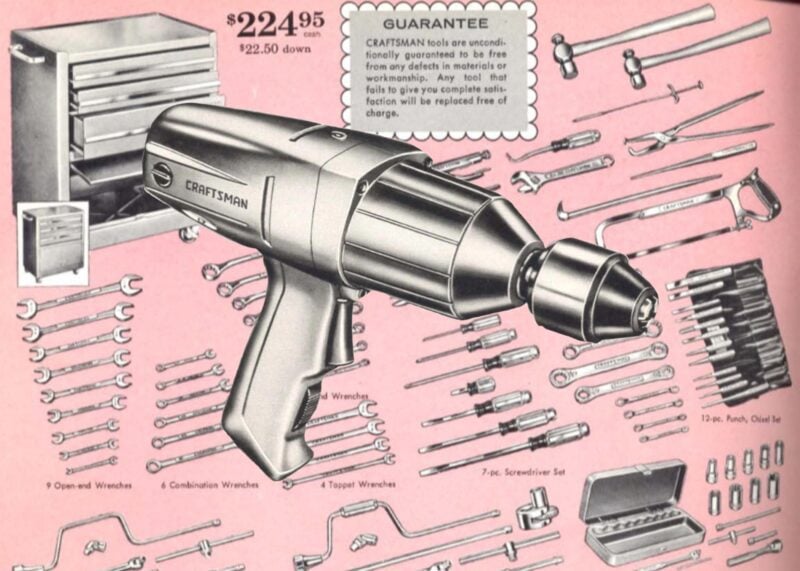
In the ’60s, brands like Black & Decker and Craftsman dominated home garages and workshops. The availability of tools at department stores like Sears made these brands more accessible to middle-class homeowners and Pros alike.
1960: Craftsman 5-Tool Power Shop
Introduced in 1959 and finding its roots in the early ’60s, the Craftsman 5-Tool Power Shop was a 5-in-1 tool designed to save space in home garages and workshops. It consisted of a tilting arbor bench saw, jointer-planer, jigsaw, saber saw, and disc sander.
1961: Black & Decker Cordless Drill
Black & Decker revolutionized the power tool industry in ’61 with the introduction of the world’s first battery-powered drill. Powered by nickel-cadmium (NiCad) cells, it introduced the power tool industry to cordless capabilities.
1962: Black & Decker Cordless Hedge Trimmer
Black & Decker provided more cordless innovation in 1962 with the world’s first battery-powered outdoor power tool—the cordless hedge trimmer. Interestingly, during the same era, the brand also offered one of the first hedge trimmer attachments for drills. Oh, how far we’ve come.
1963: Stanley PowerLock Tape Measure
Stanley released the first slide-locking tape measure in 1963, and it was a hit. Its reliability and design even led NASA to select it for use during the Apollo 11 lunar landing in 1969! Stanley still manufactures the PowerLock tape measure, and many brands used its blueprint for their own tapes after the patent expired in 1970.
1964: Black & Decker U-100 Electric Drill
Perhaps the most versatile of Black & Decker’s corded drill lineup was the U-100 electric drill, which was popular among homeowners for maintenance and home projects. In fact, it was advertised with the tagline, “When you can’t hire an expert… buy one.”
1965: Black & Decker Cordless Impact Wrench
Another NASA-related tool is the Black and Decker Cordless Impact Wrench, which was commissioned in 1965 specifically for space-related applications, namely maintenance on the Gemini spacecraft, according to Motorhead Tools. The space race novelty influenced other cordless consumer versions around this time.
1966: Metabo S-Automatic Safety Clutch Angle Grinder
In 1966, Metabo led the charge for angle grinder safety, including an S-Automatic Safety Clutch on its popular corded angle grinders. This safety advancement greatly reduced the likelihood of kickback, while also preventing your wheel from shattering or your gears from damage.
1967: Hilti TE 17 Electro-Pneumatic Drill
The Hilti TE 17 electro-pneumatic drill, released in 1967, revolutionized concrete drilling using a powerful hammering action. Hilti claims it “makes a 90-minute job a 90-second job,” and if that was the case, there’s no wonder it was a popular tool for professional contractors at the time.
1968: Craftsman Home-n-Shop Vacuum
Craftsman had a variety of vacuums and dust collectors available in 1968. One of the most versatile was the Home-n-Shop vacuum, which they advertised as being ideal for shop areas, garages, and “many places where ordinary cleaners clog.” Much like the shop vacs of today, this model could also be used as a blower.
1969: Makita 6500D Battery-Powered Drill
While Black & Decker produced the first cordless drill 8 years earlier, Makita was the first brand to market battery-powered technology to the masses with the 6500D cordless drill released in 1969.
1970s

The 1970s continued the mission of evolving tool technology. Here, we still see brands like Black & Decker and Craftsman at the forefront, with other best-selling additions like Bostitch, Milwaukee, and Stanley coming into play.
1970: Bostitch N 16 Portable Framing Nailer
Created at the turn of the decade, Bostitch’s N 16 marked the brand’s entry into the framing nailer market. Soon after, this pneumatic tool found its way onto heaps of heavy-duty construction and framing jobs.
1971: Stanley Hammers
Stanley is just one brand that manufactures hammers, and even in the early 1970s, they had dozens of models available. One notable model from their ’73 catalog includes the 51-616 claw hammer, which is still manufactured today.
1972: Craftsman 7 1/2-inch Circular Saw
Craftsman continued to be ever-present on the power tool scene in the 70s, with corded tools like the 7 1/2-inch circular saw on many workbenches. This model featured an electronic brake, which stopped the blade as soon as you released the trigger.
1973: Skil 8 1/4-inch Circular Saw Model 554
Skil rated its corded 554 circular saw “The most powerful saw in its class” in its 1973 consumer catalog. It featured a 13-amp motor and came in at just under $100 that year. Today, that would be around $760!
1974: Black & Decker Workmate WM325
Finding its roots in the UK at trade shows earlier in the decade, the Black & Decker Workmate was brought to the United States in 1974, where it saw great success. This workbench featured a portable, folding design that evolved into dozens of different models after its inception.
1975: Skil 599 Xtra-Tool
Dubbed “The multipurpose tool for every home,” this tool could drill and drive, had a hammering mechanism, could cut circular holes, and much more. Like modern multi-tools, you could purchase accessories for each application, and its inline drill-like design made for easy use.
1976: Craftsman Screwdrivers
While Craftsman had been producing screwdrivers for decades by the 70s, 1976 marked the year they rolled their 100 millionth screwdriver off the assembly line!
1977: Milwaukee Sawzall
Milwaukee introduced the first Sawzall in 1951, and throughout the 1960s, the brand added enhanced features like dual speeds and dial controls. While it would have been well-established by the 1970s, it was extremely popular with contractors, plumbers, and electricians, and remained one of Milwaukee’s flagship sellers through the decade.
1978: Makita 6010D 7.2V Cordless Drill
Almost a decade after Makita brought cordless drill technology to the masses, the brand released its 7.2V 6010D cordless drill. This model pioneered the modern battery-powered design, with a handle-mounted, removable NiCad battery.
1979: Milwaukee 4 1/2-inch Angle Grinder
Following larger 7-inch and 9-inch angle grinders produced before the ’70s, Milwaukee brought forth the first United States-made 4 1/2-inch angle grinder at the tail end of the decade.
1980s

During the 1980s, power tool companies continued to hone in on the cordless technologies of previous decades. During this time, we see more battery-powered solutions becoming available for the everyman homeowner, not just construction-focused contractors. Brands like Skil start showcasing more cordless options, and we also see Ryobi enter the tool market.
1980: Skil 3.6V Cordless Drill
Skil’s 3/8-inch cordless drill (model 2007) became a popular light-duty cordless option for homeowners upon its 1980 release. This model had two speed modes and a charge indicator light for its internal battery.
1981: Makita AN5000 Pneumatic Nailer
Launched in 1981 along with the AC6001 air compressor, the AN5000 nailer was Makita’s first pneumatic tool. It helped pave the way for more pneumatic tools, speeding up construction for Pro framers.
1982: Skil 7.2V Drill/Driver
First sold in 1982, the Skil 2011 3/8-inch drill/driver featured a removable quick-charge battery pack and came with a charger. Following Makita’s removable battery design a few years prior, Skil brought this blueprint to smaller-scale applications for homeowners.
1983: Leatherman Pocket Survival Tool (PST)
The very first Leatherman multi-tool was introduced in 1983 after years of development by founder Tim Leatherman. It featured 14 tools, including the iconic folding pliers that we still see in Leathermans (and other multi-tools) today. In ’83, you could get your hands on the first Leatherman model through mail-order catalogs from Early Winters and Cabela’s.
1984: Bosch Cordless Hammer Drill GBH 24 V
Bosch released one of the first cordless hammer drills, the GBH 24 V, in 1984. It featured a 24V NiCad battery system, enabling tradesmen to drill into stone and masonry cord-free. This first iteration drilled up to 60 holes on a single charge.
1985: Ryobi Routers
Ryobi finally expanded its power tool efforts into the US starting in 1985, with routers being one of the first tool types offered. The brand had started manufacturing power tools in Japan in the late 1960s, but they brought their router lineup, with their old iconic blue color scheme to America starting in ’85.
1986: Paslode Impulse Cordless Framing Nailer
The very first cordless, non-pneumatic framing nailer was from Paslode in 1986. It used a combination of a fuel cell for the driving force and an internal NiCad battery to power the drive system, allowing framers to break free from the air hose for the first time.
1987: Bosch SDS-Plus Rotary Hammer
The Bosch 11210VSR rotary hammer became widely available in 1987 and featured the (new at the time) SDS-Plus bit system. It gave contractors the ability to drill into concrete and masonry, as well as perform light-duty chiseling applications.
1988: Milwaukee Magnum Hole-Shooter
The Milwaukee 1/2-inch 0234-1 Magnum Hole Shooter was in production around 1988. This corded tool offered Pro-grade durability and power, and was known as a “buy it for life” tool for plumbers and electricians.
1989: Kreg Pocket Hole Jig
Kreg Tool Company was founded in 1989, after the invention of the U-shaped single-hole jig that came to be known as the Kreg Jig. In 1989, it was being sold at woodworking shows to great success, and a patent was issued the following year.
1990s

In the 1990s, we’re seeing existing tool brands up the ante in the cordless market. We also see players like DeWalt popping up after their relaunch, targeting contractors and Pro woodworkers. Let’s dive into some popular tools from each year for the ’90s babies.
1990: ICS 801H Hydraulic Chainsaw
ICS’s first-ever cutting system started out with a bang, winning the Best New Product of the Year award at the 1990 World of Concrete trade show. This chainsaw could slice through concrete and even complete square cuts without the overcutting associated with earlier circular saws.
1991: Milwaukee Super Sawzall
The first Sawzall from the 1950s was hugely popular, but the Super Sawzall was released in 1991 with even more built-in features. Most notably, Milwaukee added an internal counterbalance system that significantly reduced vibration levels during use.
1992: Black & Decker SnakeLight Flashlight
The SnakeLight flashlight is Black & Decker’s second-best-selling product to date. Released in 1992, it gained huge popularity in the following years for its flexible design and hands-free, versatile lighting.
1993: Black & Decker VersaPak Tools
Even Black & Decker, the inventors of the very first cordless drill, were entering the interchangeable battery system game in the early 1990s. Tools in the VersaPak system ran on 3.6V NiCad battery packs, including flashlights, screwdrivers, and other common homeowner tools.
1994: DeWalt 14.4V Cordless Tool System
While this isn’t a single tool, 1994 marked a significant year for DeWalt, which launched a new 14.4V system of over 30 tools. For the first time in DeWalt’s history, Pros could use the same 14.4V NiCad batteries interchangeably to power an entire range of power tools, which was a huge selling point for Pros who wanted to go cordless.
1995: Porter-Cable Tiger Saw
In 1995, Porter-Cable redesigned a lineup of reciprocating saws that featured a groundbreaking innovation: the first-ever tool-free blade change system. Gone were the days of Allen wrenches for blade changes; these ’95 reciprocating saws used a twist-lock clamping system, enabling quick blade swaps.
1996: Festool CDD 12 Cordless Drill
While it may have come a bit later than its competitors, Festool released its own cordless drill in 1996. It featured a compact C-shaped design that allowed for easier access into tight spaces. Notably, the removable 12V battery mounted on the front of the handle rather than the base to promote better balance for its shape.
1997: Makita 6213D Driver Drill
Makita again leads the charge into new battery territory, with the 6123D drill being the first model to feature a Nickel-Metal Hydride (Ni-MH) battery. This tool offered increased performance over NiCad battery tools, as well as an enhanced design that allowed it to be set down upright.
1998: Makita 18V 5621D Cordless Circular Saw
In 1998, Makita was producing cordless circular saws for both their 9.6V and 18V platforms. Tools in the latter system, like the 18V 5621D, offered a higher performance level than their more compact 9.6V models.
1999: Milwaukee 7 1/4-inch Tilt-Lok Circular Saw
Milwaukee’s Tilt-Lok circular saw was released in 1999. Its standout feature was its titular Tilt-Lok handle, which could be adjusted to 8 different positions for a variety of angled cuts.
2000s

Finally, the last decade we’re going to cover (which should encompass most of the new tradesmen entering the job force) is the 2000s. During this decade, much of the modern power tool technology we see today is making landfall, like lithium-ion batteries and brushless technology. Here, we see brands like Milwaukee, Makita, and DeWalt continue to dominate the professional jobsite with innovative solutions.
2000: Ryobi 18V System
Ryobi introduced its first 18V cordless drill (still powered by NiCad batteries) in 1996. However, an exclusive partnership with The Home Depot in the year 2000 put Ryobi in front of millions and solidified it as a huge player in the DIY market.
This is also a significant development for their modern One+ platform, which launched a few years later in 2004. Today’s High Performance batteries can power the very first Ryobi 18V tools, and the old Ni-Cad 18V batteries can also power modern One+ tools!
2001: DeWalt Cordless Reciprocating Saw
By 2001, DeWalt’s lineup had grown to over 200 power tools and more than 800 accessories. A best-seller from this era was the cordless DW938K reciprocating saw, part of the expanding 18V NiCad battery system.
2002: Milwaukee 9079 18V Cordless Impact Wrench
In 2002, Milwaukee’s 18V cordless (NiCad) battery platform was growing rapidly, which was a huge plus for Pros who prioritized portability. The 18V 9079 impact wrench was part of the 18V Power-Plus system (which makes us think of another brand…) and was designed for automotive and construction jobs.
2003: Bosch IXO Cordless Screwdriver
Bosch made battery-powered history with the 3.6V IXO cordless screwdriver in 2003, as it was the first power tool to feature a lithium-ion battery. Before this year, lithium-ion batteries were used mostly in mobile phones and laptops, so the introduction of this battery tech in tools helped shape what we know today.
2004: Milwaukee Lok-Tor Cordless Drills
In 2004, Milwaukee introduced the Lok-Tor 2 drill/drivers and hammer drills. These tools made design changes like all-metal, single-sleeve ratcheting chucks for better durability and bit retention. They also featured a unique dual-orientation reversible battery that allowed the tool to fit into confined spaces.
2005: Milwaukee V28 Lithium-Ion Battery System
Following Bosch’s lithium-ion battery implementation in their IXO screwdrivers, Milwaukee introduced the first lithium-ion battery tool system, the V28 platform, to the market in 2005. To say it significantly changed the power tool world would be an understatement!
2006: Worx Revolver Power Tools
Worx was recognized in the 2006 Editor’s Choice Awards for its Revolver lineup. The line consisted of a rotary drill, a hammer drill, a circular saw, and a reciprocating saw. These tools featured ergonomic handle rotating technology for a more comfortable user experience.
2007: Milwaukee Trade Titan Work Carts
Predating the ultra-popular Packout system of today, Milwaukee released the Trade Titan work carts in 2007, designed for jobsite organization and mobility. These carts were more like mobile work stations, featuring caster wheels, removable accessory racks, and a high weight capacity.
2008: Milwaukee M12 and M18 Batteries
In trying to withstand adding too many instances of the same brands on this list, we struggled not to include Milwaukee’s M12 and M18 battery platforms. Introduced in 2008, and building off of the lithium-ion battery tech the brand introduced a few years prior, these systems are the earliest instances of the mega-popular tool platforms we still see today.
Incidentally, this was the same year two guys named Clint DeBoer and Tom Gaige launched a little tool blog called Pro Tool Reviews.
2009: Makita Brushless 3-Speed Impact Driver
The Makita BTD144 cordless impact driver was one of the first tools to feature both a brushless motor as well as three speed/torque settings. Powered by Makita’s novel 18V LXT battery system, this tool offered more power and runtime than brushed solutions of yesteryear.
…And the rest is history.
Have any thoughts on your birth year’s most popular power tool? Drop us a comment below!


What happened to the 2010’s? I was born in ’99, but still. If you want to be thorough and up to date.
We figured that since we started in 2008, we had much more thorough coverage of 2010 to the present. We might have to talk Noelle into bringing it forward a couple more decades in an update, though.
The 50’s aren’t listed ’cause all we had then were sticks an’ rocks – sometimes some mud if it rained. Good times though, settin’ things up for the 60’s
Sorry Jim—had to draw the line somewhere! Thanks for reading.
You guys got the Sawzall, though, so there’s something to be said for the 50s.
“Sticks and Rocks” I dreamed of sticks, I only had rocks… 1954 here, lol
😂