

When Makita launched its 40V max XGT system, I thought it would be treated similarly to other high-voltage systems. They tend to drive primarily high-performance tools along with a few core products for people who don’t want to switch back and forth. Of course, with DeWalt and Metabo HPT having backwards compatibility to their 20V Max and 18V systems, you don’t have to manage two completely independent battery platforms.
Join the conversation and drop a comment below!
That’s not the path Makita chose. On one hand, they went more old school and skipped the voltage-switching technology DeWalt and Metabo HPT embraced. On the other hand, the 40V max XGT system has a beefier internal structure that makes it far more than just a higher voltage platform with the same internals.
What I wasn’t prepared for was how aggressively Makita was going to build out its XGT line. It certainly started with high-performance products, including 40V max X2 tools, along with some core products. But as time continues to run its course, Makita is clearly setting up XGT to be a complete, one-platform solution.
As I reflected on the past few years, I realized that we’ve talked frequently about the XGT system. That got me wondering… What’s happening with the LXT line? Is Makita soft-pedaling it and trying to convince its loyal customers to switch? Or is there still solid product development going on? After all, it’s been tremendously successful over the years.
Makita 18V LXT Core Tool Develpments

The last major step forward for drills and hammer drills was the XFD14/XPH14. We covered that one back in 2021. However, with 1250 in-lbs of torque and 2100 RPM at the top end, does Makita really need to go bigger to compete with its closest rivals? Probably not.
The most recent 18V drills and hammer drills have focused on refining the smaller tools, with the XFD15/XPH15 taking the next step for the Sub-Compact line and the XFD16/XPH16 offering a solid mid-range choice.
Moving over to impact drivers, the XDT20 is a much newer option, taking the place of the XDT16 as the flagship Quick-Shift option. Its simpler controls, purpose-built performance package, and ridiculously compact size helped it earn a 2025 Pro Tool Innovation Award.
18V circular saws have remained unchanged since the XSH06, XSH07, and Sub-Compact XSH04 launched pre-Covid.
It’s a similar story for reciprocating saws, where the XRJ05 remains the top demolition saw, though the XRJ08 came out as a one-handed option in 2023.
The latest angle grinders were the XAG25 and XAG26, which we covered in 2021.
Makita LXT 18V Niche Tool Developments
Shifting focus to more trade-specific tools, there are some newer products to consider. Here is a sampling of what launched in 2025.
May saw an expansion in outdoor cleaning with the release of the XWH02 power cleaner. With 320 PSI to work with, it’s a lightweight, highly portable alternative to a pressure washer for light-duty cleaning.
In June 2025, Makita came out with a new lantern/Bluetooth speaker combination (XRM13), offering some crossover appeal between low-light work and weekend adventures.
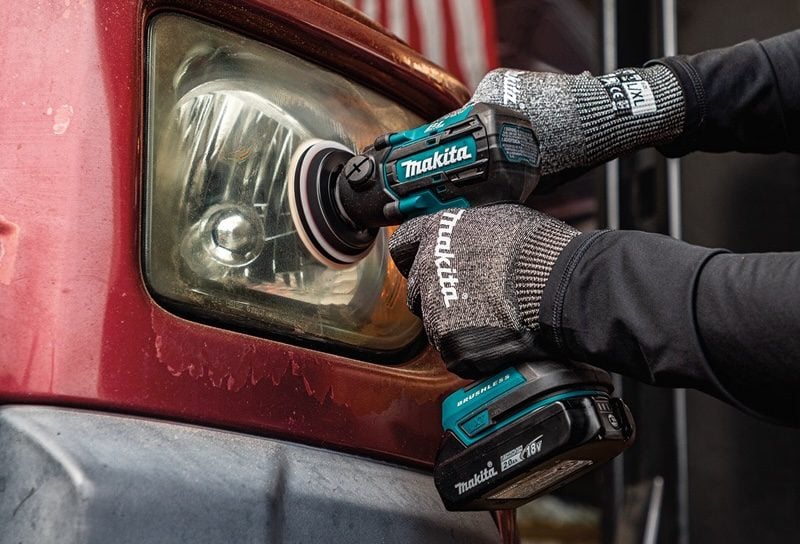
The auto body sector saw the new XVP01 3-inch sander/polisher launch in August 2025.
The same month, HVAC techs got a boost from the DVP181—a 4 CFM Dual-Stage Vacuum Pump that operates on two 18V batteries to run at 36V.
The 18V LXT nailer lineup got a facelift in September 2025 with new finish nailers and a stapler that boast faster firing speeds compared to previous models. They followed on the heels of a couple of framing nailers that launched earlier in the year.
Takeaways
From what I can see, it’s clear that core product development has slowed down for Makita’s 18V LXT battery system. However, that’s not necessarily an indication that Team Teal is neglecting it. Many of the tools have reached their peak growth curve, with new models primarily benefiting from incremental changes rather than the big jumps in performance or feature designs we saw in previous years.
Makita isn’t alone in this. We’ve seen a similar slowdown from other brands as well. DeWalt, for one, had an incredibly slow 2025 in terms of core tool launches.
However, it’s evident Makita still sees room to expand the 18V LXT system in trade-specific tools. Between products they’ve never had before and improvements to existing ones, there’s still good reason to invest in the platform.
There’s one more thing that’s hanging out there, though: battery advancement. Makita’s batteries, especially the 5.0Ah packs, have historically been excellent. In our own experience, we’ve had remarkably few failures with them.
But Makita hasn’t taken the leap into pouch cells like DeWalt, Milwaukee, Flex, and others. Those brands have proven there’s a very real performance advantage available. While Makita’s 18V LXT platform is a solid choice for many professionals, product teams could breathe new life into it if they decide to pursue an advanced battery option.
Certainly, Makita’s 40V max XGT system is outstanding, and it’s a solid choice if you frequently rely on power-hungry tools. The 18V LXT line isn’t dead, though, and I see no indications that there’s reason for concern. It’s a system that’s been field-proven for well over a decade, and offers Makita quality and service at a lower price than most XGT products.