

Battery-powered lawn care has come a long way, and you might be considering one of the best cordless leaf blower models 2025 has to offer this fall. It’s a good move if you’re frustrated by dragging a cord around or want to avoid the noise and maintenance of gas blowers.
Drawing from the brands we review and trust, some models rise higher than others. In this article, I’ll share the latest results of our head-to-head testing, several additional noteworthy models we recommend, and what I look for when I’m comparing cordless leaf blowers.
Best Cordless Leaf Blowers

Scoring
Note that the scoring is different from our normal rating system. The scores are based on how each blower performed and compared in this specific group and this set of tests only. Our typical rating system offers a comparison of the tool to the entire range of what is available. Here’s how to interpret the scores from this test:
- 90 – 100: Outstanding. You’ll love using this leaf blower.
- 80 – 89: Excellent. There may be minor tradeoffs.
- 70 – 79: Very good. There are more significant tradeoffs.
- 60 – 69: Good. Notable tradeoffs, but still earns our recommendation.
- < 60: Not recommended.
Want a bit more info to help you decide? Jump to these sections!
- How the Rest of the Field Fared
- More Cordless Leaf Blowers We Recommend
- How We Tested Head-to-Head
- What to Look for When You’re Shopping
- Why You Can Trust Pro Tool Reviews
Best Cordless Leaf Blower Overall
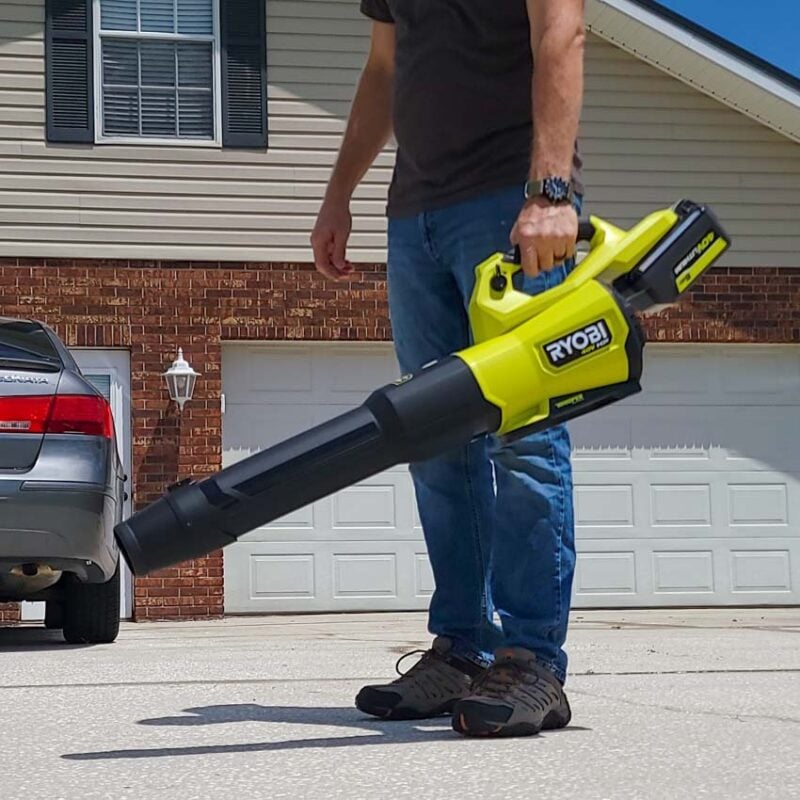
Ryobi 40V HP Brushless 800 CFM RY40HPLB01
Score: 95 Points
- Max Airflow: 800 CFM
- Max Air Speed: 180 MPH
- Rated Blowing Force: Not rated
- Working Weight: 10.6 lbs w/ 8.0Ah battery
- Price: $229 bare, $329 kit w/ 8.0Ah battery
- Warranty: 3 years
| Test | Result |
|---|---|
| Max Tested Blowing Force | 24.8 Newtons (1st place) |
| Runtime in High Mode | 11 minutes, 37 seconds (9th place) |
| Ramp Test | 34.50 inches (1st place) |
| Noise Level at 36 Inches | 79 dB(a) (1st place) |
Pros
- Strongest blower in our tests
- Quietest blower in our test group
- Excellent value
Cons
- Shortest runtime in our test group
Ryobi came out with the highest overall score in our testing, thanks to the highest tested blowing force combined with the lowest noise measurement of the entire group.
The only test it struggled in was runtime, but even that has to be taken in context. We ran that test in high, and Ryobi was still producing 20 Newtons at that level—the highest of the group. It makes sense that with the higher blowing force, it would have a lower runtime. However, use the cruise control to back off to 15 Newtons or so, and you’ll see much better runtime numbers.
With a $329 price tag for the kit to go with its impressive performance in our tests, it’s a solid value as well.
Best Cordless Leaf Blower Runner Up
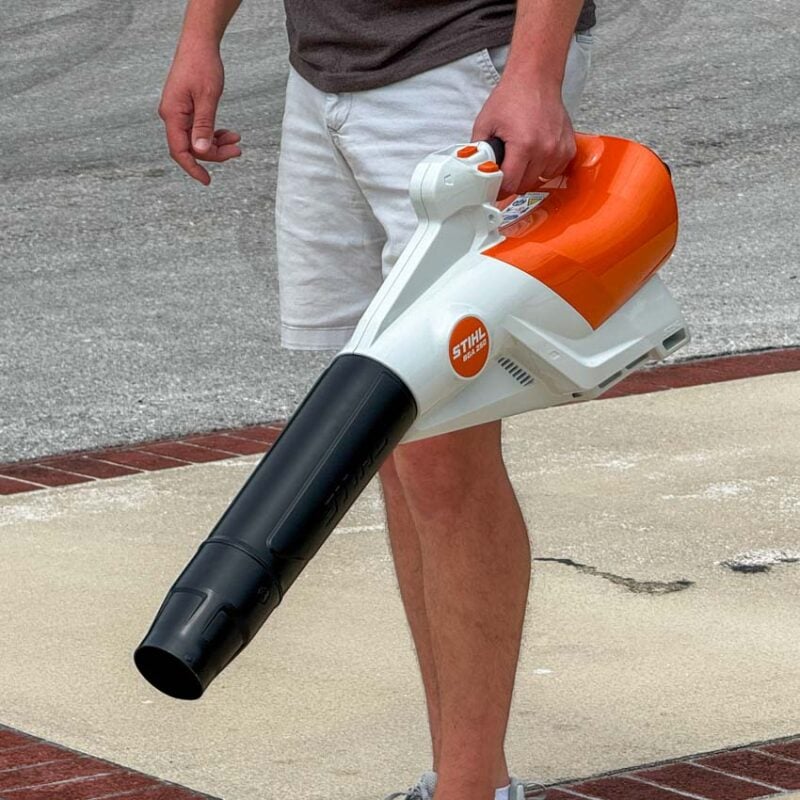
Stihl 36V 615 CFM BGA 250
Score: 94 Points
- Max Airflow: 615 CFM
- Max Air Speed: 190 MPH
- Rated Blowing Force: 26 Newtons
- Working Weight: 10.1 lbs w/ AP 500 S battery
- Price: $329 bare, $769 kit w/ two AP 300 S batteries
- Warranty: 2 years
| Test | Result |
|---|---|
| Max Tested Blowing Force | 24.4 Newtons (2nd place) |
| Runtime in High Mode | 14 minutes, 51 seconds (6th place) |
| Ramp Test | 30.50 inches (4th place) |
| Noise Level at 36 Inches | 83 dB(a) (3rd place) |
Pros
- Second-strongest blower in our tests
- Quieter operation than most
- Ergonomic design that angles the tip down
- Compact size
- Legit Pro-quality build backed by an extensive service network
- Made in the USA using global materials
Cons
- Expensive
Stihl was Ryobi’s major challenger in our tests and finished just one point behind. Its blowing force was only slightly trailing and while it wasn’t as quiet, it was quieter than most.
As for the unusual angle of the blower tube—it works. The ergonomics under load are noticeably better than the straight inline design of the others. Does it introduce extra air friction that limits it performance? Slightly, maybe, but it’s clearly still producing top-tier blowing force.
If you’re looking for the best Pro-focused cordless blower, there’s no question the Stihl BGA 250 is it, based on our results. While it’s more expensive, it has the quality and service network you need to keep your crew productive.
Third Place Cordless Leaf Blower
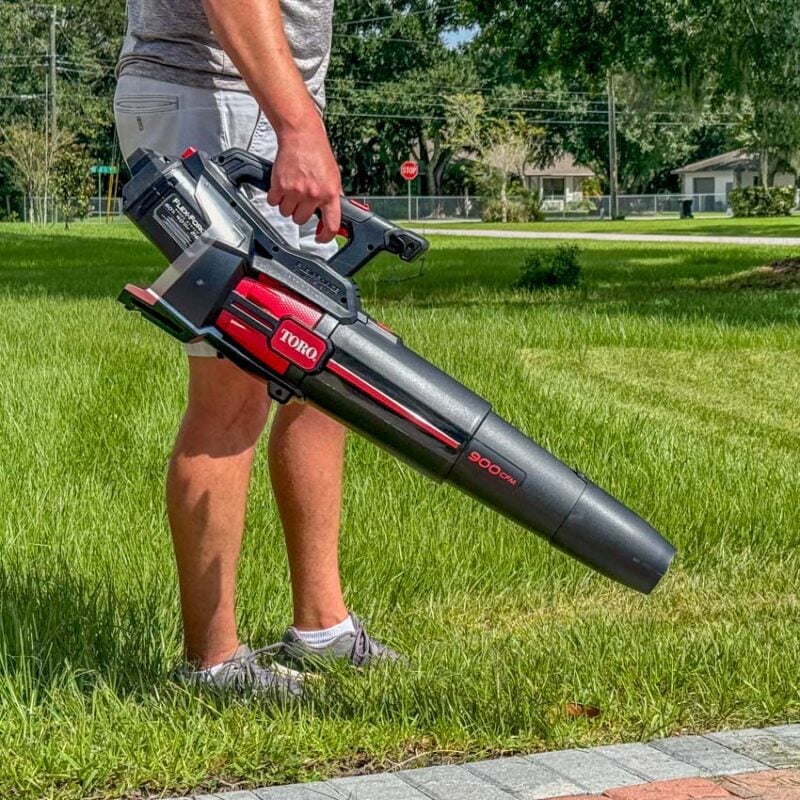
Toro 60V Max 900 CFM 51827
Score: 86 Points
- Max Airflow: 900 CFM
- Max Air Speed: 165 MPH
- Rated Blowing Force: Not rated
- Working Weight: 11.7 lbs w/ 4.0Ah battery
- Price: $360 kit w/ 4.0Ah battery
- Warranty: 3 years
| Test | Result |
|---|---|
| Max Tested Blowing Force | 22.0 Newtons (3rd place) |
| Runtime in High Mode | 14 minutes, 46 seconds (7th place) |
| Ramp Test | 32.25 inches (2nd place) |
| Noise Level at 36 Inches | 93 dB(a) (7th place, tie) |
Pros
- Excellent blowing power
- Highest air flow of our test group
- Compact length
Cons
- Heaviest working weight of the group
- On the expensive side
We had high expectations for Toro coming into this test, given its eye-popping 900 CFM airflow rating, and it didn’t disappoint. However, its nozzle design to reach such a high number has consequences.
With a larger diameter than most, it trades off some air speed to get the higher airflow. Still, its Newton force measurement wasn’t too far behind Ryobi and Stihl, telling us it has both the power and airflow to easily tame your lawn year-round.
The biggest downside is that it’s the heaviest blower in the group by a significant margin.
More Cordless Leaf Blowers We Tested
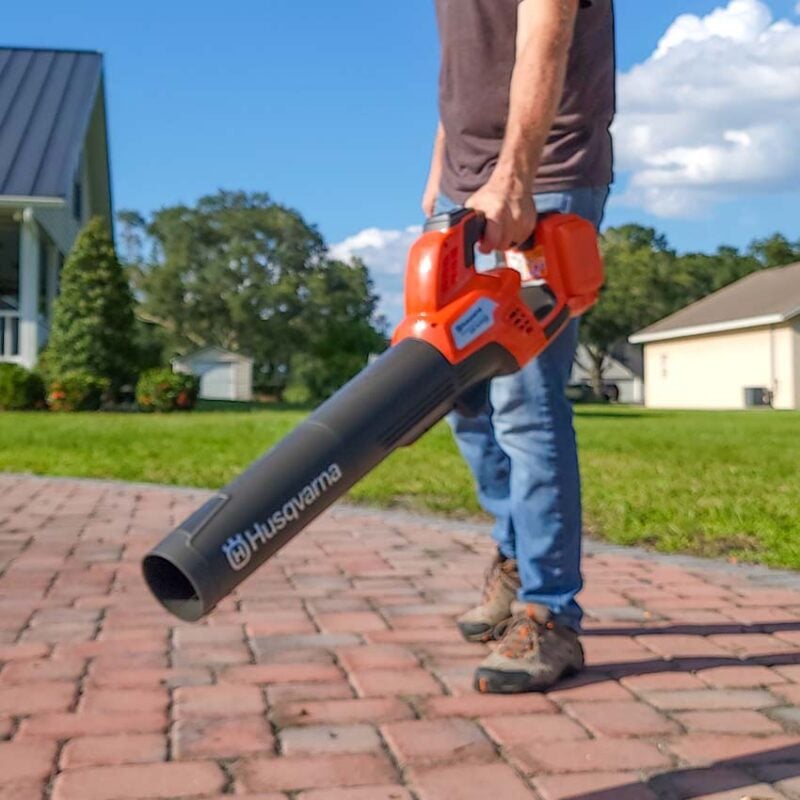
Husqvarna 40V 800 CFM Leaf Blaster 350iB
Score: 85 Points
- Max Airflow: 800 CFM
- Max Air Speed: 200 MPH
- Rated Blowing Force: 23 Newtons
- Working Weight: 9.7 lbs w/ 7.5Ah battery
- Price: $229 bare, $379 kit w/ 7.5Ah battery
- Warranty: 3 years
| Test | Result |
|---|---|
| Max Tested Blowing Force | 20.9 Newtons (4th place) |
| Runtime in High Mode | 38 minutes, 4 seconds (1st place) |
| Ramp Test | 31.25 inches (3rd place) |
| Noise Level at Operator’s Ear | 97 dB(a) (9th place) |
Pros
- Longest runtime in our tests
- Excellent blowing force
- Low overall weight
Cons
- Loudest in our test group
While Husqvarna didn’t reach the podium based on our test results, it was our favorite to use. Its blowing force easily hit above 20 Newtons, making lawn care and leaf cleanup easy. At the same time, its sub-10-pound working weight was less fatiguing to use. So, if you’re looking for the best balance of performance and weight, the Husqvarna 350iB is it.
There are a few things to consider, though. In case you’re not sure, the Leaf Blaster is part of Husqvarna’s 300-series residential line, not their 500-series Pro line. This was also the loudest blower we tested (though it’s still WAY better than gas).
Finally, this model had the best runtime of the group, but there’s some context to go with that. We measured just 9.5 Newtons in high, so there’s a wide gap between the max force in Turbo and that. It’s fine for dry grass and leaves, but you might find you wish you had more on the trigger for extended use.
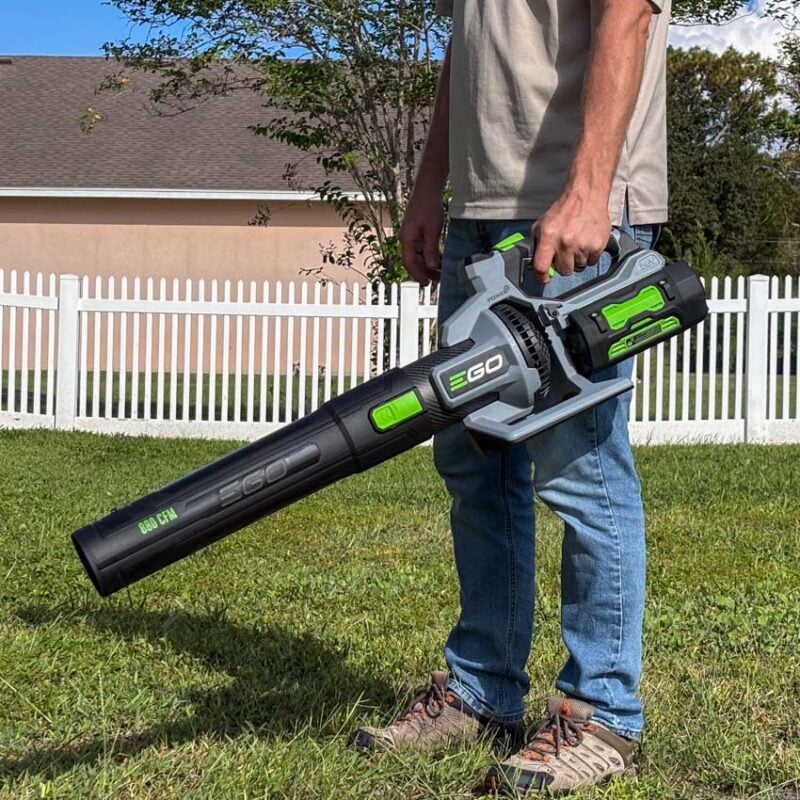
EGO 56V 880 CFM LB8803-2
Score: 83 Points
- Max Airflow: 880 CFM
- Max Air Speed: 200 MPH
- Rated Blowing Force: 30 Newtons
- Working Weight: 9.7 lbs w/ 4.0Ah battery
- Price: $299 bare, $439 kit w/ two 4.0Ah batteries
- Warranty: 5 years
| Test | Result |
|---|---|
| Max Tested Blowing Force | 20.0 Newtons (5th place) |
| Runtime in High Mode | 12 minutes, 21 seconds (8th place) |
| Ramp Test | 25.75 inches (5th place) |
| Noise Level at 36 Inches | 87 dB(a) (6th place) |
Pros
- Highest potential blowing force of the group
- Lightweight carbon fiber body
Cons
- High-capacity battery required to reach peak performance
- Low runtime with kitted battery
On the surface, EGO may seem to have underperformed in our tests, considering the numbers it boasts. As we investigated deeper, we discovered it’s all about battery selection. This blower is intentionally designed with specific steps to match the battery you use.
With the 4.0Ah battery that comes in the kit and we tested with, you can hit 20 Newtons. By stepping up to the 7.5Ah battery, we measured 25 Newtons. Finally, with a 12.0Ah battery, we got the promised 30 Newtons. If you happen to use a pack less than 4.0Ah in capacity, only the first two of the four speed modes are available to you.
The point is, you’ll only get the highest blowing force from the highest-capacity batteries. That works great for some folks, but if you want to get higher performance with lighter packs, you may want to consider the 765 CFM LB7650 instead.
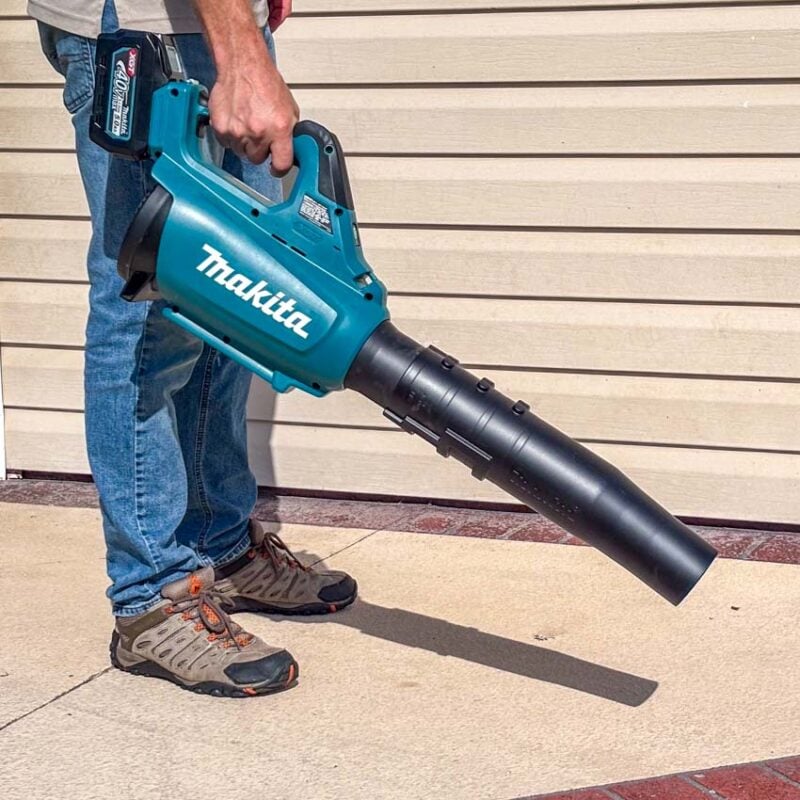
Makita 40V max XGT 565 CFM GBU01
Score: 71 Points
- Max Airflow: 565 CFM
- Max Air Speed: 143 MPH
- Rated Blowing Force: Not rated
- Working Weight: 8.2 lbs w/ 4.0Ah battery
- Price: $259 bare, $459 kit w/ 4.0Ah battery
- Warranty: 3 years
| Test | Result |
|---|---|
| Max Tested Blowing Force | 17.7 Newtons (6th place) |
| Runtime in High Mode | 16 minutes, 30 seconds (5th place) |
| Ramp Test | 12.25 inches (6th place) |
| Noise Level at 36 Inches | 81 dB(a) (2nd place) |
Pros
- Lightest working weight in our test group
- Second-quietest in our test group
- Built-in nozzle length adjustment
Cons
- Lower blowing force than most of the group
- On the expensive side
When it comes to battery-powered leaf blowers, Makita historically hasn’t chased the biggest numbers. Instead, they usually focus on what Pro crews need to do the job well while managing their battery assets. That’s the case with the 40V max XGT GBU01.
With handheld blowers, Makita knows Pros using gas aren’t getting 25 or 30 Newtons. In fact, the best gas models tap out around 15 Newtons, which Makita’s design exceeds.
With that design context in mind, Makita begins to look even more attractive, considering it’s the second-quietest model we tested and had the lightest working weight while beating the 15-Newton mark. Legit gas-replacement performance with low noise and less fatigue resonates with Pros switching to battery power.
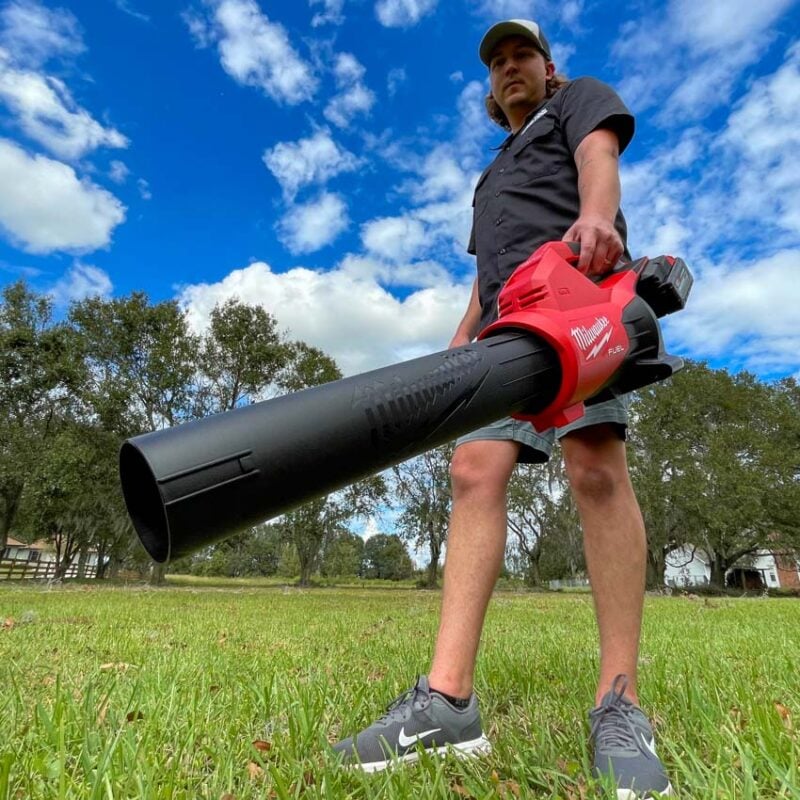
Milwaukee M18 Fuel Dual Battery 2824
Score: 65 Points
- Max Airflow: 600 CFM
- Max Air Speed: 145 MPH
- Rated Blowing Force: 17.7 Newtons
- Working Weight: 10.7 lbs w/ two 8.0Ah Forge batteries
- Price: $299 bare
- Warranty: 3 years
| Test | Result |
|---|---|
| Max Tested Blowing Force | 17.1 Newtons (7th place) |
| Runtime in High Mode | 18 minutes, 15 seconds (4th place) |
| Ramp Test | 4.75 inches (8th place) |
| Noise Level at 36 Inches | 84 dB(a) (4th place, tie) |
Pros
- Improved blowing power
- Clear battery level display
Cons
- Lower blowing force than most of the group
- On the heavy side
- Requires two batteries for operation
Compared to the rest of the group, Milwaukee’s overall rating wasn’t what we’re used to from Team Red. Part of that is due to some intentional design choices. The biggest one is that Milwaukee doesn’t include a turbo mode, instead giving you a higher constant blowing force on the trigger that exceeds the majority of other models.
With handheld gas blowers topping out at 15 Newtons, Milwaukee’s design feels more like using a gas blower where all your power control is on the trigger. At the same time, it exceeds gas performance.
As part of the M18 battery system, one of the biggest challenges for Milwaukee is balancing performance, runtime, and weight. By using 8.0Ah Forge batteries, this model finds its sweet spot and offers Pro crews a legitimate gas-free option.
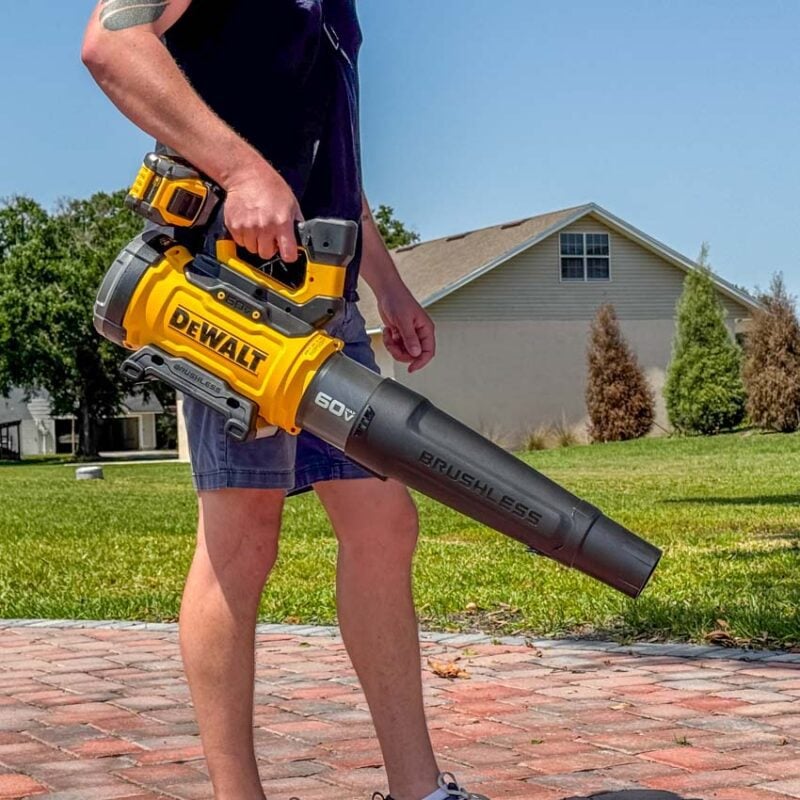
DeWalt 60V Max 760 CFM DCBL777
Score: 64 Points
- Max Airflow: 760 CFM
- Max Air Speed: 160 MPH
- Rated Blowing Force: 17 Newtons
- Working Weight: 10.3 lbs w/ 9.0Ah battery
- Price: $299 bare, $449 kit w/ 12.0Ah battery
- Warranty: 3 years
| Test | Result |
|---|---|
| Max Tested Blowing Force | 16.8 Newtons (8th place) |
| Runtime in High Mode | 18 minutes, 40 seconds (3rd place) |
| Ramp Test | 6.25 inches (7th place) |
| Noise Level at 36 Inches | 84 dB(a) (4th place, tie) |
Pros
- Improved blowing force
- Greatly improved noise levels
- Clear Battery Level Meter
- Shoulder strap included
Cons
- Difficult to hang on a hook
- Expensive
DeWalt made some major improvements in the design of the DCBL777. The blowing force came up, which we appreciate. However, it’s the noise reduction that really got our attention. The previous model was not only loud, but it also had a pitch that was difficult to tolerate. With this update, both problems are solved.
While this model is on the expensive side compared to other models in our test group, it’s a solid upgrade for crews committed to the 60V Max line for their lawn care needs.
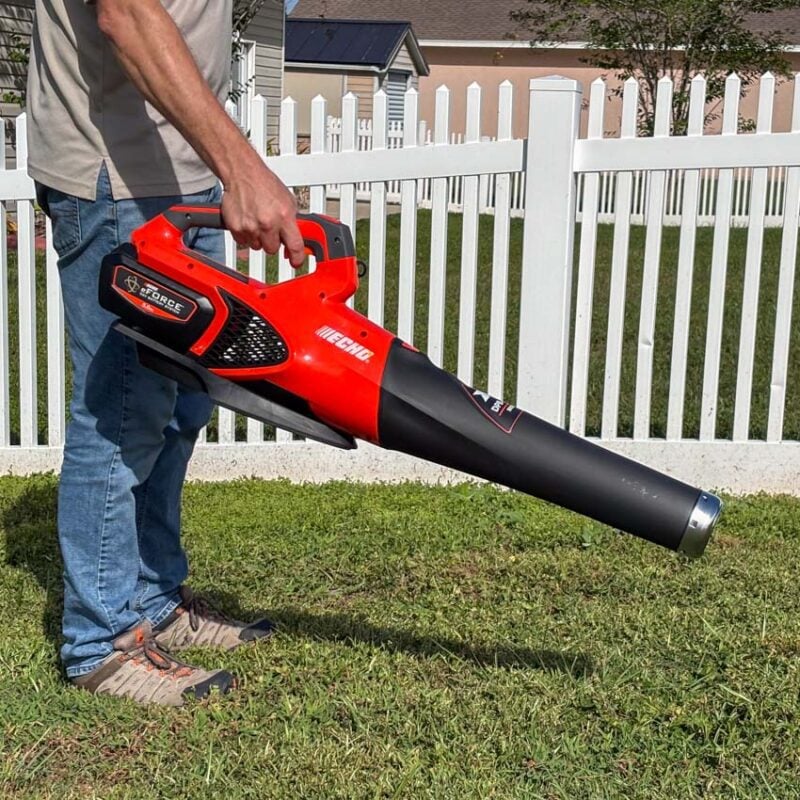
ECHO 56V 549 CFM DPB-2610
Score: 63 Points
- Max Airflow: 549 CFM
- Max Air Speed: 158 MPH
- Rated Blowing Force: 17 Newtons
- Working Weight: 10.0 lbs w/ 5.0Ah battery
- Price: $200 bare, $320 kit w/ 5.0Ah battery
- Warranty: 2 years
| Test | Result |
|---|---|
| Max Tested Blowing Force | 15.6 Newtons (9th place) |
| Runtime in High Mode | 31 minutes, 15 seconds (2nd place) |
| Ramp Test | – – (9th place) |
| Noise Level at 36 Inches | 93 dB(a) (7th place, tie) |
Pros
- Long run time
- Metal protection scraper ring on nozzle
- High-value pricing
Cons
- Lowest blowing force of the group
- Second loudest in testing
ECHO had the lowest specs on paper, and we weren’t surprised by its performance. We weren’t disappointed, either. With gas handheld blowers reaching just 15 Newtons on the Pro end of things, ECHO can outperform them.
ECHO was the only model to join Husqvarna with more than 30 minutes of runtime. Similarly, it gets there by governing the trigger to reach under 10 Newtons at WOT. That’s great for dry blowing, but you may want a bit more if you’re not in ideal conditions.
Don’t miss the price point on this model. It’s the least expensive of the group and rounds out an excellent line of lawn care tools targeting residential needs.
More Cordless Leaf Blowers We Recommend
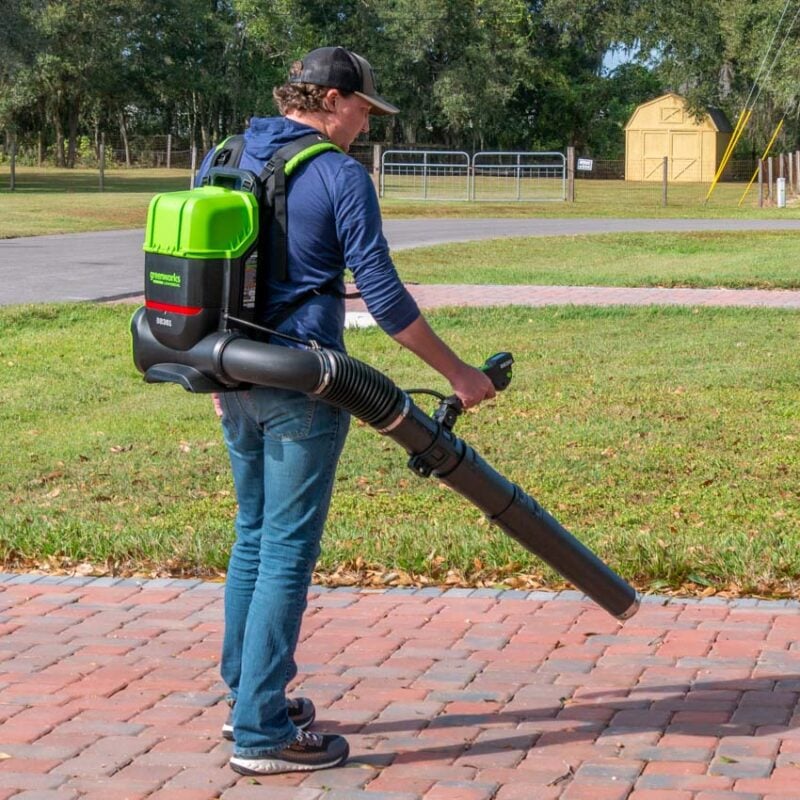
Greenworks Commercial Optimus Backpack Leaf Blower BB361
- Max Airflow: 755 CFM
- Max Air Speed: 225 MPH
- Rated Blowing Force: 36 Newtons
- Working Weight: 31.9 lbs w/ two 8.0Ah batteries
- Price: $600 bare, $1500 kit w/ two 8.0Ah batteries
- Warranty: 2 years
Greenworks Commercial has delivered a backpack blower that set a new benchmark for how much blowing force a battery-powered leaf blower can produce. We’ve tested it against their rating of 36 Newtons and it measured 36.9 Newtons on our meter. That gives Greenworks Commerical the distinction of having the most powerful battery-powered leaf blower we’ve tested by a wide margin.
In addition to its blowing force, Greenworks Commercial also includes a handy display on the throttle. You can easily see your battery levels and which mode you’re in with just a glance. Combined with a comfortable harness and a Pro-focused design, it’s a serious option for Pros who want to move away from gas but have been holding back because of performance.
While this model is impressive, keep your eyes open for even more in 2026. Greenworks Commercial has a couple of new backpack blowers launching, including one that can hit 50 Newtons!
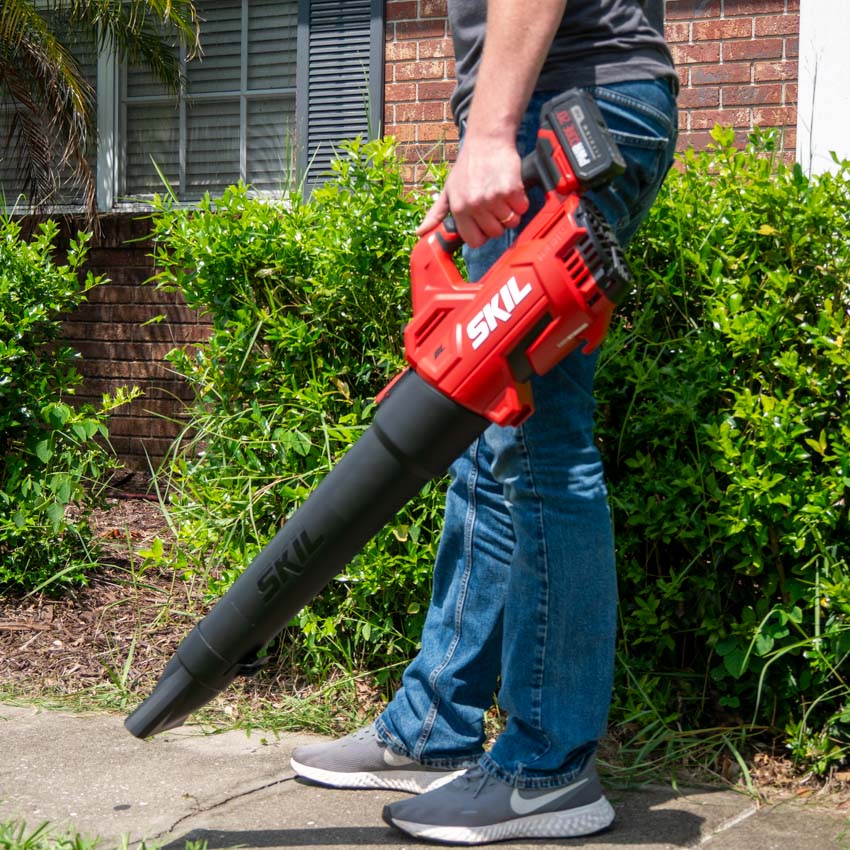
Skil PWRCore 20 Brushless Leaf Blower
- Max Airflow: 400 CFM
- Max Air Speed: 52 MPH
- Rated Blowing Force: 9.0 Newtons
- Working Weight: 5.7 lbs w/4.0Ah battery
- Price: $139 kit w/4.0Ah battery
- Warranty: 5 years
When you want to give your arms a break with a lightweight cordless blower, you won’t get the same blowing force as the other models on our list. However, you don’t have to give up all the benefits of a quality build.
Of the lightweight cordless leaf blowers I’ve used, Skil’s 20V 400 CFM model stands out. Its brushless motor produces up to 9 Newtons—a much more relevant level of blowing force than the cheaper models we considered. It also comes with a 4.0Ah battery, offering higher capacity and runtime than less expensive options, yet it’s still under 6 pounds with that battery.
As a bonus, you’ll be on the same battery platform as Skil’s most popular and highest performing power tools, keeping your lawn and DIY products all on one system.
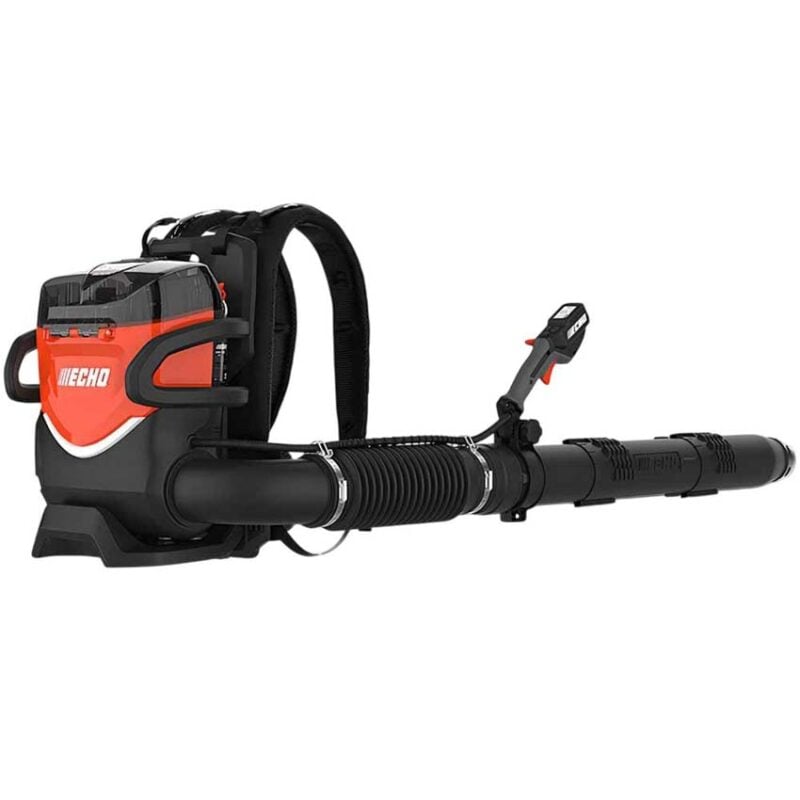
ECHO 56V X Series Backpack Leaf Blower DBP-7700T
- Max Airflow: 850 CFM
- Max Air Speed: 220 MPH
- Blowing Force: 36 Newtons
- Working Weight: 37.4 lbs w/ three 8.0Ah batteries
- Price: $750 bare, $1700 kit w/ three 8.0Ah batteries
- Warranty: 2 years
ECHO’s DBP-7700 is a beast of a backpack blower and targets Pro crews with its build and performance. It can use between one and three batteries, but you need to use at least two 5.0Ah batteries to reach peak performance. If you use one battery or smaller packs, it won’t reach that 36N blowing force.
Realistically, three 8.0Ah batteries are the way to go, and that’s what comes in the kit. Not only will you get the best performance, but you’ll also maximize your runtime so you don’t have to stop for battery swaps as often.
One other thing to note is the red light on the back. With such low noise compared to gas, it’s an extra layer of safety for you when you’re working around the road.
Stihl 36V Backpack Blower BGA 300
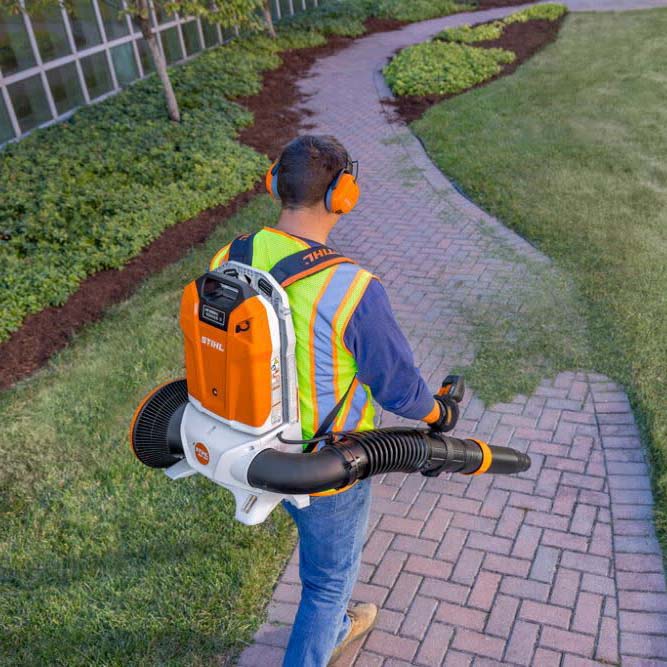
- Max Airflow: 571 CFM
- Max Air Speed: 192 MPH
- Rated Blowing Force: 26.0 Newtons
- Working Weight: 37.9 lbs w/AR 3000 L battery
- Price: $700 blower only
- Warranty: 3 years
Stihl’s reputation for backpack blowers expands into the battery-powered realm with the BGA 300. With blowing force reaching 26 Newtons, it’s the cordless equivalent of the BR430 from Stihl’s professional gas backpack blower series.
As Stihl’s most powerful battery-powered blower, it takes advantage of the AR 3000 battery as its primary power source. However, it’s compatible with the ADA 1000 AP battery adapter if you’d prefer to stick with smaller packs.
The other thing to note is how quiet this blower is. Taking a cue from other low-noise designs, Stihl’s Noise Reduction System keeps the noise level far below what other cordless blowers in the power class are producing.
Want Even More? Check Out These Reviews!
- Low Noise + High Performance: Ryobi 40V HP Brushless Whisper Series 730 CFM Leaf Blower
- The First Legit Pro Option: EGO Commercial Backpack Blower 800 CFM Leaf Blower
- Ridgid Jumps into Lawn Care: 18V 510 CFM Leaf Blower
How We Tested Cordless Leaf Blowers Head-to-Head
Battery Selection
There’s no way to balance out battery capacities in a group like this, so we paired each blower with the battery(ies) that come in the kit or that the manufacturer recommends. We want to give you the best idea of what you’ll experience in the field, and those kitted batteries are the most frequently used.
| Model | Tested Battery |
|---|---|
| DeWalt DCD777 | 60V Max FlexVolt 9.0Ah/3.0Ah |
| ECHO DPB-2610 | 56V 5.0Ah |
| EGO LB8800 | 56V 4.0Ah |
| Husqvarna 350lB | 36V 7.7Ah |
| Makita GBU01 | 40V max XGT 4.0Ah |
| Milwaukee 2824 | 2 x M18 8.0A Forge |
| Ryobi RY40HPLB01 | 40V High Performance 8.0Ah |
| Stihl BGA 250 | 36V 9.4Ah AP 500S |
| Toro 51827 | 60V Max 4.0Ah |
Newton Force Test
For this head-to-head review, each blower is tested at 3 inches to the force meter’s plate using a fully charged battery, and we record the highest stable measurement it registers.
| Model | Measured Blowing Force |
|---|---|
| DeWalt DCD777 | 16.8 Newtons |
| ECHO DPB-2610 | 15.6 Newtons |
| EGO LB8800 | 20.0 Newtons |
| Husqvarna 350lB | 20.9 Newtons |
| Makita GBU01 | 17.7 Newtons |
| Milwaukee 2824 | 17.1 Newtons |
| Ryobi RY40HPLB01 | 24.8 Newtons |
| Stihl BGA 250 | 24.4 Newtons |
| Toro 51827 | 22.0 Newtons |
Ramp Test
Our ramp test sets each blower up on our custom rig to see how far it can push a target plate at full power. Set at 30°, it takes four pounds of force to hold the target mechanism steady.
In essence, this test shows us how far each blower is capable of pushing our four-pound load. The relevance is that it helps us compare blowing strength in a consistent, repeatable way.
| Model | Distance from Nozzle |
|---|---|
| DeWalt DCD777 | 6.25 inches |
| ECHO DPB-2610 | – – (no movement) |
| EGO LB8800 | 25.75 inches |
| Husqvarna 350lB | 31.25 inches |
| Makita GBU01 | 12.25 inches |
| Milwaukee 2824 | 4.75 inches |
| Ryobi RY40HPLB01 | 34.50 inches |
| Stihl BGA 250 | 30.50 inches |
| Toro 51827 | 32.25 inches |
Runtime Test
We run our runtime test on high using a fully charged battery. Because battery-powered leaf blowers are designed to use turbo in short bursts rather than continuously, we find testing in high is a better representation of how much runtime most people will experience in the field.
We run each blower on high, using either the cruise control or a zip-tie on the trigger, and set it down in a location that doesn’t restrict the air intake. The result is the stopwatch time from when we started the blower to when it shuts down due to battery depletion.
| Model | Runtime |
|---|---|
| DeWalt DCD777 | 18 minutes, 40 seconds |
| ECHO DPB-2610 | 31 minutes, 15 seconds |
| EGO LB8800 | 12 minutes, 21 seconds |
| Husqvarna 350lB | 38 minutes, 4 seconds |
| Makita GBU01 | 16 minutes, 30 seconds |
| Milwaukee 2824 | 18 minutes, 15 seconds |
| Ryobi RY40HPLB01 | 11 minutes, 37 seconds |
| Stihl BGA 250 | 14 minutes, 51 seconds |
| Toro 51827 | 14 minutes, 46 seconds |
Noise Level Test
ANSI’s blower noise standard is designed to protect bystanders around working areas and is set to 50 feet away from the blower.
To simulate what it’s like for you to use, we measured the sound from 36 inches, which is roughly the distance from the blower in your hand to your ear, depending on your height.
| Model | dB(a), Slow Response |
|---|---|
| DeWalt DCD777 | 84 dB(a) |
| ECHO DPB-2610 | 93 dB(a) |
| EGO LB8800 | 87 dB(a) |
| Husqvarna 350lB | 97 dB(a) |
| Makita GBU01 | 77 dB(a) |
| Milwaukee 2824 | 84 dB(a) |
| Ryobi RY40HPLB01 | 79 dB(a) |
| Stihl BGA 250 | 83 dB(a) |
| Toro 51827 | 93 dB(a) |
What to Look for When Shopping for a Cordless Leaf Blower
Blowing Force
How much blowing force a cordless blower has makes a big difference in how you’re going to use it. Some might be great for helping you with fall leaves, others might be good for light sweeping only. Air value (CFM) and airspeed (MPH) are helpful, but the numbers we see on the box are best-case scenario, sometimes with different nozzles.
Newton force gives you a single number that describes how much force is actually coming from the blower. At the end of the day, that’s the best way to compare the work a blower does.
Keep in mind that residential gas blowers only reach about 12 Newtons, and Pro handheld models top out at around 15 Newtons. However, many cordless leaf blowers are available that easily exceed that.
Runtime
Understanding how much work you have helps you determine whether a blower meets your needs. For example, you might have less than 10 minutes of actual trigger time when you clean the driveway and sidewalk after mowing. When fall rolls around, you might need 20 or 30 minutes, but at a lower power level.
You might get more runtime than using the battery that comes in the box, though. Many people buy multiple tools for the same system, and having the extra batteries from those tools can extend the amount of work you can get done.
Noise Level
Cordless blowers are quieter than gas models, but that doesn’t mean that all of them are quiet. ANSI standards rate blower noise levels from 50 feet away to consider the hearing safety of bystanders. We measure from our operator’s ear so you know how much noise you have to deal with as the user.
Weight and Balance
Because most cordless blowers are handheld models, it’s good to know how much weight you’re going to muscle around. The balance is important, too. A well-balanced blower points down naturally at wide open throttle so you don’t have to work as hard to keep the nozzle at the best working angle.
Features and Design
Blowers are fairly simple compared to some of the tools we review. Here are some of the features that make using them easier or improve the performance:
- Brushless motor
- Cruise control
- Turbo mode
- Inline design
- Multiple nozzles
- Shoulder strap
- Rapid charger
In addition to the features themselves, we also look for things you might like or dislike while you’re using the blower such as uncomfortable seams or a rough grip.
Value
At Pro Tool Reviews, we know price is important. Most of us have some kind of budget we’re working under, but value is more than just an inexpensive price tag. Sometimes, the most expensive option is so far ahead or solves such a big problem that it’s also a great value. Other times, one of the best budget picks presents itself as the best value. Often, it’s something in between. Wherever it is, your top priorities will help define what’s the best value for you.
Why You Can Trust Pro Tool Reviews
Ever check out a “review” site and you can’t tell if they actually test products or if they’re just “recommending” the Amazon top sellers? That’s not us. We won’t recommend anything unless we’d use it ourselves, and we don’t care who the primary retailer is. It’s all about giving you a legitimate recommendation and our honest opinion of each product.
Since 2008, Pro Tool Reviews has provided in-depth tool reviews, buying guides, how-to articles, and industry news in the construction and lawn care industries. We focus on professionals in the trades and our writers have the skills and experience to know whether a tool or accessory will hold up on the jobsite.
Each year, we bring in and review more than 250 individual products. Additionally, our team will put their hands on hundreds more tools at media events and trade shows throughout the year.
The bottom line is that tools are what we do, and if I recommend a cordless leaf blower, I’d use it myself.