
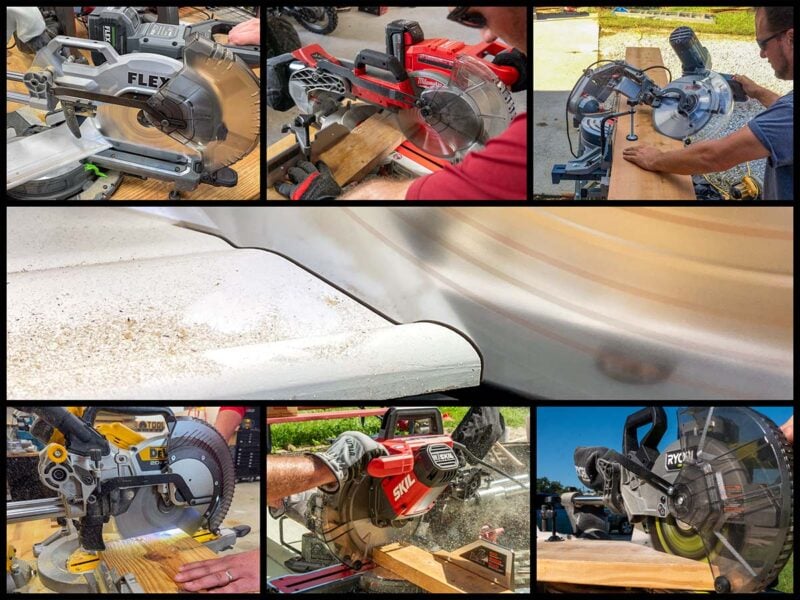
As one of the core woodworking and carpentry tools, our crew and I have had the privilege of testing dozens of the best miter saw models over more than 15 years. A lot has changed in that time, mostly for the better. If you’re looking to buy, lean on our experience to determine what rises above the rest and is worth your consideration.
In this article, I’ll share the miter saws that have stood out from the crowd in our testing, plus our favorite blades and stand. If you’re new to miter saws, I’ve also included several helpful sections to help you learn what to look for when you’re shopping, the terms and parts you should know, and the different types of miter saws available.
Best Miter Saw Overall: Bosch Axial Glide 12-Inch GCM12SD

- Motor: 120V, 15A
- Blade Diameter: 12 inches
- Speed: 3800 RPM
- Miter: 52° left, 60° right
- Bevel: 47° left and right
- Nested Crown Capacity: 6 1/2 inches
- Lumber Capacity: 2×14 @ 90°, 4×10 @ 45°
- Weight: 65 lbs.
- Price: $729
Highlighted Features
- Axial Glide System: Offers smooth sliding cuts with no need for rear clearance
- Front-mounted Bevel Lock: No need to reach behind the saw for bevel angle adjustments
- Sliding Dual Bevel Compound Design: The most comprehensive set of blade movements
Pros
- Powerful cutting
- Smooth, stable gliding action
- No rear rail clearance needed
- Low blade deflection
Cons
- Heavy
- No cutline indicator
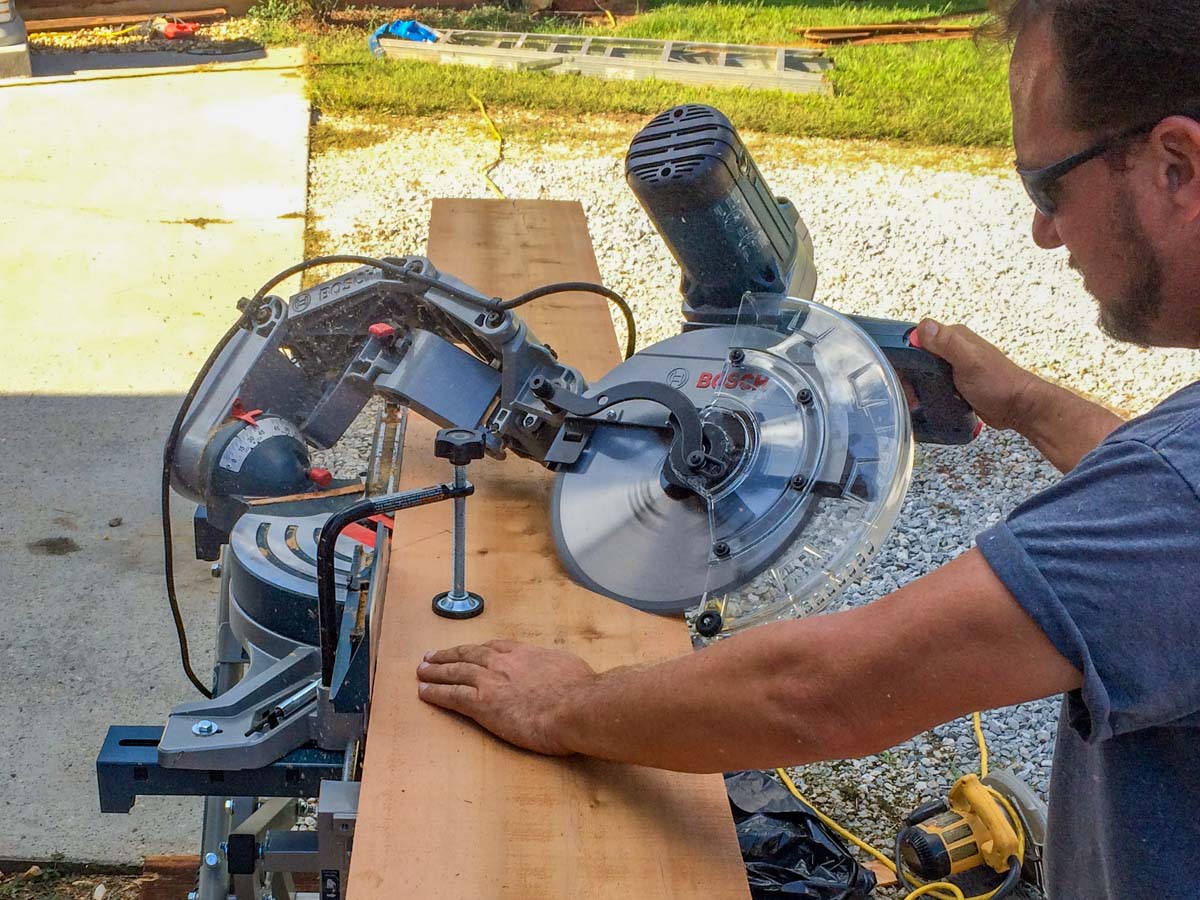
Earning my pick as the best miter saw overall, the Bosch GCM12SD is a design we’ve used for well over a decade now. What sets it apart is its unique axial glide system that replaces traditional rails. It’s butter-smooth and stable, allowing us to make precise compound cuts. Plus, it doesn’t need any rear clearance, so you can back it right up against a wall and cut.
I realize that it’s not as ultra-precise as the Festool Kapex, but Bosch’s price tag is $1000 less, and its precision has been more than enough for the jobs we’ve done. Based on our experience, we’re confident most of you will get the results you need without spending so much extra to get it.
It’s more than just a rail system, though. Bosch powers this saw with a 15-amp motor that’s more than happy to help you cut 4x lumber if you ask it to.
But trim cutting is what we use miter saws for most often, and this model has a generous capacity for nested crown, plus more than enough clearance to cut today’s higher baseboards vertically.
Love the concept, but on the hunt for a different size? Bosch has you covered with a 10-inch model, plus a cordless 12-inch version if you’re tired of dragging an extension cord around.
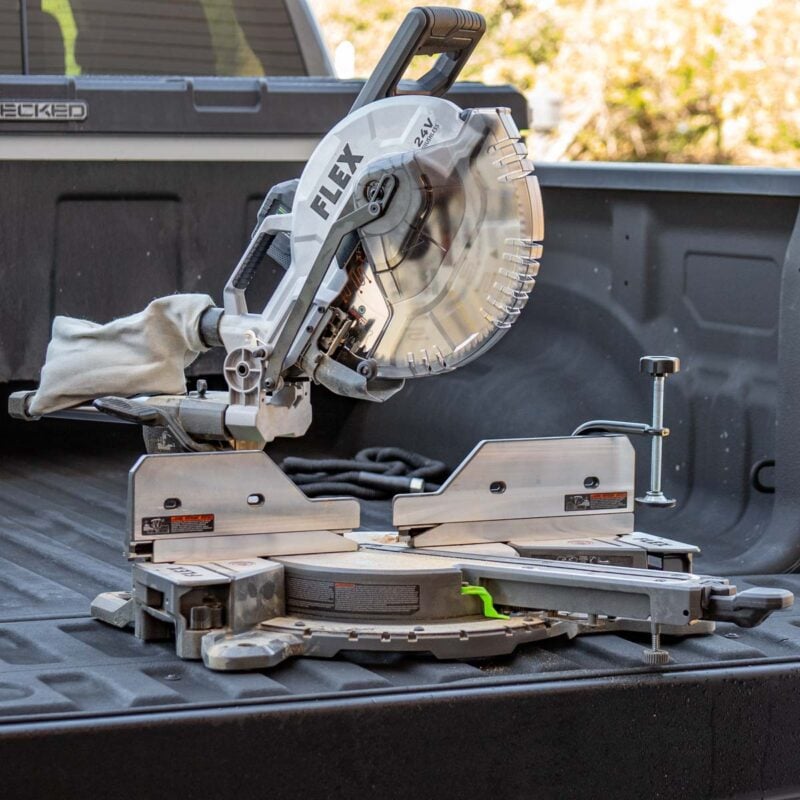
Best Cordless Miter Saw: Flex 24V 12-inch FX7141
- Motor: 24V brushless
- Blade Diameter: 12 inches
- Speed: 4000 RPM
- Miter: 52° left, 60° right
- Bevel: 48° left and right
- Nested Crown Capacity: 7 1/2 inches
- Lumber Capacity: 4×14 @ 90°, 2×14 @ 45°
- Weight: 63.9 lbs. bare
- Bare Price: $719
- Kit Price: $939
Highlighted Features
- Hybrid Power: Use Flex 24V batteries or the AC adapter
- FastShift Bevel Lever: Easily adjust the bevel angle and quickly find detent presets
- Spindle Stop Shaft Lock: Makes blade changes easier by freeing up both hands
- LED Shadow Cutline Indicator: Shows you where the blade will cut in any light conditions
- Sliding Dual Bevel Compound Design: The most comprehensive set of blade movements
Pros
- Cordless freedom
- Strong cutting power
- Excellent runtime
- Smooth rail action
- Corded or cordless operation
- Impressive cutting capacity
- Solid feature upgrades
- No deflection
Cons
- Heavy
- Rear clearance required for rails
There are several excellent cordless miter options available (I’ve detailed my other favorites below). Milwaukee’s 10- and 12-inch models are solid, and Bosch’s 12-inch Surgeon axial glide is another favorite among our crew.
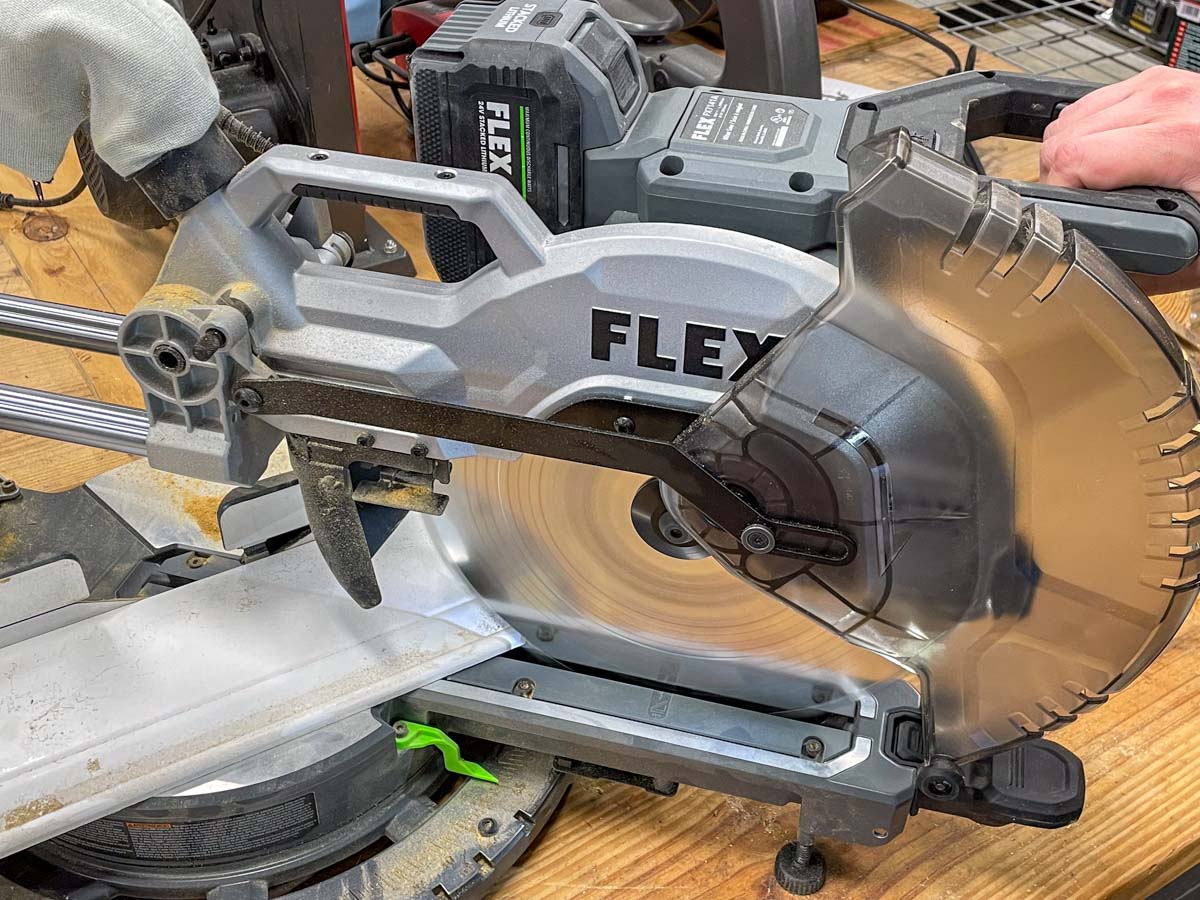
But Flex’s 24V 12-inch miter saw is one that stands out for the way I like to work. It has something the others I mentioned don’t: hybrid power capability. You can run the saw using Flex 24V batteries or use the AC adapter and run off 120V power, giving you the best of both worlds. Better still, you can pair it with Flex’s table saws as well.
Metabo HPT’s 36V miter saws have the same option, and I really like their 10-inch model, even though it appears to be discontinued. It’s being replaced by a 12-inch version that I’m confident will be excellent, but I haven’t had a chance to test it for myself yet.
Moving back to Flex, it’s an excellent design with several upgraded features and has some of the best nested crown capacity you can hope for.
There are a couple of downsides to consider. One is that its rails need clearance behind the saw, so there’s no backing it up against a wall while you’re cutting. If you’re like us and have dealt with that before, it’s not too difficult to work around it.
The other is that this is a heavy saw, so if you’re planning to get it for full cordless freedom and high portability, be sure to grab a good wheeled stand.
Best Miter Saw for the Money: Skil 10-inch MS6305
- Motor: 120V, 15A
- Blade Diameter: 10 1/4 inches
- Speed: 4800 RPM
- Miter: 50° left and right
- Bevel: 45° left and right
- Nested Crown Capacity: 6 1/4 inches
- Lumber Capacity: 2×12 or 4×6 @ 90°, 2×8 @ 45°
- Weight: 48.8 lbs.
- Price: $279
Highlighted Features
- LED Shadow Cutline Indicator: Shows you where the blade will cut in any light conditions
- Sliding Dual Bevel Compound Design: The most comprehensive set of blade movements
Pros
- Outstanding value
- Excellent cutting power
- Easier to move than 12-inch saws
Cons
- No bevel stops between 0° and 45°
- So-so dust collection
- Rear clearance required for rails
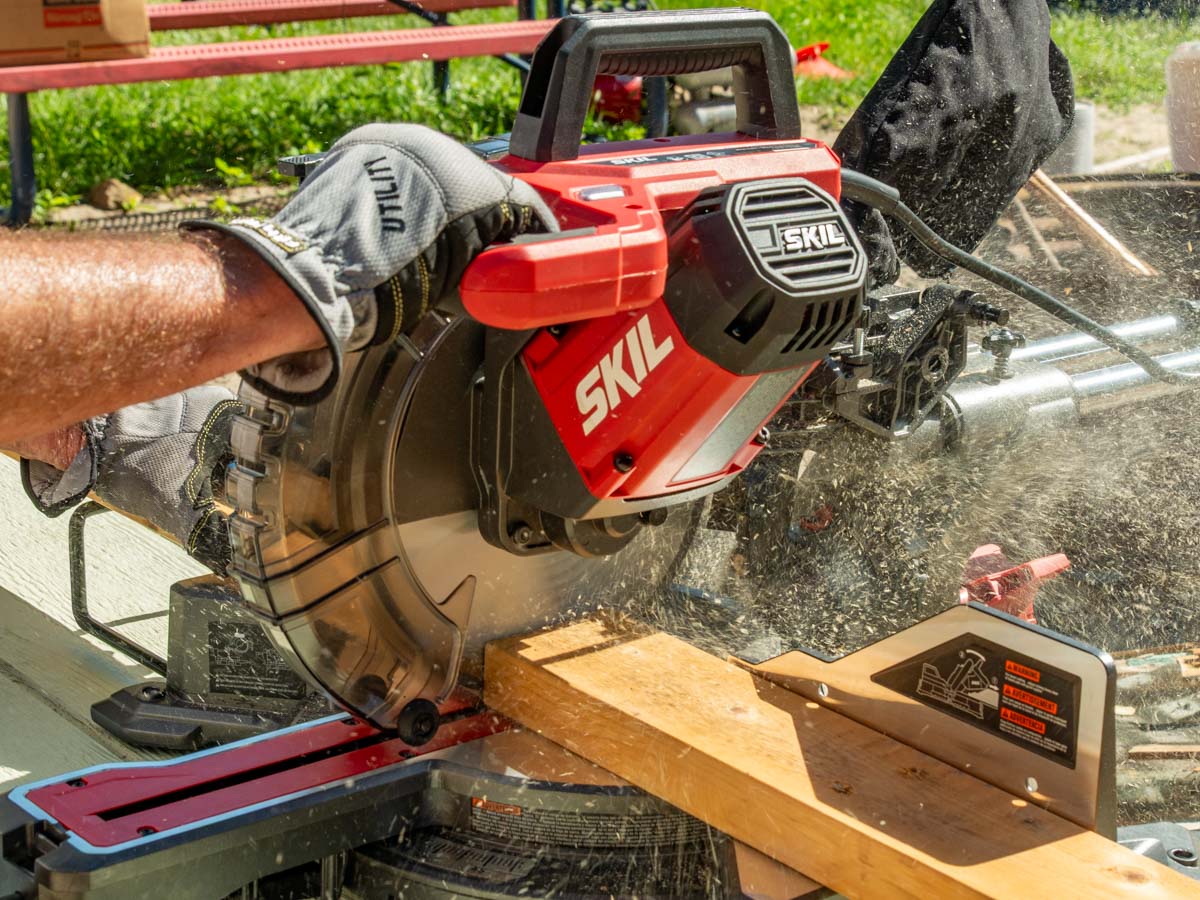
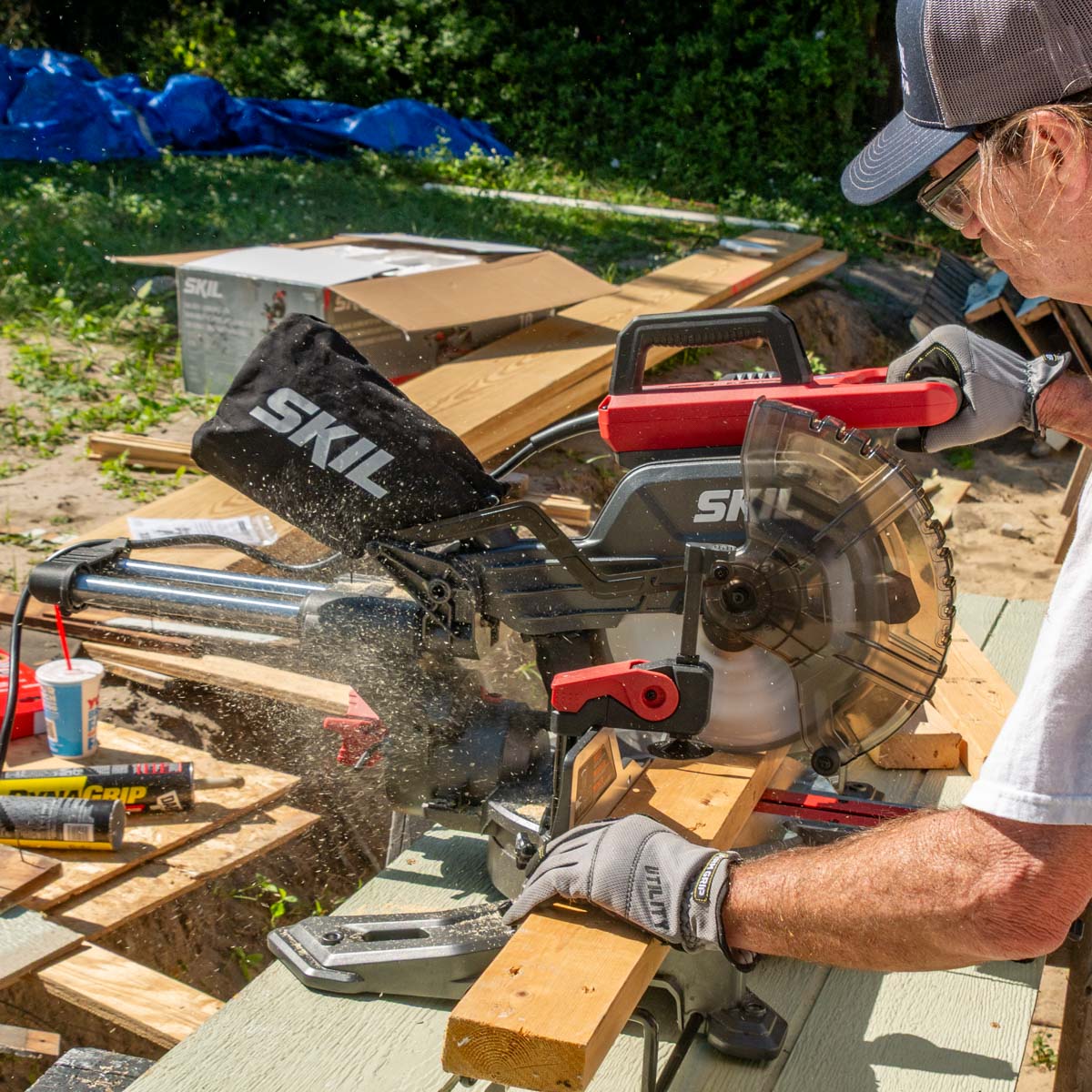
Skil’s 10-inch miter saw threw the value category for a loop. At just $279, it’s a 15-amp dual-bevel sliding model that looks impressive on paper. But is it any good?
Our own Tom Gaige put it to the test by using it to build a second-story addition and came away impressed. To use his words:
“It’s hard to sufficiently convey the surprise of finding a tool at this price that offers all the features you get with the Skil MS6305-00.”
Getting down to the nuts and bolts, this obviously isn’t a premium saw with the highest cut capacities, greatest precision, and slickest features. But it is well-built, has most of the features you need, and is more capable than anything else in the same price range.
The one glaring downside is the lack of bevel stops between 0° and 45°. For compound cuts that fall inside that range, you’ll have to take your time setting it up.
Still, this is an easy recommendation as my top choice for DIYers, and it’s also a compelling option for Pro-level carpentry on a budget. Sure, fine finish carpenters will need something higher up the precision food chain, but for many projects, you’ll be surprised how capable this saw is.
More Miter Saw We’ve Reviewed and Recommend
Milwaukee M18 Fuel 10-inch Miter Saw 2734

- Motor: 18V brushless
- Blade Diameter: 10 inches
- Speed: 4000 RPM
- Miter: 50° left, 60° right
- Bevel: 48° left and right
- Nested Crown Capacity: 5 1/4 inches
- Lumber Capacity: 2×12 @ 90°, 2×8 @ 45°
- Weight: 45 lbs. bare
- Bare Price: $599
- Kit Price: $699
Highlighted Features
- LED Shadow Cutline Indicator: Shows you where the blade will cut in any light conditions
- Sliding Dual Bevel Compound Design: The most comprehensive set of blade movements
Pros
- Cordless freedom
- Excellent runtime
- Easier to move than 12-inch saws
- Part of the extensive M18 battery system
Cons
- So-so dust collection
- Rail design can introduce more deflection than traditional designs
- Rear clearance required for rails
- No AC adapter option
Milwaukee had one of the first 10-inch cordless miter saws, and with nearly a decade of field service under its belt, it consistently continues to shine. While Milwaukee also has a 12-inch and a 7 1/4-inch cordless miter saw, this one is my favorite of the three thanks to its balance of performance, weight, capacity, and price.
From a power perspective, it’s not the strongest saw we’ve tested. I don’t feel that it’s underpowered, though. If you’re used to a 15-amp corded model, you’ll notice you need to ease up on your tougher cuts a touch to keep those blade RPMs high.
For most cutting applications, runtime isn’t an issue. Milwaukee estimates 400 cuts on a charge. In our experience, if you use at least an 8.0Ah battery (which is what comes in the kit), you’ll have more than enough to cut all day on trim jobs. If you’re cutting lumber at a production level, I recommend grabbing a second battery and Milwaukee’s Super Charger to keep you going non-stop.
It doesn’t have a ton of bells and whistles, but it has a solid, Pro-grade design that offers all the detents and stops you need to set up your cuts easily.
The rail design is unusual in that it runs through the table. It makes for a more compact, less busy profile, but there are a couple of consequences. The big one is that it can introduce a little more blade deflection than traditional designs. To avoid that, use a little less pressure pushing through your cuts. Use the sound of the blade speed as an indicator—if you hear the RPMs dropping, there’s a better chance you’ll lose a little accuracy.
That design also affects the dust collection, and we found it doesn’t capture as much as some of the other saws we’ve tested. That’s not a big deal to me, but if you do a lot of your cutting indoors, it’s something to consider.
While the saw is worth your consideration on its own, don’t miss the value of it being part of Milwaukee’s M18 battery system. From general construction to niche trade-focused tools, you won’t find a more wide-reaching platform to buy into.
DeWalt 20V Max 12-inch Miter Saw DCS785
- Motor: 18V/20V Max brushless
- Blade Diameter: 12 inches
- Speed: 3800 RPM
- Miter: 50° left, 60° right
- Bevel: 49° left and right
- Nested Crown Capacity: 6 1/2 inches
- Lumber Capacity: 2×12 @ 90°, 2×8 @ 45°
- Weight: 51.7 lbs. bare
- Bare Price: $699
- Kit Price: $879
Highlighted Features
- Regenerative Braking: Returns a small amount of energy back to the battery to extend runtime
- Bevel Gear Transmission: Delivers more confident cutting than belt-driven drives
- Wireless Tool Control: Automatically turns on compatible vacuums
- LED Shadow Cutline Indicator: Shows you where the blade will cut in any light conditions
- Sliding Dual Bevel Compound Design: The most comprehensive set of blade movements
Pros
- Cordless freedom
- Solid cutting power
- Good dust collection with a vacuum
- Part of the extensive 20V Max system
Cons
- Expensive
- Rear clearance required for rails
- No AC adapter option
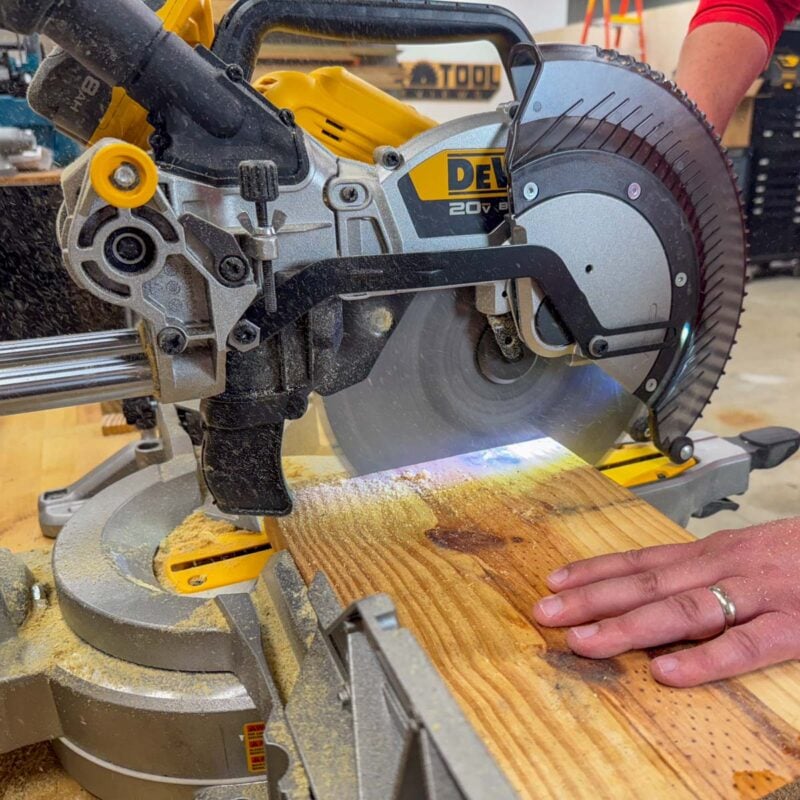
I tested DeWalt’s first cordless 12-inch miter saw when it came out, and was impressed with how far battery technology had come. It took a pair of FlexVolt batteries to run, though. When I caught wind of the DCS785 and saw that it runs on a single 20V Max battery, I was a little skeptical. However, once Josh tested it, he told me I had to give it a shot.
The obvious benefit is that you can use 20V Max or FlexVolt batteries, and you only need one. But you really need to use at least an 8.0Ah pack, and stepping up to an advanced PowerPack or FlexVolt pack is a must unless you’re cutting basic trim.
Cutting is more confident than you might think for a 20V saw. Part of the that is the PowerPack battery’s tabless design that delivers much greater energy transfer. The other is that DeWalt uses a bevel gear system instead of a belt drive. That provides a more direct energy transfer to the motor, which translates to better torque through your cuts.
DeWalt runs deep in the miter saw department, so it’s no surprise that the DCS785 is technically excellent from a design standpoint. There are a couple of minor caveats, though.
One is the traditional rail system. You’ll need rear clearance for it. It also has a traditional rear-mounted bevel release, so you’re stuck reaching around the back and screwing/unscrewing that knob.
Aside from those, there’s not much to complain about. Just be sure to pick your battles. You can run all day for trim jobs, but cutting lumber will drain your battery much quicker.
I’m not sure how long it will be available, but I found a bundle at Acme Tools that gives you the kit at the bare tool price. Grab it while you can!
Makita 40V max XGT 8 1/2-inch Miter Saw GSL02
- Motor: 36V/40V Max brushless
- Blade Diameter: 8 1/2 inches
- Speed: 4800 RPM
- Miter: 60° left and right
- Bevel: 48° left and right
- Nested Crown Capacity: 3 3/8 inches
- Lumber Capacity: 2×12 @ 90°, 2×8 @ 45°
- Weight: 35.4 lbs. bare
- Bare Price: $879
- Kit Price: $1099
Highlighted Features
- Direct Drive: Delivers more confident cutting than belt-driven drives
- Rail-forward Design: No rear clearance required for the rails
- Front-mounted Bevel Lock: No need to reach behind the saw for bevel angle adjustments
- AWS Capable: Automatically turns on compatible vacuums when you add the AWS chip
- LED Shadow Cutline Indicator: Shows you where the blade will cut in any light conditions
- Sliding Dual Bevel Compound Design: The most comprehensive set of blade movements
Pros
- Cordless freedom
- Solid cutting power
- Smooth rail action
- No deflection
- Full miter and bevel range
- No rear clearance needed for rails
- Lightweight and easy to carry
Cons
- Expensive
- Not much crown molding capacity
- Can’t cut 4x lumber
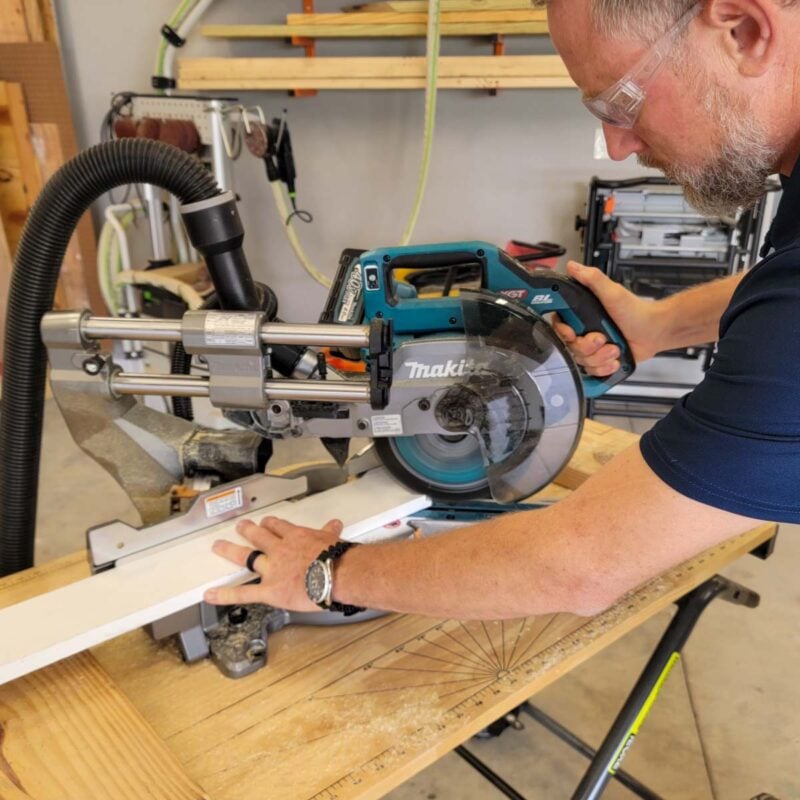
In my opinion, compact miter saws are where it’s at when you’re not cutting crown, and Makita’s 40V max XGT GSL02 is the best we’ve tested in that class. It’s simply a joy to use, and it’s so much more efficient with its battery use that I don’t miss having an AC adapter.
It starts with Makita’s brushless motor, which uses a direct drive instead of a belt drive. In our use, it cut confidently, even when we stepped up to compound cuts in 2x lumber.
The rail system on this model is solid as well. In addition to not needing rear clearance, it’s super-smooth, and we couldn’t detect any blade deflection while we cut.
Sometimes compact saws skimp a bit on your bevel or miter ranges, but the GSL02 doesn’t. With a full 48° left and right on the bevel and 60° left and right on the miter, it matches the best full-size premium miter saws.
Obviously, there are some trade-offs for going smaller, and that comes in the form of capacity. You won’t be able to cut 4x lumber (which would be awkward on such a light and compact saw anyway), and the crown capacity is very limited.
This is also an expensive saw. But if you’re looking for a refined compact model capable of genuinely high-precision cuts, it’s worth it.
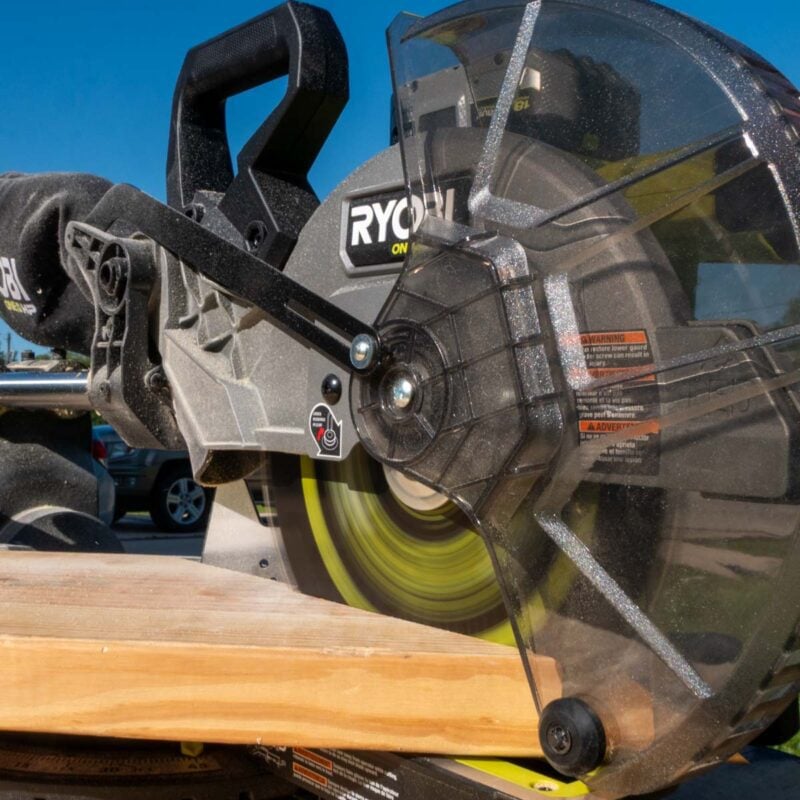
Ryobi 18V One+ HP Brushless 10-inch Miter Saw PBLMS01
- Motor: 18V brushless
- Blade Diameter: 10 inches
- Speed: 4100 RPM
- Miter: 47° left and right
- Bevel: 45° left
- Nested Crown Capacity: 5 1/4 inches
- Lumber Capacity: 2×12 @ 90°, 2×8 @ 45°
- Weight: 35.8 lbs. bare
- Bare Price: $349
- Kit Price: $399
Highlighted Features
- LED Shadow Cutline Indicator: Shows you where the blade will cut in any light conditions
- Sliding Single Bevel Compound Design: Allows for full range of miter, bevel, and compound cuts
Pros
- Cordless freedom
- Pro-level cut capacity
- Solid runtime
- Lightweight
- Part of the extensive 18V One+ system
Cons
- No bevel stops between 0° and 45°
- More limited miter range than Pro saws
- Rear clearance required for rails
- No AC adapter option
DIYers who want a miter saw with cordless freedom but without the Pro price tag need look no further than their local Home Depot where you can find Ryobi’s 10-inch HP Brushless miter saw.
As you’d expect, we found some trade-offs compared to premium Pro cordless models. There’s not quite as much power, you don’t have bevel stops, it’s a single bevel design, and the miter range is a bit smaller.
Don’t pass over it too quickly, though. It’s still strong enough to cut pressure-treated 4x lumber and has a cut capacity that matches Pro-grade saws in the 10-inch class. You’re still able to make all the compound cuts you need, even though the math is a little different. Plus, it has a shadow cutline indicator, and its light weight made it easy for us to move around.
After using it for a while, we can confidently recommend it for your DIY project needs. Just be sure to check the calibration between uses, and consider upgrading the blade to a premium 60T to get better cut quality than the stock blade provides.
More PTR Miter Saw Reviews
- Hilti Nuron 12-inch Miter Saw Review SM 60-22
- Bosch Profactor 18V 12-inch Miter Saw Review GCM18V-12GDCN
- Metabo HPT Single-Bevel 10-inch Miter Saw C10FCGS
- Ryobi 18V One+ 7 1/4-inch Miter Saw Review PBT01
Best Miter Saw Stand
Bosch T4B Gravity Rise Miter Saw Stand

The Bosch T4B Gravity Rise miter saw stand has been our favorite since the first day we used it. This stand also stands the test of time—as evidenced by its 10+ year run. Its rugged build and easy conversion between transport and working positions set it apart.
The stand also adjusts in length via riser extensions that we have found function better than other options. If you set it up correctly, you don’t have to hold the end of the board or add third-party accessories to make sure you have a true cut.
One downside is that the wheels could be bigger. Compared to competing models with larger wheels, it doesn’t quite roll as easily over rough terrain, though it does fine on stairs.
Price: $449
Best Miter Saw Blade
Diablo/Freud

When it comes to cutting, the blade makes all the difference. Use a cheap, low-quality blade, and your results will suffer. Put a quality blade on an inexpensive saw, and you might be surprised by how well your cuts turn out.
For most users, I recommend going with Diablo miter saw blades. They’re fast-cutting and packed with innovative features that improve their service life and value.
If you’re a serious woodworker or carpenter who demands the absolute best results, go with Freud. These high-end blades are more expensive than Diablo but are purpose-built to deliver precision cuts with zero blade wobble or deflection and the finest finish.
Both brands are part of the same company, so it’s more about deciding what level best meets your needs rather than a question of technology or quality control.
You Might Also Enjoy:
Miter Saw Terms to Know
Below are some of the most common terms you should know about a miter saw. This isn’t an exhaustive list, so check your manual for additional features your saw may have.
Miter Cut: Cutting with the blade rotated horizontally to the left or right. A scale and indicator around the outside of the table help you set the proper angle.
Bevel Cut: Cutting with the blade tilted at an angle. A scale and indicator toward the back of the saw near the pivot point help you set the proper angle.
Compound Cut: Cutting with a combination of a miter and bevel at the same time.
Nested Cut: A technique for cutting crown molding where you push the material into the table and fence at an angle in the same manner it installs against a wall and ceiling.
Calibration: The process of adjusting a miter saw’s head, miter guage, and bevel gauge to produce accurate cuts. Calibration can also refer to adjusting a saw’s laser cutline indicator.
Blade Guard: A plastic, usually transparent section that covers the blade when it is upright and rotates to expose the blade’s teeth as you lower the head to cut.
Cutline Indicator: Usually a laser or shadow from an LED light, the cutline indicator shows exactly where your blade will contact the material to help line your cut.
Depth Stop: A mechanism that prevents the blade from dropping all the way for non-through cuts.
Detents (Positive Stops): Preset points for commonly-used miter and bevel angles that the miter or bevel rotation will automatically lock into. Detent overrides allow you to slide past them without stopping.
Fence: An upright section on the table used to press material into for stability and accurate cutting.
Material Clamp: A type of support that slips into a hole beind the fence and screws down on top of your material to hold it stable against the table, freeing up your hands.
Table: The flat section of a miter saw that you set material on for cutting.
Table Extensions (Wings): Sections of the right and left sides of the table that can slide out to support larger material.
Types of Miter Saws
When it comes to miter saws, there are quite a few choices. Each additional layer of movement makes your miter saw more versatile.
Miter Saw: A saw that can rotate the blade left and/or right to cut at an angle. By contrast, to make a miter cut on a table saw, you have to change the angle of the material rather than the blade. To make a miter cut with a circular saw, you change the angle of the entire tool.
Sliding Miter Saw: The head of the saw is attached to rails (in most cases) so that it can slide forward and back, increasing the size of the material you can cut in one pass.
Compound Miter Saw: A bevel action tilts the blade to the side, allowing the saw to make bevel and compound cuts.
Dual-Bevel Miter Saw: A compound miter saw that has the ability to bevel both left and right.
Sliding Dual-Bevel Compound Miter Saw: This is the pinnacle of miter saw versatility with the ability to slide, miter, and bevel to both sides.
Chop Saw: A common term for miter saws in general, but this is actually a metal-cutting saw that only has the ability to bring the blade down to the material in a chopping motion. The blade cannot miter, bevel, or slide.
What to Look for When Buying a Miter Saw
How Will You Use Your Miter Saw?
Before you start shopping, consider include the type of work you intend to do. Are you a carpenter? Do you work primarily on trim or decking materials? Is cabinetry your thing?
The type of work you do determines the materials you’re going to work with and the level of precision you need. Start with your desired applications and make sure you get the power, capacity, and features you need to create outstanding results.
What Blade Size Do You Need?
Material capacity is one of the biggest things you need to consider when you’re buying a miter saw. Bigger isn’t always better, though. As you go up in blade size, you (typically) gain capacity, but you can also introduce more blade wobble and deflection. Plus, larger blades usually mean and larger, heavier saw and those blades more expensive when it comes time to replace them.
Take a close look at each saw’s capacity before you buy. If you do trim work, be sure to check the base and crown capacities since those can vary more widely than the lumber capacities. Some manufactures use innovative designs to get more clearance than others. We’ve even seen 10-inch miter saws rival the nested crown and vertical base capacities of some 12-inch models.
Pro Tip: Vertical cuts are important for many carpenters because it eliminates a lot of the “math” associated with making a flat compound miter cut. With a vertical cut on crown or base molding, you simply measure your angle, divide by two, and make your cut. It will line up perfectly every time.
Belt Drive vs Worm Drive vs Direct Drive
The majority of miter saws on the market feature a belt drive system. A belt connects to the motor on one end and the blade spindle on the other. Across the board, belt drive saws cut more smoothly in terms of how they feel.
They can also affect the clearance on the back fence. The position and distance of the components determines how much clearance there is on the back of the blade, directly affecting the vertical and nested cut capacity. Notably, DeWalt’s vertical belt design offers some of the highest cut capacities on the market.
Less common among corded miter saws are direct-drive models, which have noticably more muscle to power through tough cuts without bogging down. Makita was one of the only brands to use a direct drive system initially. With so many cordless saws on the market today, Makita has a lot more company, though their corded saws continue to use a direct drive.
Skilsaw is on its own with a worm drive miter saw. Closely related to direct drive models, it uses worm drive gearing, increasing the saw’s torque to muscle through thick lumber and hardwoods.
Do You Need a Sliding Miter Saw or a Chop Saw?
The type of miter saw you buy also affects portability and functionality simultaneously. A basic chop saw, for example, can give you miter and bevel cuts in all directions but may only cut up to a 2×6 at 90 degrees. A sliding miter saw can cut up to a 2×12 or even a 2×14, depending upon your choice of setup.
That same chop saw also likely weighs a whole lot less than a comparable sliding miter with the same size blade. Take all these things into consideration before you take the plunge.
In general, I’d almost always choose a smaller sliding miter saw over a larger fixed chop saw. An exception would be in a production capacity where you know exactly what the tool needs to do every day.
Is Cordless Better than Corded?
The choice between a corded or cordless miter saw gets harder and harder each year. Some manufacturers, like Bosch and Makita, have released saws in both corded and cordless formats—saws that remain identical in all other features. Other companies, like Metabo HPT and Flex, have cordless miter saws with battery adapters that can connect you to 120V AC power.
Believe it or not, the newest cordless miter saws are matching their corded counterparts in power. If you find yourself looking at newer models, you no longer need to worry about premium models not being able to make the cut.
Typically, quality cordless miter saws with batteries cost a lot more than their corded counterparts—often significantly more. But you can’t beat the convenience of battery power when it’s hard to find an outlet. Battery-powered miter saws have also increased run-time significantly in the past 5 years. Using 2x4s as a reference, we’re now seeing hundreds of cuts on a single charge.
Do You Want a Cutline Indicator?
Some saws lack any sort of cut line indicator while others use a laser or LED. The LED-style cut line indicator works better than any other. It uses an LED light (or two) positioned just above the blade. Since it follows the blade down and hits both sides, it produces an exact shadow line where the blade cuts the wood.
The shadow-cut LED works perfectly, never needs to be adjusted, and functions on all blade types. It also works in broad daylight! It doesn’t even matter if you switch to a thin-kerf blade. The shadow never lies, and you always have an accurate “mark” for your cut. Seriously, it’s not my #1 must-have, but I hope all manufacturers switch to an LED shadow cut line system soon. Close to this is the Kapex dual laser system, but I still prefer a shadow cut line for daytime visibility.
Front vs Rear Bevel Controls
Another thing I love about some miter saws has to do with up-front bevel controls. Up-front controls reduce the need to reach around to make adjustments to the bevel angle. All miter saws include front controls for mitering, of course. Adding a front bevel control steps up the saw to a new level of convenience. Very “worth it” if you do a ton of beveled cuts.
Zero Rear Rail Clearance
Traditional sliding miter saw rails move with the head and push behind the saw, so you need to account for that when you’re setting it up. However, there are rail systems that don’t require any part of the saw to extend behind it as you slide the blade. Alternative designs like Bosch’s Axial Glide also eliminate the need for rear clearance. You can put those kind of saws right up against the wall, and the saw takes up less of your valuable workspace.
If you find a saw that combines front controls and zero clearance at the back, it’s a big win.
Do You Need a Stand?
Around here, we love keeping our miter saws on stands. We also tend to run with pickup trucks, trailers, and work vans. That makes a wheeled gravity rise-style miter saw stand our top pick. If you need to load and unload into a smaller space, you may find that a smaller saw that removes easily from the stand works even better.
And, of course, for maximum portability, you can forgo a stand altogether. You can always make cuts on a tailgate. You can also whip up a couple of sawhorses and use a piece of 3/4-inch T&G or plywood for a tabletop. Just take a look at your workflow and how you like to move tools on and off the job site.
Pro Tip: If you want a stand, check for miter saw bundles that include one to save some money.
Features That Can Improve Your Miter Saw Experience
As long as the saw you buy is capable of making the cuts you need, you’re good to go. But there are features that make the job easier and more convenient. Here are the ones we look for:
- Soft start motor to avoid that “jump” when you pull the trigger
- LED or shadow cut line indicator
- Miter and bevel detents that match your common cuts
- Easy-to-use depth stops for cuts requiring sacrificial boards and fences
- Blade brake
- Removable fences
- Dust extraction
- Material clamp(s)
- Front bevel controls
Disagree with our Choices?
That’s okay! We know personal preferences take a front seat in determining the best miter saw for you, and every Pro is different. Get involved in the conversation and tell us what your top pick is and why you love it. Drop us a comment below!
Why You Can Trust Pro Tool Reviews
Ever check out a “review” site and you can’t tell if they actually tested the product or if they’re just “recommending” the Amazon top sellers? That’s not us. We won’t recommend anything unless we’d use it ourselves, and we don’t care who the primary retailer is. It’s all about giving you a legitimate recommendation and our honest opinion of each product.
Since 2008, Pro Tool Reviews has provided in-depth tool reviews, buying guides, how-to articles, and industry news in the construction and lawn care industries. We focus on professionals in the trades and our writers have the skills and experience to know whether a tool or accessory will hold up on the jobsite.
Each year, we bring in and review more than 250 individual products. Additionally, our team will put their hands on hundreds more tools at media events and trade shows throughout the year. If I recommend a tool, that means I’d use it myself (and perhaps I or one of our staff already does!)